When the subject is the wild card, two thoughts come to mind: how Bud Selig gets/takes credit for its creation and how the president was the only owner who objected to it.
George Bush, of course, wasn’t the president yet; otherwise he wouldn’t have been the owner of the Texas Rangers and in position to object to the creation of the wild card. He didn’t necessarily object to the wild card itself, but he opposed the change to three divisions in each league, which was tantamount to opposing the wild card.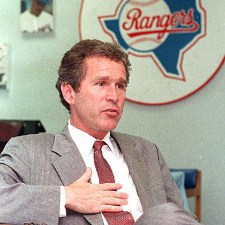
Under the proposed three-division format, the Rangers would have been placed in the American League West and would have been two time zones from the division’s other teams. Bush believed that difference would have had too severe an economic impact on the Rangers’ television and radio advertising revenue.
Eventually, Selig convinced Bush that the new format was necessary and good for baseball. Selig himself did not create the wild card. Once representatives of the clubs (Richard Ravitch) and the union (Gene Orza) negotiated the three-division format, the wild card became its child.
It was an inevitable outcome. Baseball couldn’t have a sensible post-season format with three division champions in each league competing for the World Series. Two of the division champions in each league would have to play for the right to meet the third, meaning the winner would use up its best pitchers while the third team rested its pitchers.
Add the second-place team with the best won-lost record, and each league would have four playoff teams.
I have never been a fan of the wild card because I have always believed a team should have to win something, a division or league title, to compete in the post-season for the ultimate championship.
Furthermore, the existence of the wild card undermines what otherwise would be a scintillating division race. A perfect example exists right now. The Yankees and the Rays have the best records in the majors. Both are in the same division and should be involved in a terrific race for the A.L. East title. But the race is meaningless. Both teams are virtually certain to make the playoffs, one as division champion, the other as the wild card.
Their non-race is reminiscent of the real race that prompted the creation of the wild card. In 1993 the San Francisco Giants won 103 games but didn’t gain a playoff spot because the Atlanta Braves, then in the National League West, won 104 games and the N. L. West title. The Giants took their 103 wins and went home.
 To make sure that sort of injustice didn’t happen again, the two sides came up with the idea of having three divisions in each league. The wild cards followed.
“We knew there would be instances like San Francisco and Atlanta, which was a fabulous race,” Orza said, discussing the impact the wild card could have on division races. “It’s not a perfect system replacing a flawed system, but this system is better from an economic standpoint. If you didn’t have the wild card, teams would be out of contention by July.
“Will there be years like this? Yes, there will be years where you decry the wild card because it undermines some exciting races. It does diminish races, some of which we’re seeing this year, and that’s a negative. But over a decade or two decades, you’ll find that the wild card is better economically.”
The strength and value of the wild card, its proponents argue, is that it keeps more teams in post-season contention later into the season, and it’s hard to argue with that. It’s economically beneficial to baseball because the more teams that are in contention, the more fans will go to ball parks and watch games on television.
There are years like this, where the wild card is decided early. But while the loser of the Rays-Yankees competition might have a lock on the A.L. wild card, with only a few weeks left in the season, the N.L. wild card race is wide open. Recent developments have altered that landscape as well as the division competition.
Until Tuesday night, the Braves had been in first place in the N.L. East since May 31, basically 60 percent of the season that had been played. The Phillies had been the wild-card leaders. Suddenly they switched places.
The Giants were 6 ½ games behind the Padres in the N.L. West Aug. 25, but 10 games later – 10 games that the Padres lost – they were only a game behind San Diego.
Not to be overlooked are the Colorado Rockies, the comeback kings of recent seasons. They are threatening to do it again. The Rockies were 11 games out as recently as Aug. 22, cut their deficit to 7 games by the start of this month and were 4 ½ out when the Padres ended their losing streak at 10.
The Cincinnati Reds capitalized on a couple of weak weeks the St. Louis Cardinals had and built an 8-game lead at the start of this month in the N.L. Central, but their fortunes were reversed and the Cardinals started chipping away at the Reds’ margin.
The wild cards have attracted enough positive attention to prompt some people to suggest that baseball should add more wild cards to the playoffs. Fortunately, though, the commissioner has said that won’t happen.