A long-time friend and even longer-time baseball fan called me the day after the United States and Portugal tied in their World Cup soccer match and asked if he had missed something. What’s going on, he wondered.
I laughed, instantly knowing what he meant. I am asking the same questions, I told him, and I don’t know that I have any answers.
Soccer was consuming American sports fans, and it was happening right in the middle of the baseball season. Major League Baseball had attained Commissioner Bud Selig’s goal of parity; more teams than ever were bunched near the top of the division and wild-card races.
Yet a game foreign to the homeland of America’s pastime was captivating fans in unprecedented numbers. How could this be happening?
I don’t have an answer to that question. I can guess and I can speculate, but you’ll excuse me if I am not among the soccer bandwagon jumpers.
My interest in watching soccer peaked 30 years ago with my son’s match in the championship game of the losers’ bracket of the Princeton intramural tournament. The good guys won on Mark’s three goals. He kicked in one, he headed in another and he scored the third on a throw-in that the goalie tried to catch but muffed and it slithered between his hands into the net.
In the interest of full disclosure I had the television in my office tuned into the USA games with Ghana (my grandson Jake, a high school soccer goalie, insisted I had to watch it) and Portugal. To say I was watching, though, would be an exaggeration. I had the games on as I might have background music.
Some people who are not baseball fans say the game is too slow, but if baseball is too slow, watching soccer is utterly a waste of time. Nothing happens for 90 minutes. Watching 20 men (not including the goalies) run up, down and across a field just doesn’t do it for me.
Plodding through 90 minutes, trying to keep my eyes open, to see one or two goals doesn’t intrigue me. I might be impressed by a cross-field kick that winds up precisely at the “receiver’s” big toe, but how many of those passes can I watch to want to see the entire game?
How many of those passes lead to goals? Not even 1 percent, I would think. Goals are so rare that scoring one triggers an orgy of exultation, with teammates pummeling the player who scored the goal. That happens in baseball only when a player drives in a game-winning or, excuse the expression, a walk-off home run.
Baseball too slow? Nothing happens for most of the game? Only an ignorant person would make such claims.
A regulation nine-inning game has 51 or 54 outs. According to Elias Sports Bureau, 71 percent of all outs this season, nine-inning and extra-inning games, resulted from batted balls, 0.3 percent from baserunning and 28.7 percent from strikeouts.
Basically, that means that the average game, in addition to 17 hits, produces 38 batted balls, or chances for additional hits among the 293 pitches per game. A miniscule number of kicks in soccer have a chance for producing goals.
To rationalize their interest in soccer, advocates resort to talking about the beauty and finesse of the game.
I would suggest that there is greater beauty in the way pitchers induce batters to swing at and miss pitches or take them for strike three. Seeing how badly batters are often fooled by changeups and breaking balls makes it worthwhile to watch games on television.
 Watching soccer on television invites sleep. First, the ball goes in this direction and then it goes in the opposite direction, etc., etc., etc. There is a lot of wasted time as the ball is kicked back and forth in the middle half of the field with neither team getting anywhere.
Once in a while someone might actually kick the ball in the direction of the net; that kick is supposed to pass for a shot. Even less often one of those kicks winds up in the net, and the announcer screams in over-the-top excitement, “G-O-O-O-O-O-O-A-A-A-A-A-A-L-L-L-L-L-L.” Viewers, however, don’t have to endure that silliness very often.
What they do have to endure, though, is not knowing how much time is left in the game. Football, basketball and hockey have clocks that run out and let fans know when the game is over. Baseball doesn’t have a clock, but the 27th out when the game isn’t tied serves the same purpose.
Soccer has a clock, but a match isn’t necessarily over when the game reaches the 90-minute mark. There’s something called stoppage time – some call it injury time – that the referee, at his sole discretion, can add to the game. This additional time accounts for in-game stoppages due to injuries or other reasons, but no one but the referee necessarily knows how much time he will add.
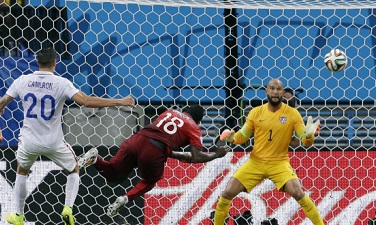
When the USA-Portugal game reached the 90-minute mark, USA led, 2-1. But the referee added five minutes of stoppage time, and Portugal scored the game-tying goal about 4½ minutes into that additional time.
Nevertheless despite that weird way of clock-keeping, despite the absence of scoring, despite the suffocating boredom of the back-and-forth play, soccer has penetrated the psyche of American fandom.
The 18.22 million who Nielsen said watched the USA tie with Portugal on ESPN – not including the additional 6.5 million who watched on Univision – exceeded the average television audience for eight of the last nine World Series, including last year’s 14.9 million. The soccer audience also eclipsed the television audience for this year’s National Basketball Association finals, which averaged 15.5 million.
The soccer viewership didn’t threaten the total of 111.5 million who watched the last Super Bowl, but that game also produces the largest outpouring of betting, the single biggest factor, I have always believed, in the success of the NFL.