Archive for August, 2011

THE NATIONALS PAST AND FUTURE IS STRASBURG

Sunday, August 28th, 2011

I have been to World Series games and witnessed walk-offs. I have attended sunny day games and survived battles of attrition on cold, rainy nights. In the entirety of my baseball experience, the most electric crowd of which I have ever been a part was at Nationals Park on June 8, 2010. Just days earlier, the ballpark had been sparsely populated for a game against Cincinnati, with the lower-level seats all but unused.Stephen Strasburg4 225

When I arrived on June 8, though, a constant stream of fans was already shuffling into the stadium two hours before gametime; my seat actually had a cobweb for decoration, a sad reminder of the last time Nationals fans had gone in droves to the ballpark and actually sat in the nosebleed section. That night was different. It was the debut of the highly touted phenom, Stephen Strasburg.

On that lovely summer evening 40,315 fans poured into the stadium, and the buzz in the air was overwhelming. Just standing in the concourse, just waiting in line to buy overpriced concessions, just observing the mint-condition Strasburg jerseys filing in through the turnstiles, the excitement in the air was infectious. The hometown Redskins and Wizards were, and still are, in the midst of long bouts of futility, with the Capitals’ fans still recovering from a first-round playoff collapse. Here, finally, was a beacon of hope for suffering fans long on disappointment and short on superstars.

The entire crowd gave Strasburg a standing ovation when his name was announced in the lineup, and he did not disappoint, setting the Pirates down 1-2-3 in the first inning. He put an exclamation point on his first inning as a big leaguer with a strikeout of Lastings Milledge, and while some fans were still settling into their seats, he had already found a groove.

In the second inning, Strasburg works around a harmless two-out single to strike out the side, giving him four outs in a row via the K.

Numerous comedy Web sites mocked the overbearing attention surrounding the newest member of the Nationals, proclaiming Strasburg a surefire Hall of Famer just based on his premiere. And for the most part, they were right. Baseball history is dotted with Brien Taylors and Bryan Bullingtons, number one draft picks who have spectacularly failed to produce anything on the big league level. Was there something different about Strasburg’s situation that would save him from the flameout potential of his predecessors?

Third inning: two more strikeouts (“six in a row!” we gaped from the stands) and a weak ground ball. Still no damage done.

For one, Strasburg was more MLB-ready coming out of college. He reached the majors after less than a year of overpowering minor league hitters, and all indications pointed to a mental toughness which would hopefully prevent him from befalling the same troubles as others deemed “franchise savior” too early. If anything, Strasburg already looked to be the best starter in a Nationals uniform, and both the cheering fans and whiffing Pirates could attest to his dominance.

As the Pirates go through their second turn in the order, they seem to have figured out the phenom. Three hits, one a deep home run,  and the Nationals trail 2-0. Silence descends over the stadium; is Strasburg’s magic so transient that it has escaped him after just three innings?

None of Strasburg’s later-season starts were quite as dominant. He did continue pitching well, allowing more than three earned runs only once, and ended the season with a sub-3 ERA. His strikeout totals, while declining in number following his debut, still remained high, with more than 12 per 9 innings. His last start, though, became all of the collective worst fears of Nationals fans wrapped up inside an injured elbow. His unorthodox motion, in which the elbow rises over the back shoulder upon delivery, had always presaged catastrophic injury, and the season of Strasburg and excitement ended prematurely.

Fifth inning: Facing a weak bottom of the order, Strasburg rebounds, with a 1-2-3, two-strikeout inning. With eight K’s in only five innings so far, Strasburg looks poised for a legendary game. And even that wasn’t enough preparation for the innings which followed.

While much of the focus on the Nationals this year has been negative – Jim Riggleman’s abrupt resignation, Jayson Werth’s failure to live up to his ridiculous contract – positives have still flowed from Nationals camp. Rookie second baseman Danny Espinosa is tied for third among all rookies in home runs and sits at fourth in RBI; if he can raise his average from a pitiful .229 to match his slugging prowess, the Nationals look to have identified a long-term solution at second base.

Michael Morse 225This year’s greatest find, Michael Morse, took over at first base with the departure of the now-inept Adam Dunn. Rather than challenge the all-time record for lowest batting average in a season, Morse has starred as a replacement, leading the team in home runs, batting average, RBI, on-base percentage, slugging percentage, OPS, WAR, VORP…the list goes on and on. Suffice it to say that both traditional and newfangled statistics agree that Morse is having a pretty remarkable season.

The sixth inning is when many pitchers tire and lose their best stuff. But Strasburg is no mere mortal. On his third turn through the order, he becomes, if anything, more electric with his fastball and more deceptive with his slider. Andrew McCutchen goes down on strikes. Neil Walker duplicates the result with yet another forwards K. Lastings Milledge swings through a pitch and join his teammates back in the dugout. 11 strikeouts for Strasburg.

Next year, Morse, Espinosa, rough but talented shortstop Ian Desmond, and stalwart third baseman Ryan Zimmerman should combine to create one of the most formidable infields in the National League. Jordan Zimmermann has had a quietly solid season, posting a 3.10 ERA and holding opponents to a .249 average. With the anticipated return of Strasburg for a full year, Nationals prospects are looking up.

This year already, progress has come in leaps and bounds. The team hasn’t finished in the top three in the division since 2002, when it resided in Montreal, but currently sits in third place. Perennial threats to lose 100 games, the Nationals are on pace for nearly 80 wins this year, a marked improvement over the dreadful teams of years past.

Strasburg, nearing the preset pitch count limit, jogs back to the mound as the seventh inning commences, drawing hearty cheers from the giant crowd. Garrett Jones battles off foul balls but quickly succumbs to Strasburg’s wizardry on the mound. Next up is Delmon Young, and Strasburg wastes no time in vanquishing this foe, cutting him down on three pitches. The cheering reaches a crescendo for the 0-2 count on Adam LaRoche, who can only wave his bat at Strasburg’s 94th pitch of the night.

We couldn’t hear the seventh-inning stretch music. The fans, finally proud of their hometown Nationals, did not relent with their clapping and cheering and screaming until the star of the day re-emerged from of the dugout and doffed his cap to the crowd.

At one point during the middle innings, when Strasburg was in the midst of mowing down the overmatched Pirates yet again, my friends and I turned to each other after a strikeout and just started laughing. We didn’t know what other reaction would be appropriate for such an amazing athletic performance. For all of the unbelievable hype surrounding the young pitcher, he had in fact surpassed expectations.

Next year, when he returns at full strength to assume his position as Nationals ace, he will be the most-hyped prospect to play in years…at least until that other Nationals’ #1 pick, Bryce Harper, is called up. Maybe Harper will have to hit three home runs in his first game to keep pace with Strasburg’s career, and then D.C. fans would certainly have a team to cheer.
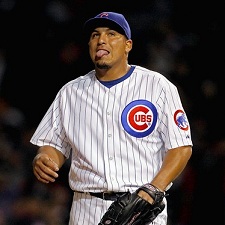
HENDRY GOES DOWN; ZAMBRANO WILL RISE

Thursday, August 25th, 2011

The Chicago Cubs had to do something. Carlos Zambrano was acting up again so general manager Jim Hendry banished him without pay for 30 days, and the team was playing so poorly the Cubs fired Hendry. The interesting twist is Hendry deserved it more than Zambrano.

I don’t like to see people get fired, but sports history is filled with the dismissal of general managers, managers and coaches who have been fired for failing to get the job done. I like Hendry, but how long could the Cubs’ new owner, Tom Ricketts, spend more than $125 million on the Cubs’ payroll, which he has done each of his first two years, and not get at least a contender out of it?Carlos Zambrano 225

The 2011 Cubs are an awful team. They have not had a winning record since 17 games into the season, and the last time they were even at .500 was three games later. The National League Central has been a forgiving division, but the Cubs are forgiven nothing.

Hendry, who held the job for nine years, is a good baseball man and a good guy, but he had a penchant for giving lucrative contracts to players who didn’t produce.

Zambrano, for example, signed a 5-year contract worth $91.5 million that also provided a player-vesting option for a sixth year with a $19.25 million salary. But he has a 43-26 record under that contract, including 9-7 with a 4.82 earned run average this season.

Zambrano has also caused internal off-field problems that have prompted suspensions, including the current 30-day unpaid banishment to the disqualified list.

The 30-year-old Venezuelan pitcher was ejected from a game in Atlanta in the 5th inning Aug. 12 and basically had a temper tantrum. He cleaned out his locker, told clubhouse attendants he was retiring and left Turner Field before the game was over.

Hendry was understandably upset with Zambrano and had as much as he was going to take from the pitcher. But he went overboard in his remarks to reporters and sounded as if he were throwing a tantrum.

“His actions last night were totally intolerable,” Hendry told reporters. “This was the most stringent penalty we could enforce without a release.”

Zambrano, however, clearly acted out of frustration. The problem is players aren’t allowed to become frustrated. They are expected to be cold, hard automatons but not human beings.

Earlier this season Jorge Posada of the New York Yankees incurred blistering criticism from his team, the news media and fans for removing himself from the starting lineup, in which he was scheduled to bat ninth.

Posada, who had been mired in a lengthy slump, acted out of frustration and deserved more compassionate and more intelligent treatment.

It was the same with Zambrano. He wasn’t angry with the Cubs; he was angry and frustrated with himself and his performance.

The public and the news media don’t get to see general managers’ tantrums when their $20 million players boot ground balls that lose games or strike out for the final out with the tying run at third base.

General managers do it in the privacy of their boxes or their offices. Owners do it, too, some privately, some, like George Steinbrenner, very publicly.

Jim Hendry and ZambranoHendry’s comments about Zambrano had nothing to do with Hendry’s dismissal. Hendry told reporters that Rickettts, the owner, had told him July 22 he was being let go but asked him to stay on to complete pending business, such as the July 31 trading deadline and the signing of draft choices.

In other words, Hendry was the lamest of ducks when he erupted over Zambrano and sent him away for 30 unpaid days.

Hendry will have to return to testify at a hearing on Zambrano’s grievance, if the grievance reaches that stage. Chances are good, however, that the union and the commissioner’s office will resolve the dispute without a hearing.

Although I would never predict what an arbitrator might do, the Cubs’ action seems to have no chance to survive the discussion. Zambrano might have angered Hendry with his behavior, but the only thing he did that seemed to be punishable was violate team rules by leaving the park before the end of the game.

Players have been disciplined – fined – for that act, and they haven’t been suspended without pay for 30 days.

It is not a violation for a player to clean out his locker; nor is it a violation to tell a clubhouse attendant he is retiring. It’s not even official. A player can retire any time he wants, but it’s official only if he puts it in writing.

That reminds me of the time many years ago when a frustrated and fed-up Lou Piniella, the New York Yankees’ right fielder, told a reporter after a night game that the game had been his last; he was retiring.

But it was getaway night, and the reporter wanted to make the team charter home so he told Piniella he didn’t have time to write a retirement story along with a game story and he should wait until the next day to retire.

I don’t recall when the cooperative Piniella retired, but it wasn’t that night so it was no more official than Zambrano’s utterance to the clubhouse attendants.

An ESPN.com columnist suggested that Zambrano might have created a loophole through which the Cubs could tear up the remainder of the pitcher’s contract. His reasoning? Zambrano cleaned out his locker and said he was retiring.

Sorry, but neither one of those acts will work to free the Cubs of the minimum $23 million and possibly $42 million they owe Zambrano.

The same columnist, on a roll apparently, suggested that the union might be better off not taking the case and defending Zambrano, unpopular in the Cubs’ clubhouse and around baseball.

Such a suggestion could come only from someone who has never dealt with the union nor has any understanding of the way the union operates. The union defends any player no matter how unpopular he or the case is.

The view here is that the union will win back every dollar the Cubs withhold from Zambrano’s $17,875,000 salary.

MORE WILD CARD WACKINESS

Monday, August 22nd, 2011

Last fall, the Yankees jumped out to a lead in their first-round playoff series behind their ace, C.C. Sabathia, on their way to yet another sweep of the Twins. If the big lefty had already been used earlier in the week, however, the entire dynamic of the series might have changed. The Yankees, mindful of this potential, had decided to rest Sabathia for the final regular season game, instead conceding the division title to the Rays.Yankees Wild Card 2010 225

Such a development, with an exciting division race dwindling to nothingness as the two teams limped to the finish line, was the perfect fodder for media types to explode. Such overreaction, coinciding with this year’s potentially similar scenario involving the Yankees and Red Sox, has also led baseball higher-ups to consider adding more wild card teams to the postseason. The proposal would have a second wild card in each league face the wild card “winner” in one game to determine which advances to the divisional round.

Last year, the Yankees finished six games ahead of the Red Sox in the wild card chase but, under the proposed new structure, would have had to beat Boston again, as if the initial 162 games weren’t enough to prove the Yankees’ superiority over the duration of the season. Would it have been fair to the Yankees to victimize their postseason chances by playing a do-or-die game against the runner-up?

What about the 2009 season, when Boston clinched the wild card with an eight-game advantage over Texas? Or in 2008, when the Red Sox finished six games ahead of the rival Yankees in the wild card standings? Or in 2007, when the Yankees finished on top, leading Detroit and Seattle by six games each (would Detroit and Seattle have had a playoff to make the playoff to make the playoffs?)? Or in 2001, when the wild card Oakland A’s won the wild card by a whopping 17 games? Would it have been fair to ask those victors, clearly superior in record and regular season performance, to play a winner-take-all game against the teams which they bested over the course of 162 games?

Since 1996, the first full season in which the wild card was in place, the American League wild card winner has finished at least five games clear of the second-place team ten times, and only once (2000, with Seattle edging Cleveland) was the margin only a single game. That is two-thirds of the time when a team with a significantly better record would have had to play an inferior opponent for the right to join the division winners in the divisional round.

In the National League, on the other hand, wild card teams have consistently been closer to the rest of the field than their AL counterparts. Seven times in the past fifteen years, the wild card runner-up was either tied with the winner (forcing a playoff) or only one game behind. The cases falling in the former category already produced a wild card play-in game, most recently in 2007 between the Rockies and Padres.

And while the latter cases certainly call for a closer inspection on whether a play-off would be more logical and fair, comparing the NL data with that of the AL only emphasizes the AL East stranglehold on the wild card for years running – clearly, the AL is more top-heavy, with fewer teams in mediocrity able to battle against the high-spending AL East clubs. In any case, creating a new playoff position and game based on only one league’s data would be undesirable and inequitable.

Another issue with an addition could be that, logistically, the proposal could in fact favor the runner-up. This season, for example, the Yankees and Red Sox could conceivably be tied going into the final day of the season, and each would pitch its ace in an attempt to grab the division crown. If the Angels, though, were already assured of the second wild-card spot, they would rest Jered Weaver to save his arm for the play-in game.

While the Yankees-Red Sox runner-up would have by far a better record than the Angels, it would face a de facto penalty for fighting for the division, in effect sacrificing its best pitcher. This scenario would in fact reverse baseball’s purported effort to incentivize a true division race and reward the Angels for already being eliminated from the AL West picture.

As more of a traditionalist sentiment, one of the most unique aspects of baseball is how selective the playoffs are. In the NFL, nearly 40% of teams make the playoffs, including a 7-9 team last year. The NBA and NHL are even more absurd, as more than 50% of the teams are playoff teams and the postseason becomes a two-month long marathon for television viewers. In recent years, the NBA’s Eastern Conference has been so porous that teams with losing records routinely contend and qualify for the playoffs. Last year, the Indiana Pacers “won” the last playoff seed with a 37-45 record (“won” being used loosely to describe a record of that caliber), a .451 winning percentage which would translate to a 73-89 baseball season.

In baseball, however, only 26.7% of teams currently make the playoffs, further incentivizing a strong regular season. After 162 games and six months of regular season baseball, the best teams usually rise to the top of the standings. While the other ‘Big 4’ sports have shorter regular seasons, it is possible for the best teams to slip, as one or two losses have much more of an impact than they do in a long baseball season. Correspondingly, it does make sense for those leagues to widen their respective playoff nets, to grab all possible championship contenders. In baseball, though, the longer season generally reveal the best teams, the ones who actually deserve the extra rewards and recognition which come with making the playoffs.

Because of its structure, baseball is simply in the best situation to showcase only its best teams and players when the games are at their most important. Rather than have the worthy wild card winner battle the lesser runner-up – the baseball equivalent of last year’s NBA playoffs matching up the #1 seed Chicago Bulls with the woeful Pacers, or the dominant Miami Heat with a .500 Philadelphia 76ers team—let the best vie for a championship.

The wild card has been wildly successful and popular, in terms of adding revenue and excitement for numerous fans without another option. But rewarding mediocrity is no way to run any sort of business. Letting more losing and near-losing teams enjoy a September race does not provide as much incentive for improvement as does the current situation, with playoff spots in smaller supply. The proposal would ostensibly incentivize teams to win their divisions, while in fact it would allow teams to aim for #5 in the league, as opposed to continuing to strive for the best spot.

Under baseball’s current structure, with fewer teams making the playoffs, having a strong regular season is thus incentivized further. The argument becomes that by that same logic, winning the division should be rewarded more, as doing so indicates a stronger regular season. However, solving that problem by adding teams destroys the very reason behind the problem, as letting in additional teams makes the playoffs less a reward of having a good regular season and more a result of Bud Selig, owners, players, media, etc. overreacting to the outliers of the past two years, when the best two teams in a league resided in the same division.

Maybe this proposal would make this year’s Red Sox/Yankees race more exciting, but it could also diminish the sanctity of the playoffs and dilute them further, stripping the playoffs of their selective tradition.