Archive for August, 2011

LOOK OUT, HERE COME MORE WILD CARDS

Sunday, August 14th, 2011

With six weeks left in the season, five of baseball’s six divisions have legitimate races for the division championships. That kind of frequency doesn’t happen every year, but Major League Baseball is poised to make sure it never happens.

As much as division races have been diluted by the existence of the wild card in each league, they will soon be diluted even more by the creation of even more wild cards, almost certainly one in each league.selig4-225

“It’s a concept I like,” Commissioner Bud Selig said Friday about the wild-card plan that is under discussion with the intention of implementing it for next season.

The addition of wild-card teams to the post-season and the new format of the playoffs have been topics of discussion in negotiations for a new collective bargaining agreement. It is on the bargaining agenda because the union has to agree to the new format, both in terms of the number of teams and the adoption of any new rounds of the playoffs.

The participants in the talks are not talking about them because they have agreed to keep them confidential, and believe it or not, they have maintained the confidentiality and the secrecy of their talks. How boring.

But I have learned this much pertaining to the wild-card discussion. They have had extensive discussions on the subject and have discussed details of a prospective format, but neither side has put forth a proposal with a specific plan.

What that means is they are serious about adding teams to the post-season. The commissioner favors it, and the players want it.

Critical in the commissioner’s position is the input he has received from the 14-man committee he has established to scrutinize all on-field phases of the game and recommend changes.

Committee members – managers, executives, owners – are barred by Selig from discussing their deliberations, but a person familiar with developments indicated Saturday that the committee favors the addition of one wild card in each league with that team playing the other wild card in a one-game playoff to advance to the second round of the post-season.

A three-game wild-card playoff was discussed, the person said, “but they didn’t find it as appealing. It doesn’t have the drama or the sex appeal as one game. One game would be unique. It’s a dramatic opportunity to have one of these teams advance when they otherwise wouldn’t have that opportunity.”

A baseball official agreed that one game would be exciting, but he said, “Some teams wouldn’t like to see the 162-game season come down to one game.”

On the other hand, the person who related committee deliberations pointed out that a one-game wild-card playoff would be like a one-game playoff for a division championship.

Yes, I said to him, but the teams in a division playoff had 162 games in which to win the championship. “So did a wild-card team but didn’t,” he responded.

These are the issues that are being discussed with the union and are not final.

The commissioner at one time assured us that the number of wild-card teams would stay at one in each league and would not be increased.

“We kept expanding and eventually you have to add some playoff teams,” Selig said, explaining his change in thinking. And of the wild card itself, he added, “It’s worked out tremendously, better than I thought it would.”

Including better financially. Selig’s interest in wild cards increased proportionately with his understanding of the economic value of additional teams in the playoffs:

More teams in contention for playoff spots, better late-season attendance for contending teams, additional post-season attendance at premium prices, more television money for rights to the extra games.

More money for the players, too. They share in gate proceeds and maybe could even get additional bonus provisions for being named most valuable player of the extra game or series between wild cards.

But a person familiar with the players’ thinking said they have a different reason for wanting to add wild cards. Players, he said, think that adding teams to the playoffs would reduce a wild card’s chances of getting to and winning the World Series.

The wild-card teams would have to use their best pitchers against each other and therefore not have them available early in the Division Series. Scheduling and travel requirements could also work against the wild cards.
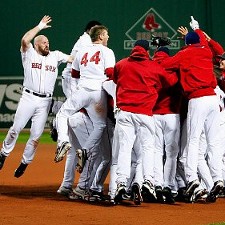
Red Sox Celebrate 225From that standpoint alone, the players’ thinking makes sense. But there’s another way to look at it. Under the existing format, 25 percent of the post-season teams (two of eight) are wild cards. If another wild card is added to each league’s playoff, 40 percent of the post-season teams (four of ten) would be wild cards.

In other words, despite the obvious pitching problems, would the addition of wild cards enhance the chances of the World Series winner being a wild card based on simple math?

It’s a question to ponder along with many others, but the commissioner is prepared to go forward with a wild-card plan of some sort no matter the answers.

A major league official described Selig as being excited about the addition of wild cards but added, “He has said he doesn’t want to play in November.”

That’s another reason why the wild-card round will be a do-or-die game, loser go home.

“We’re still thinking about it, how to do it,” Selig said. “There are talks that keep going back and forth. It’s just a concept I like.”

Selig likes it so much he is prepared to abandon division races in favor of wild cards. For all I know, he may be prepared to abandon divisions as well, creating two 15-team leagues. But that’s another story; let’s stick to wild cards.

At the end of play Saturday night, these were the contenders in five of the six divisions. Forget the National League East. The Phillies are just hanging out awaiting the playoffs. The numbers here are the teams’ won-lost records with number of games behind the leaders:

A.L. East A.L. Central A.L. West
Red Sox 73-45 Tigers 64-55 Rangers 68-52
Yankees 72-46 1 Indians 60-57 3 Angels 65-55 3
White Sox 59-60 5

N.L. East N.L. Central N.L. West
Phillies 77-41 Brewers 69-51 D’backs 67-53
Cardinals 64-56 5


Giants 65-55 2

These were the wild-card standings:

American League National League
Yankees 72-46 Braves 70-50
Angels 65-55 8 Giants 65-55 5
Rays 64-55 8 ½ Cardinals 64-56 6

If there were no wild cards, all, or most, of these five divisions would be hotly contested. With wild cards, there are four, and there’s barely a wild-card race. If there were two wild cards in each league, there would be a race in each league.

Wild-card advocates would say those races would be enough to maintain interest and excitement. I say nonsense. If the Red Sox and the Yankees were playing for something meaningful now, that would be exciting. I suppose if the new format makes it meaningful for them to play for first place, it would be an improvement over the current system.

On the other hand, I don’t care to have the door opened to more wild cards because on the other side of that door is a slippery slope that could lead to worse things, like even more playoff teams.

Look at the NBA and the NHL. They allow so many teams into their playoffs that they become a second season and render the first season meaningless. Teams with losing records get into their playoffs.

The baseball season, whether 154 or 162 games, is unique and should remain that way.

A friend who knows baseball as well as anyone replied cynically when I asked him what he thought of the addition of wild cards.

“There will be realignment and additional wild cards,” he said. “Eventually, there will probably be eight two-team divisions, with eight division-winners and four wild-cards making the playoffs.”

READ THIS LINE: R Z E P C Z Y N S K I

In case you didn’t see it, the Human Eye Chart has changed locations. Marc Rzepczynski was traded 120795470by Toronto to St. Louis, where he has been active out of the bullpen.

The left-hander, who turns 26 in two weeks, has relieved seven times for the Cardinals, allowing only one earned run in six and a third innings.

Rzepczynski was one of four players the Cardinals acquired July 27 for four players, including outfielder Colby Rasmus. The Cardinals also received starting pitcher Edwin Jackson.

The Cardinals didn’t need an eye chart, but they did need a left-handed reliever. They liked Rzepczynski because with Toronto this season he held left-handed hitters to a .159 batting average and .247 on-base and .102 slugging percentages

NEO-NUMBERS MAY HAVE TO BE OLD NUMBERS

Justin Verlander 225Maybe much could change in the last six weeks of the season to change this outlook, but from the looks of things now, the neo-number guys are going to have a tough time pulling an American League Cy Young award winner out of their computerized hat.

Last year they came up with Felix Hernandez, whose 13-12 record belied everything the award had ever meant. The neo-number guys told us that wins don’t mean anything, that it’s the last thing on which to judge a pitcher. Forget Tom Seaver, Roger Clemens, Catfish Hunter, Jim Palmer, Ferguson Jenkins, Robin Roberts and all those other guys.

This season, however, Justin Verlander, CC Sabathia and Jered Weaver are not only the leading winners in the American League, but they are also the leaders in many other pitching categories like earned run average, opponents’ batting average, strikeouts and innings pitched.

My goodness, Verlander even has the No. 1 WAR ranking among A.L. pitchers. What’s a voter to do? He might have to become instantly old and wise.

Which reminds me that in last Monday’s Boston Globe, Dan Shaughnessy had a terrific column about Carlos Slim, the world’s wealthiest man and a great and knowledgeable baseball fan, who was at Fenway Park for the series finale between the Red Sox and the Yankees. That same day The New York Times’ baseball column was about WAR.

CLUBS NEED TO COMPENSATE TRADED PLAYERS

Thursday, August 11th, 2011

Some players have no-trade provisions in their contracts, meaning they have veto power over any trade. In some cases, the players want the clauses because they genuinely want to ensure that they will remain with the team they signed with. Most often, though, they have and use the provisions for economic purposes. That is, if a team wants to trade a player with such a provision, the player says how much are you willing to pay for my ok?

It’s the latter group that prompts me to propose a revolutionary idea. Representatives of the players and owners are negotiating a new collective bargaining agreement, and I am suggesting that they insert a new element into their trading rules.Cliff Lee Press1 225

Unfortunately, while the union would heartily endorse the idea, the clubs would want no part of it because it would cost them money. Yet it would be well spent money.

I propose that when a player is traded, unless he has asked to be traded, he receives a payment as part of the deal. Either team in the trade could pay the “trade bonus.”

I’m not talking about millions of dollars or a sum that would infringe on the trade, but a payment that would acknowledge the upheaval the trade would have on the life of the player and his family (yes, players have living, breathing wives and children). It could be a flat fee or a small percentage of a player’s salary, to be determined in the negotiation of the plan.

The idea came to me as I studied this year’s trades that were made in the month before the non-waiver trading deadline and realized that there are some players for whom this saying applies: If this is July, I must be changing teams.

Let me offer some names: Orlando Cabrera, Wilson Betemit, Edwin Jackson, Octavio Dotel, even Cliff Lee and Mark Teixeira, whose multi-million payoffs were preceded by repeated changing of addresses.

The premier pitcher Lee, for example, was traded three times in less than a year, from the Indians to the Phillies July 29, 2009; from the Phillies to the Mariners Dec. 16 of the same year, and from the Mariners to the Rangers July 9, 2010.

And that series of moves didn’t include his trade from the barely breathing Expos to the Indians June 27, 2002.

Lee finally gained control of his life last winter when he signed a 5-year, $120 million contract with the Phillies as a free agent. The contract includes a partial no-trade provision. In this instance, the provision is more about allowing Lee to say where he will play than about an ability to extract more money from the Phillies or the team they might trade him to.

Teixeira has full no-trade protection in his 8-year, $180 million contract with the Yankees. He welcomed it after his experience in the 15 months before he became a free agent.

The Rangers traded the first baseman to the Braves July 31, 2007, and two days short of a full year later the Braves sent him to the Angels. Three months later Teixeira ended the baseball version of musical chairs, became a free agent and joined the Yankees.

Wilson Betemit played for the Yankees but only passed through. The Dodgers, who obtained the infielder from the Braves July 28, 2006, traded him to the Yankees July 31, 2007. The Yankees then sent him on to the White Sox for Nick Swisher Nov. 13, 2008.

Betemit was most recently traded by the Royals to the Tigers July 20.

For the first seven and a half years of his career, Orlando Cabrera played for one team, the Expos. In his last seven and a half years, though, the shortstop has played for eight teams. Five times he changed teams as a free agent; he was traded four times:

Expos to Red Sox July 31, 2004 in four-team swap; Angels to White Sox Nov. 19, 2007; Athletics to Twins July 31,2009; Indians to Giants July 30, 2011.

Octavio Dotel, a 37-year-old pitcher, has never had the kind of payday Teixeira and Lee have gained, but he has had as much experience being traded as the two of them combined. He epitomizes the kind of player I’m talking about who deserves additional payment each time he is traded.

Dotel has earned less than $40 million in his 13-year career, which in real life is nothing to sneeze at but in baseball falls short of today’s average salary.

Playing at the moment for his 12th team, the Cardinals, the Dominican right-hander has been a free agent five times and has been traded six times.

Signed by the Mets, Dotel was with them less than a full season when the traded him to the Astros Dec. 23, 1999. The Astros made him part of the three-team trade in which Carlos Beltran moved from Kansas City to Houston June 24, 2004, setting up his great post-season performance that year and his move to the Mets for 7 years and $119 million.

Dotel was next traded by the Royals to the Braves July 31, 2007. On the same date in 2010 he was traded by the Pirates to the Dodgers. Later that season, on Sept. 18, the Dodgers sent Dotel on to the Rockies .

Octavio Dotel 225The well-traveled Dotel wasn’t finished traveling. He signed with team No. 11, the Blue Jays, as a free agent just before the end of last year. The Blue Jays made it an even dozen for Dotel a few days before the trading deadline, sending him to the Cardinals.
And the season still has seven weeks in which the Cardinals could trade the pitcher to yet another team, as the Dodgers did last September.

Even Dotel, though, would find it difficult to outdo the arduous pattern of Edwin Jackson’s career. The 27-year-old right-handed pitcher has less than six years of major league service, but he has played for six teams (belonged to seven) and has been traded six times, averaging more than one trade for each season.

Jackson was traded twice on the same day last month, July 27, going on paper from the White Sox to the Blue Jays, who turned around and traded him to the Cardinals. At least he didn’t have to travel to Toronto.

His hectic trade history began Jan. 14, 2006, when the Dodgers sent him to Tampa Bay. The Rays traded him to the Tigers Dec. 10, 2008.

The Tigers then included Jackson as one of seven players in a three-team transaction in which he landed with the Diamondbacks and Curtis Granderson with the Yankees Dec. 8, 2009.

Jackson didn’t stay with the Diamondbacks for long. They traded him to the White Sox July 30, 2010, and a year later he moved rapidly from the White Sox to the Blue Jays to the Cardinals.

Club officials wouldn’t agree, but it only makes sense that a player who has endured Dotel’s and Jackson’s trials, tribulations and travels should be subsidized beyond the travel expenses the labor agreement calls for.

What general manager would subject himself to the constant changes in place of employment as Dotel and Jackson have had? What makes it acceptable for general managers to do it to Dotel and Jackson without compensation of some sort?

Wherever the two sides are in their confidential negotiations, they have time to adopt this revolutionary step 35 years after they negotiated terms of free agency.

BUNTS ARE A BEAUTIFUL THING

Sunday, August 7th, 2011

If you’re as big on bunting as I am, seeing Juan Pierre pop a bunt over the third baseman’s head for a hit has to be the highlight of the week. Pierre’s hit against the New York Yankees, though, was only one of four bunts that grabbed my attention last week. It was definitely a good week for bunting, sadly a lost art in today’s homer-happy game.Juan Pierre Bunt 225

If Phil Rizzuto, the Yankees’ Hall of Fame shortstop, were alive, he would rejoice alongside me because as a player he was baseball’s master at bunting and in retirement its most ardent advocate.

Two of Rizzuto’s fellow Yankees, Brett Gardner and Derek Jeter, were among the players I applauded last week for their bunting exploits. Gardner, the Yankees’ leadoff batter, opened a game against the Chicago White Sox with a bunt single, and Jeter duplicated his effort by also bunting for a hit.

The dual hits led to a four-run inning, and the four-run outburst led to an 18-7 win.

When is the last time you saw a team start a game with two bunt hits? The Elias Sports Bureau said it happened only one other time this season, April 12, in a game between the Chicago Cubs and the Houston Astros.

Michael Bourn led off the Astros’ half of the first inning by bunting for a hit, and Angel Sanchez followed with another bunt hit. Three runs resulted, and the Astros won, 11-2.

When it comes to bunting for hits, though, Pierre is by himself. His bunt hit against the Yankees was his major league-leading 15th bunt hit of the season, according to Elias, putting him four ahead of Houston’s Jason Bourgeois.

In his career, which began in 2000, Pierre has 189 bunt hits, including two doubles. Closest to him in that time is Willy Taveras with 122.

The beauty of Pierre’s bunt against the Yankees was that third baseman Eric Chavez was coming in to protect against a bunt, and Pierre popped the ball over his head, too high for him to intercept, too far behind him to reach back and grab. Chavez was helpless in his effort to snare the ball.

“It was set up early in the series with CC pitching,” Pierre said by telephone from Minneapolis Friday, referring to CC Sabathia. “I bunted and Chavez got me out. He made a pretty good play. He was in real close, taking away the bunt down the line.”

Pierre, a left-hand hitter, who turns 34 Sunday, did not claim to be able to pop the ball over the third baseman’s head any time he wanted.

“I wish I could do it regularly,” he said, “because I’d do it all the time. If I get a pitch up and out, I try to hit it over his head. Actually, I want to hit the ball toward the shortstop if he’s charging. I’ve gotten a couple doubles doing that. I’ve been successful with it.”

It’s too bad that Michael Kay didn’t know that. The Yankees’ lead broadcaster, Kay was on the air when Pierre executed his pop bunt single. Kay and John Flaherty, his partner in the booth, proceeded to debate whether or not Pierre deliberately did what he did.

Flaherty said yes, he thought Pierre did. No way that he could do that deliberately, Kay countered. It was surprising that someone who has been around for Pierre’s entire career would not know of his ability to bunt, using his bat the way a magician uses his wand.

There was nothing magical about Erick Aybar’s bunt against Detroit, but it was controversial and became a subject of debate.

Aybar, the Angels’ shortstop, led off the eighth inning of a game the Tigers were ahead, 3-0, by bunting. Nothing wrong with the leadoff batter trying to get on base in a tight game, right? Except Justin Verlander was pitching a no-hitter and didn’t appreciate Aybar’s attempt to spoil it with a bunt single.

Justin Verlander 225Verlander called the bunt “bush league” but acknowledged that it was a “tight game.” The pitcher apparently was so unnerved by the bunt that he fielded it and threw the ball away, enabling Aybar to reach second on the two-base error. He went on to score, and the Angels added a second run on Macier Izturis’ single, certainly justifying Aybar’s bunt.

But Verlander lost his no-hitter and his temper, yelling at Aybar after the inning.

If the game had been one-sided, I would agree that bunting to break up a no-hitter is a poor play. Not in this instance, however. Pitchers can’t expect the opposing team to accept its fate and lay down its weapons.

In 1978, the Atlanta Braves stopped Pete Rose’s record-threatening hitting streak at 44 games, and Rose complained bitterly that the Braves’ pitchers did not challenge him with fastballs but instead threw him off-speed stuff. Well, they were trying to get him out, and if he couldn’t handle off-speed pitches, they chose the right strategy.

Verlander would have preferred that Aybar swing away, but his bunt triggered a rally that nearly pulled the game out for the Angels. You can’t legitimately argue with that strategy.

PIRATES ARE PUMPKINS AGAIN

The Pittsburgh Pirates obviously couldn’t stand prosperity. They had been down so long they suffered a serious setback when they reached the rarified air of first place.Pirates Lose4 225

Through their own grit and determination and the grace of the poor quality of their division, the National League Central, the downtrodden Pirates spent four days in first place and another day tied for first. They had half a game lead on two of the days and a percentage-point lead the other two days.

Since they last occupied the division’s top spot (July 25), the Pirates (through Saturday) lost 11 of 12 games, including the last nine. Philadelphia, the league’s best team, began the Pirates’ perilous plunge by sweeping a three-game series.

Then the Chicago Cubs, the league’s second-worst team, wiped out the Pirates in a four-game series in front of horrified Pirates fans. San Diego, in last place, extended the Pirates’ problems by winning the first two games of their series.

After a major league-record 18 successive losing seasons, the Pirates last month soared seven games over .500 at 51-44. It soon figures to be a bittersweet memory in another disappointing, if not disastrous season.

A-ROD THE LIGHTNING ROD

Alex Rodriguez’s name can’t be found among the league leaders, but that’s because the category he leads isn’t published anywhere and, in fact, doesn’t exist.

Rodriguez, however, leads the majors in Major League Baseball investigations. No one else is close.

Alex Rodriguez Strikeout3 225The New York Yankees’ third baseman is the lightning rod for all of the ills baseball perceives it has. The latest is the supermarket tabloid report that Rodriguez played in an illegal high-stakes poker game.

My first thought about that accusation was of the low-stakes but presumably also illegal poker games my father played weekly with neighborhood friends. He was a good poker player and usually won, but I never thought that he was doing anything illegal.

My father’s pastime and success at it did not influence me to become a poker player. Nor have I had any interest in watching the poker that has become popular on television.

As a result, I initially questioned an investigation of Rodriguez for playing a card game. I am aware, on the other hand, of all sports’ concern that consorting with gamblers could lead athletes down a path of temptation.

But, I wondered, here’s Rodriguez making $25 million to $30 million a year, how could even a high-stakes poker game get him trapped in the clutches of gamblers?

I posed that question to Fay Vincent, the former baseball commissioner and the most moral man I know. He provided a good answer, as he usually does.

“No matter how wealthy someone is,” Vincent said, “a gambler can get to him. Say the player owes him $100,000. He says to the player, ‘Forget what you owe. The next time you know something about the team, an injury, a player going through a tough time, call me and let me know.’ The gambler is looking for an edge.”

And he added, “No matter how much money someone has, he doesn’t like to lose it.”

I called one other person, Arnie Wexler, who touts gamblers off gambling. He describes himself as a recovering compulsive gambler. He is passionate about his work and knows gamblers and gambling. I asked him the question about wealthy athletes and gambling losses.

“Got a call a few years ago from a guy playing in the NL,” he replied in an e-mail. “He was making $800,000 a year and owed Trump in AC $25,000. Could not pay it and was afraid MLB would find out. I cut a deal 4 him for the $8,000 he had.”

More e-mail, much more e-mail, followed. As I said, the man is passionate about his subject. He said he is working on a book about gambling but has not found a publisher.

“I have gotten calls on my 888 LAST BET help line and met with guys who had and made more than him,” he wrote, referring to A-Rod, “and ended up busted and 2 are in jail even today.

“2 come to mind 1 a big time NYC lawyer who had over 100 lawyers working 4 him came to me when he owed over $4,000,000 in AC and could not pay it.

“I worked out a deal for him to pay it out. Today he’s in jail.

“Another guy lost $27,000,000 in all cash in AC. Today hes in jail if he’s still alive.

“Look at Pete Rose John Daily (sic) Lenny Dykstra and Art Schlister. I have been trying to help him from 1980. Hes in jail again right now.”

As for my question about what makes a poker game illegal, Wexler wrote, “They are illegal. It’s only legal if the state takes a piece.”

There has been speculation that if M.L.B. investigators determine that Rodriguez played in these high-stakes poker games, he could face suspension. Union officials don’t think so.

“The union sees nothing in the report of his alleged poker playing that would warrant suspension,” one official said.