Most of the names that are listed here are most likely unfamiliar to most readers. Without an explanation for their being listed, most would probably wonder why I even include them in this column.
There is a good reason. These are the players the Pirates acquired in the controversial trades they made in the last couple of seasons. Well, it’s not accurate to characterize all of the trades as controversial in and of themselves. What is controversial is the plan the Pirates have for returning to Major League Baseball.
The Pirates have been missing from Major League Baseball for so long that they have been largely forgotten. The only time anyone thinks of them is when they have suffered their 82nd loss of the season, and the refrain changes from “they have now had a record 15 consecutive losing seasons” to “they have now had a record 16 consecutive losing seasons” to “they have now had a record 17 consecutive losing seasons.”
In their quest to extricate themselves from their plunge into their deep, dark abyss, the Pirates have gone through a series of front-office executives. The only problem is the names and faces have changed, but the methods and the results have not.
Now Frank Coonelly is in charge, and he decided the best strategy was to start over, shed the team’s most established players and amass young prospects. For this strategy to work, there’s a large premium placed on identifying future major leaguers. Teams often have can’t-miss minor leaguers who miss.
In effect, Coonelly is betting the Pirates’ future on the players general manager Neal Huntington acquired in trades in the last 20 months for Xavier Nady, Damaso Marte, Jason Bay, Nate McLouth, Nyjer Morgan, Sean Burnett, Adam LaRoche, Jack Wilson, Ian Snell, Freddy Sanchez, John Grabow, Tom Gorzelanny and Jesse Chavez.
That group included six players who were everyday regulars for the Pirates, three infielders and three outfielders.
Because most of the players the Pirates received for those players were minor leaguers, it would be premature to judge the trades based on one or two seasons. But what would be a fair way to judge the players and the Pirates in the aftermath of those strategic swaps?
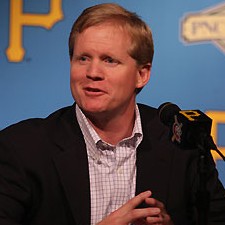 “The simplest way continues to be wins and losses,” Huntington said in a telephone interview. “Beyond that, signs of development and moving forward, how we can get guys to meet or exceed expectations.”
Coonelly wasn’t looking for any breaks either. “We have to be evaluated like every team in baseball,” he said. “You’re evaluated on wins and losses and whether you’re making a run to the post-season.”
Judging the quality of the trades is another matter, he said. “It’s hard to evaluate a group of trades until several years down the road,” he said.
But Coonelly did point to the presence in the starting lineup of players the Pirates obtained in trades: Jeff Clement (Wilson) at first base, Akinori Iwamura (Chavez) at second, Ronny Cedeno (Wilson) at shortstop, Andy LaRoche (Bay) at third and Lastings Milledge (Morgan) in left field.
The starting pitching rotation will have three trade acquisitions, Ross Ohlendorf (Nady and Marte), Charlie Morton (McLouth) and Daniel McCutchen (Nady and Marte) or Kevin Hart (Grabow and Gorzelanny).
I asked Huntington if the Pirates had any young players who might be close to being ready to play in the majors. “Probably not out of spring training but looking down the road,” he said and named pitcher Brad Lincoln, third baseman Pedro Alvarez and outfielder Jose Tabata.
Lincoln and Alvarez were draft choices while Tabata came to the Pirates with Ohlendorf and McCutchen. Referring to the Pirates’ other McCutchen, center fielder Andrew, Huntington said, “They are guys we look at, like Andrew last spring, guys we’re excited about but we have things left to accomplish with them. When we finish with those, we think they’ll be ready for the big leagues.”
What about others who came via trades? They are listed here with their likely destination for the start of the season, either major league or minor league level:
- Pitcher Joel Hanrahan (at right) – Pirates bullpen but will probably start season on disabled list with ailing elbow

- Outfielder Brandon Moss – may make the team
- Pitcher Craig Hansen – will start season on disabled list with neck problems
- Pitcher Jeff Karstens – fighting for Pirates bullpen spot
- Outfielder Jose Tabata – will start in AAA
- Pitcher Bryan Morris – starts in A
- Pitcher Steve Jackson – has outside shot at bullpen spot; otherwise, AAA
- Shortstop Argenis Diaz – AAA
- Pitcher Hunter Strickland – probably AA
- Pitcher Tim Alderson – AA or AAA
- Pitcher Aaron Pribonic – A or AA
- Pitcher Nathan Adcock – A probably
- Pitcher Brett Lorin – A
- Pitcher Jose Ascaino – disabled list following shoulder surgery last year
No one ever expects positive developments from every player acquired in a trade, and there’s no rating system by which a team can be judged. But the development and success of these players will determine how Coonelly and Huntington have done.
These players are not the only ones who hold the Pirates’ future in their hands. Players like Alvarez and Lincoln could be even more instrumental. Coonelly believes the Pirates are on the right track toward winning and competitive seasons. He disputes criticism of the plan he adopted when he became the Pirates’ president in September 2007.
“I disagree that what we’re doing is similar to what has been done here before,” Coonelly said. “I would disagree that anything we’ve done in the last two years is similar to anything that was done in the previous 15 years. They didn’t put money into amateur players, developing players, signing amateur international players. Were the Pirates’ a scouting and player development team? No, they didn’t spend any money in the draft, and they didn’t invest money in the minor league system.”
Coonelly is right in his view of previous Pirates’ regimes. They did not spend money where they should have – on the draft, for example – and they spent it where they should not have – on overrated free agents. They did nothing to develop a productive minor league system, a must for a low-revenue team. Where would the Twins be without a minor league system feeding their major league team with good players?
The Pirates didn’t have money to spend on expensive free agents, and they didn’t spend the money they had on scouting and player development. The result was the complete lack of a competitive team but instead a team that is capable of having 17 successive losing seasons.