No one has ever confused baseball players with Harvard Ph.D.’s. In retrospect, their lack of intelligence has cost them dearly.
In 2003 Major League Baseball tested players for performance-enhancing drugs for the first time. Players, however, were not subject to disciplinary action if they tested positive. They wouldn’t even be identified if they tested positive. This initial testing was for survey purposes only.
The Players Association, which had resisted testing, agreed that if more than 5 percent of the 1,200 players tested positive in 2003, testing would be conducted each year beginning in 2004. Identification and discipline would be attached. If fewer than 5 percent tested positive, players would not be tested thereafter.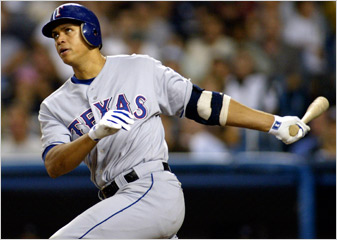
Talk about having their fate in their control. It was like a team fighting for a division title in the final week of the season and having a schedule of games against the other contender. Win those games, and the title is yours.
I am not advocating here the use of steroids, but if I were a player who used steroids and didn’t want to be tested regularly I think I know what I would have done in 2003.
All the players had to do was refrain from using steroids for a season. Now that’s asking a lot from young men who get into and can’t get out of a rut. They start a regimen, and they can’t get out of it. But the elimination of the specter of testing should have served as enough of a motivation for users to stop using. Play a season on their natural ability, and if they felt the need to resume steroids use in 2004, do it and be test free.
But no. Enough players did not have the sense to stop, or they adopted an arrogance that made them feel invincible. They would not be caught. And if they were it didn’t matter because they wouldn’t be identified or disciplined. So 104 players tested positive and triggered regular testing.
Alex Rodriguez was one of those 104 players. He is the only one of those 104 players who has been outed. That happened in an article posted on the Internet last Saturday by SI.com. In an interview on ESPN Monday Rodriguez admitted that he began using steroids in 2001 and continued using them into spring training 2003. Those were Rodriguez’s three seasons with the Texas Rangers under his historic 10-year, $252 million contract.
Rodriguez apologized for being stupid and naïve in using steroids, following Andy Pettitte and Jason Giambi on the path of acknowledgement of and apologies for their transgressions. He opted not to follow Pete Rose, Mark McGwire, Sammy Sosa, Rafael Palmeiro, Barry Bonds and Roger Clemens down the path to ignominy.
Pettitte and Giambi have fared much better than the deniers. Fans accepted their apologies and forgave them. Rose denied for 15 years that he bet on baseball, changing his tune only when he was selling a book but too late to salvage his chances of making the Hall of Fame.
McGwire told a Congressional committee that he wasn’t there to talk about the past and might as well have admitted that he used performance-enhancing substances because his remark was tantamount to an admission. In three appearances on the Hall of Fame ballot, he has not received even a third of the votes he needs for election.
Sosa told Congress he had trouble with English, which was strange because he never had any trouble with English in the clubhouse, but he never tested positive, unless he was another of the 104. Nevertheless, there has been enough suspicion about him that he will probably have trouble when he goes on the writers’ ballot in four years.
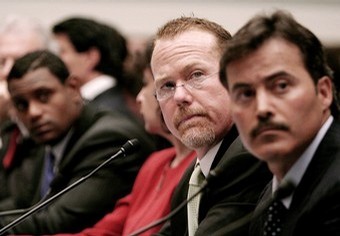 Palmeiro denied to the committee that he used steroids, wagging a finger for emphasis, then tested positive for steroids a few months later.
Bonds testified before a Federal grand jury that he didn’t knowingly use banned substances and has denied it publicly, but he was out of baseball before he wanted to be and he faces trial next month on perjury and obstruction charges. Clemens made so much noise denying that he used banned substances that he attracted the attention of Congress, and now the government is investigating to determine if he perjured himself.
Bonds and Clemens have four years before they are eligible for the Hall of Fame, but even if they are not convicted of anything, they are expected to face a difficult time gaining election.
Rodriguez, on the other hand, I think, will have a better chance of getting the writers’ votes five years after he retires. His quick and candid admissions should go a long way with the writers, though the ones who don’t like him may very well use his admissions against him in justifying their opposition.
In the immediate aftermath of Rodriguez’s admissions, I think it’s likely that he’s being honest in restricting his use of steroids to a three-year period. It’s possible that he began using earlier than that span, but he hasn’t tested positive the past five years.
By the time he retires, he will have amassed an impressive set of statistics and a collection of most valuable player awards. It has to be noted that his personal steroids era was the best three-year stretch of his career.
Missing only one game in three seasons, he hit 156 home runs, collected 569 hits and drove in 395 runs. His best three-year output in other seasons produced 137 home runs, 554 hits and 407 r.b.i., and he played all 162 games in only one other season.
Aside from Rodriguez’s use of steroids, questions arise. I’ll deal with two in particular – who leaked the information about Rodriguez, and why didn’t the union destroy the urine samples and the test results, which was its right?
Very few people in Major League Baseball and the Players Association had access to the test results, and it’s unlikely that one of the people who had access leaked it. Neither office had anything to gain and much to lose from leaking it. In fact, one official noted that the SI.com report included the name of the steroid Rodriguez tested positive for, and that information had not been supplied to either office.
Someone at one of the two labs that conducted the tests and had the results could have provided the information, but they also had more to lose than to gain, particularly future business from baseball and other businesses.
That leaves the government, and that possible source gets my vote. Federal agents seized the samples and the codes matching numbers to names, and even though the courts have ordered them not to use the data, that doesn’t mean an agent or a lawyer couldn’t have leaked Rodriguez’s name.
I am highly skeptical, however, that SI.com reporters had four sources, as they wrote. In the past 40 years, I have had more than my share of exclusive stories, and I don’t recall having as many as four sources on any one story. The only reason to try to get that many sources is if you don’t trust the first couple, and if you don’t trust them, why use them?
In this instance, if government agents were the sources, there’s no way there could have been four. Getting information out of one agent is difficult enough, let alone getting four to provide anything.
Many observers in the news media and otherwise have made an issue out of the union’s failure to destroy everything once the tests were concluded and the data compiled. Its agreement with the commissioner’s office entitled the union to take that step, and the union was prepared to do it.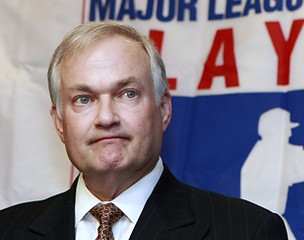
However, in a coincidence of timing, the government issued a subpoena to Major League Baseball seeking the test results of 10 players who had testified before the Balco grand jury in San Francisco.
The union learned of the subpoena Nov. 19, Donald Fehr, the union’s executive director, said in a statement Monday evening. The union, he said, had received the test results Nov. 11, finished compiling the data Nov. 13 and notified the players Nov. 14.
The union began making plans to destroy the data, Fehr added, but then learned of the subpoena. To destroy anything at that point, the union feared, would produce a charge of obstruction of justice.
It turned out that the government, after the commissioner’s office said it had no samples or results, figured out that the labs must have them and issued subpoenas to them. The day the agents contacted the labs, an employee of one of the labs made a telephone call to find out if the lab should destroy the material. She was told she couldn’t do that because baseball and the union knew the government was trying to get it.
In an effort to have the subpoena quashed, union lawyers entered into talks with the government and pledged not to destroy anything. Agents subsequently seized the material in raids on the two labs in 2004.
The union objected to the government action, claiming it was an illegal seizure in violation of the Fourth Amendment and that its collective bargaining agreement with the commissioner’s office called for the tests to be confidential and anonymous.
The disclosure of Rodriguez’s test results is exactly what the union feared would happen.
