Too often my colleagues in this business befuddle me. Here is the latest instance.
Ever since the steroids stuff started stirring up a firestorm of outrage, many reporters and columnists have demanded that steroids cheats be dealt with severely. Some fans were right there with them. Suspension would not be good enough. Throw their statistics into a shredder and grind them up into mulch. Use gallons of white-out to eradicate their records from the record books.
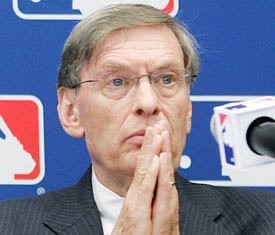
Call Seymour Siwoff and tell him to forget the asterisks; better that he expunge from The Elias Book of Baseball Records any records set by steroids cheats. Bring them before Commissioner Bud Selig and have him brand their foreheads with a scarlet S. And while he’s at it, he should etch one onto his own forehead.
Before the Mitchell report was published in December, 2007, the most popular game the news media played was speculating on whether George Mitchell would include names of steroids cheats in his report and if so, whose would they be. Everyone was on the edge of his seat waiting to see.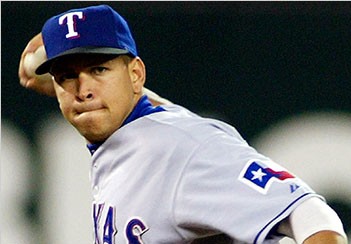
Now comes the Alex Rodriguez shocker. As soon as the news media said “wow,” they turned their attention to the other 103 unidentified players who are on the list of those who tested positive in 2003, the year of anonymous testing, and like a Greek chorus, asked why didn’t the union destroy that list, as it had a right to do under the testing agreement with the clubs?
Donald Fehr, the union’s executive director, and Gene Orza, the chief operating officer, took the brunt of the media blitz.
“Fehr should take at least one more step and explain to the players why the process of destroying the results required more than five days, rather than hours or minutes,” one columnist wrote, adding, “Based on the information we have, it’s natural to wonder why at least one set of the records could not have been destroyed, rendering the other half useless.”
The “biggest internal culprit,” wrote another, is Orza, “who was supposed to destroy all of the player samples after the numbers had been compiled and the agreement fulfilled.” Had Orza done that, Rodriguez “would have remained merely a number.”
“Maybe I’m missing something here,” another columnist wrote, “but unions are really supposed to protect their members.”
In other words, in the eyes of the writers, Fehr and Orza failed to do their jobs by not destroying the urine samples and the test results in a timely manner.
There was a similar response from an unidentified person described as an official in Major League Baseball. The New York Times quoted this official as saying “this would all have been prevented if they had just called and said, ‘Destroy the tests.'”
The union does not believe this official was Selig or Bob DuPuy, M.L.B.’s president, or Rob Manfred, the chief labor executive. He might not have been a major league official at all.
A little insight into Times practice: Although the Times likes to give its readers the impression that it is ultra careful in explaining anonymous sources, sports articles and columns take some liberties.
Identifying this person as such doesn’t necessarily mean he is an official in the commissioner’s office. There are many officials in Major League Baseball working for clubs. General managers, for example, are officials in M.L.B. So here the Times had an anonymous person criticizing Fehr and Orza, though not by name, and possibly undermining the good relations between the two sides, and he might merely be a club official.
Manfred declined to comment on the anonymous official’s remark. “I don’t comment on anonymous quotes,” he said.
But the more pertinent point is incredibly, at a time when the news media and others demand that steroids cheaters be identified so they can be vilified, the overwhelming news media response to the outing of Rodriguez as a steroids user was how could the union have allowed that to happen. How could the union not have destroyed the samples and results so that none of the 104 players who supposedly tested positive could have been identified?
Hey guys, you can’t have it both ways. You either want to know the names so that Selig can act against the cheats, or you want the union to destroy the list of names so that the players, like Rodriguez, can’t be identified.
Other names may eventually come out, but they shouldn’t. The 2002 labor agreement promised that any players who tested positive in 2003 would not be identified. The news media and fans want the names released because they have a prurient interest in knowing who they are. But we don’t have a right to know the names. The players have a right to have the names remain confidential and not have anyone violate their rights under the labor agreement.
 Aside from people wanting it both ways, the silliest aspect of the A-Rod episode is blaming the union for not instantly destroying the samples and the results. No one on either side, union or commissioner’s office, had any reason whatsoever to think they had to take that action instantly. They had no idea the government would come swooping down on them to seize the material. Nothing like that had ever happened in a private industry.
“How do you think about something that has never happened?” asked one person who was involved.
Selig would have preferred not thinking about any of the week’s developments, which also included a guilty plea by Miguel Tejada for lying to Congress about the use of steroids.
“This breaks my heart,” Selig said in a telephone interview. “This has been a very tough week.” But the commissioner had no regrets about baseball’s Mitchell investigation or its testing for performance-enhancing drugs. “I’m proud of what we’ve done,” he said, “and we’ll continue to do it in earnest.”