As repugnantly racist as Donald Sterling’s language is on the recording heard ‘round the world, the disgraced and banished owner of the Los Angeles Clippers cannot claim the title of most reviled owner in professional American sports.
Sterling’s comments to his girlfriend in a conversation that she recorded don’t approach the vile remarks uttered by his predecessor in boorish behavior by the owner of a major professional sports team. It’s not just what Sterling said compared with the best of Marge Schott but the circumstances in which he said it.
This in no way is meant to excuse Sterling for his racist remarks, but he expressed his views privately. Schott, the one-time managing partner of the Cincinnati Reds, tossed off her comments wherever she happened to be, whatever the circumstances.
Note: This column contains language I said would not appear on this web site. Its use is necessary to portray accurately the character of the main subject.
Blacks, Jews, Japanese, Asian-Americans – Schott was not particular. They were the most frequent subjects of her racial and ethnic slurs, but her language knew no bounds. No one was too important to elude her vicious comments.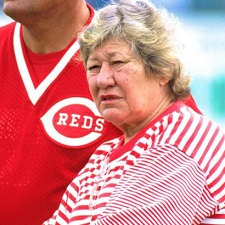
Before the first game of the 1990 World Series in Cincinnati, Fay Vincent, then the commissioner, recalled that “she wanted to go on the field and say something about the troops in Kuwait. She was drunk. I told Neal Pilson of CBS to be careful, that whatever she says won’t be suitable for TV. She went out and said the troops were in the Far East.”
Told after she left the field that she was wrong about where the troops were, Schott wanted to go out a second time.
“Pilson came to me and said she wanted to go out again and correct her mistakes,” Vincent said by telephone from Vero Beach, Fla., Tuesday. “I sent her a message telling her ‘I forbid you to go out.’ She sent back a message: ‘tell the commissioner to go fuck himself.’”
Vincent said he replied, “That was an expensive message. I’m going to fine you the maximum.” That figure was $250,000.
Schott, Vincent said, was “a raging alcoholic” and offered another example of how her inebriated state affected her.
The first President Bush and Mrs. Bush were scheduled to attend a Reds’ opener, but only Barbara Bush was able to make it.
“We were in the owner’s box, and Marge was drunk,” Vincent recalled. “Barbara leans over and says to Marge, ‘It’s nice to be here with you, with a woman owner.’ She asked her how long she’s loved baseball.
She said ‘I hate baseball.’ Barbara said to me, ‘We’re in for a long night.’”
As disconcerting as that incident might have been, it was not one of the instances where Schott expressed her bigoted views about blacks, Jews and Asians and did not boast about the swastika armband she had in a drawer at home.
“Hitler was good at the beginning, but he just went too far,” she said in a 1992 interview, and as if that weren’t bad enough said it again several years later in another interview even though the first utterance helped earn her a suspension for the 1993 season and a $250,000 fine.
She called Barry Larkin, the Reds’ Hall-of-Fame shortstop-to-be, “my boy.” She acknowledged in a deposition for a lawsuit that she had used the slur “nigger.”
Worst of all, though, were ugly comments she allegedly made in 1988 before a conference call owners had with Commissioner Peter Ueberroth. Related to The New York Times in 1992 by Sharon Jones, who had been on the phone to answer the roll call for her boss, Roy Eisenhardt, the Oakland A’s chief executive, Schott said:
“I wonder what the commissioner wants this time. Is it this race thing? I’m sick and tired of talking about this race thing. I once had a nigger work for me. He couldn’t do the job. I had to put him in the mail room and he couldn’t even handle that. I later found out the nigger couldn’t read or write.
“I would never hire another nigger. I’d rather have a trained monkey working for me than a nigger.”
Schott never denied the comments.
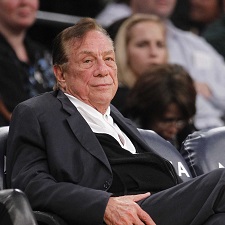 Were she and they worse than Sterling and his comments? There’s no question in my mind. In fact, should Sterling be forced to sell the Clippers and were he to challenge the action by the other owners, I wouldn’t be stunned if he won a lawsuit on the basis that his repugnant comments not only were made privately but were also recorded illegally because he didn’t know he was being recorded.
None of that mattered to NBA Commissioner Adam Silver. “Whether or not these remarks were initially shared in private,” he said in response to a question at his news conference, “they are now public and they represent his views.”
It’s understandable that Silver feels that way; he is concerned about the reputation of a league that is three-quarters African-American. A judge doesn’t have to share that concern.
Another question posed at Silver’s news conference was interesting. A reporter asked why the NBA had never taken action against Sterling for any of what apparently were his many transgressions.
“I can’t speak to past action,” Silver said, “other than to say when specific evidence was brought to the NBA we acted.”
I don’t know enough about Sterling and the NBA to know for sure, but it seemed to me that Silver was protecting his boss and predecessor, David Stern, the Mr. Clean of pro sports.
Major League Baseball, on the other hand, forced Schott to issue apologies and disciplined her with fines and suspensions before she was finally pressured to sell her controlling interest in the Reds (6.5 shares of a total ownership of 15 shares) in 1999, two years before the ownership agreement was scheduled to expire.
Not to excuse Schott for any part of her bad behavior, but she was out of her element and never should have been in something as public as baseball.
“She never intended to be in the circumstance she was in,” Vincent said. “Her husband died so she was in it.”
Schott’s husband was a wealthy automobile dealer, and that’s where Marge got the money to buy the Reds. It was never clear why she wanted to own the team. She certainly didn’t know the game.
One of her first acts after gaining control of the Reds was to fire a bunch of the team’s scouts. “All they do is sit around and watch ball games,” she said.
Vincent said “it was very hard to like her,” but he acknowledged that the fans loved her. “To them, she had great charm,” he said.
Executives, however, had a different experience with Schott.
Vincent recalled the time she announced that she was going to take the Reds to Japan.
“She hadn’t talked to anyone about it,” the former commissioner related.
He called her.
“It’s my team,” Schott told him. “I can do whatever I want.”
“You’re not going,” Vincent said he told her.
“Screw you. I can do what I want,” Vincent said she replied.
“No, you can’t,” Vincent said.
“Who the hell are you?” Schott barked. “You’re the commissioner. It’s my team.”
“She called back,” Vincent said, “and said ‘I can’t do it.’”
Len Coleman, the National League’s last president, recalled a similar incident with the cantankerous Schott. He was in Cincinnati for a game and planned to sit with the owner. That is, until he saw that she was going to light a cigarette and smoke it in smoke-free Riverfront Stadium.
“She was in her box, and she wanted to light up,” Coleman related in a telephone interview Wednesday. “I said, ‘Marge, you can’t do that. She said, ‘It’s OK if I do it, honey’ – she called everyone honey.
I said you’re not lighting a cigarette with me sitting here. She said ‘Everyone in Cincinnati knows I smoke.’”
In the end, Schott no more smoked her cigarette than she took her team to Japan. Because Coleman was the N.L.’s president, Schott was his headache.
“I was going to suspend her,” he said, “but I negotiated a deal with her where John Allen, the team president, made all the decisions for the Reds.
On major decisions she had to be consulted. If they disagreed I would make the final decision.”
Coleman said he knew that an offer would be forthcoming to relieve Schott of her control of the team, and that made life with Marge a little easier. He had a lot more to say about her, but he said, “I don’t want to say more because the lady is dead and can’t defend herself.”
Schott died 10 years ago at the age of 75.