Find the player who doesn’t belong in this group but also figure out why he doesn’t belong:
Ryan Braun, Andrew McCutchen, Matt Wieters, Will Myers, Stephen Strasburg, Giancarlo Stanton, Kris Medlen, Drew Storen, Gordon Beckham, Gerrit Cole, Yasiel Puig, George Springer, Jose Tabata, Pedro Alvarez, Carlos Santana, Mike Moustakas, Anthony Rizzo, Michael Wacha.
Most of those players are among the best young hitters and pitchers in the major leagues today. If on that basis you spotted Springer and said he has yet to establish himself as one of those hitters, you are right but wrong.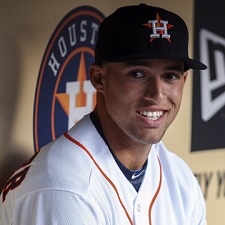
That is, that’s not the reason Springer doesn’t belong in that group. All of the other players in that group were called up to the majors (in different seasons) in the 33-day period May 17-June 18. The Houston Astros, opting not to play the game of manipulating players’ major league service time, summoned Springer April 16, barely two weeks into the season.
There are no rules or provisions in the collective bargaining agreement that intrude on clubs’ rights to call up players when they choose. However, union officials in recent years have scrutinized club practices because clubs have increasingly used callup dates to affect players’ subsequent eligibility for salary arbitration and free agency.
The Astros, who have lost more than 100 games each of the last two seasons and have had the lowest major league payroll at the end of last season and the beginning of this, are trying to reverse their fortunes, and if that means going against joint practice, they have their own future to look out for.
In recent years, when teams left their good young prospects in the minors for the first couple months of the season, they said, as if reading from the same script, that the players needed more time in the minors to work on this or that aspect of their game.
But when I asked Jeff Luhnow, the Houston general manager, why the Astros bucked the trend and called up Springer so early, he said, “He’s an exciting player. What we needed to see this year was getting off to a good start and making sure he was used to right field.
“Our club was hitting a buck 80 (.180 BA) and he was hot. We felt our game could use a shot in the arm. They were getting more excited about Springer.”
He gave them reason to be excited. In his last stop before the majors, he played 13 games at AAA Oklahoma City, hitting .353 and three home runs. However, his early games with the Astros have tempered the excitement.
In his first 11 games, through Saturday, he was hitting .186 (8 for 43) with no home runs and two runs batted in. The Astros nevertheless expect major production from the 24-year-old right-handed hitter. Manager Bo Porter put him in the clean-up spot in the lineup in only his third game.
“You have to expect an adjustment period,” Luhnow said. “He has yet to hit a home run. That’s a big part of his game.”
Springer’s early struggles haven’t prompted any regrets about bringing the rookie up this early.
“We’re not going to evaluate him after a couple of weeks,” Luhnow said in a telephone interview. “He’s here to stay. We’re going to give him time. We expect to win more games this year. We feel we can do that with him.”
Despite the Astros recent economic circumstances, the general manager said he is not concerned about Springer’s eventual status for salary arbitration and free agency. That very likely means the Astros plan to try to sign Springer to a multi-year contract before too many seasons pass.
“We look at the global picture,” Luhnow said. “We look at what players will do in salary arbitration and free agency. Every ball club does that. Financially we can handle it.”
A major question is whether the Houston fans can continue handling the Astros’ losses – 111 last season, 107 the year before. Based on their reaction to the team’s prospects, they apparently focus on the future. First, Luhnow said, the fans clamored for Springer. As soon as Springer arrived, they switched to Jon Singleton, a first baseman at Oklahoma City.
“I’d rather be in that position than have them ask who is this guy you’re bringing up,” Luhnow said.
Springer is not the only rookie who has had an early call-up this season. The commissioner’s office reports that 32 other players have made their major league debuts, most prominently Masahiro Tanaka of the New York Yankees and Jose Abreu of the Chicago White Sox.
Tanaka and Abreu, however, won’t have service-time problems because they signed multi-year contracts.
Some other players to watch who may fall into the delayed-callup category: outfielder Gregory Polanco (Pittsburgh) and pitchers Archie Bradley (Arizona), Noah Syndergaard (New York Mets) and Andrew Heaney (Miami).
The clubs and their labor representatives defend the delayed-callup practice by pointing out that the clubs’ right to decide when to promote players to the majors was established a long time ago. That may be so, but the integrity of the practice has never been debated.
If a team has a player in the minors who might pitch some games or might get some hits that would help a team win a division title or a wild-card spot but it leaves that player in the minors to undermine his eligibility for salary arbitration, the team is cheatings its fans and its other players. That is called a lack of integrity.
Some fans have argued that they would rather have their team have the player for a seventh season before free agency rather than lose him after six seasons. But that is short-sighted thinking. Most baseball people would say the chance of winning doesn’t come along often enough to sacrifice a chance to win by failing to do everything possible, including brining up a player who could make a difference.
Union officials watch the game go on but are unlikely to challenge the practice with a grievance. As wrong as it is, it would be a tough case to win.
The service-time case the union should file a grievance over is the one in which the Mets last year cheated Ruben Tejada out of a critical day on their roster.
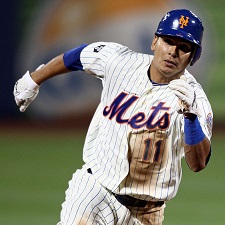 The Mets recalled Tejada with other players from the minors last September but while they put the other players on their roster they told Tejada to hang out in his New York apartment. Don’t call us, we’ll call you, they told the shortstop.
They kept him waiting only a day, but that day was enough to allow the Mets to keep him under control for an extra year. The team’s action also cost another player eligibility for salary arbitration.
With that day, Tejada would have had three years of major league service. Instead he had to qualify for arbitration as a “Super Two,” one of the 22 percent of players with between two and three years of service.
As a result, Tejada took a spot that could have gone to another player, who would have benefited with a much larger raise by being in arbitration.
The union has filed no grievance on Tejada’s behalf, but a union lawyer, Rick Shapiro, said there was still a chance that one would be filed. He said there was also a chance that the case could be resolved without a grievance.
Discussions, Shapiro said, have been held among the union, the commissioner’s office Tejada’s representative and the Mets.