Did you see the advertisement Bobby Valentine placed in The New York Times the other day? Well, it wasn’t labeled an advertisement, but it was better than any full-page ad Valentine could have bought for the going Times rate of $155,000.
Not much different from the ads for Macy’s or Bloomingdale’s luring prospective customers with swanky dresses or expensive watches, Valentine’s ad was aimed at a smaller, more specific group and it didn’t cost him a dime.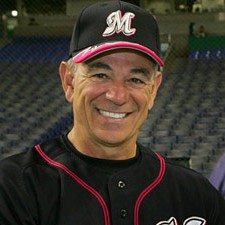
Hey, Bob Watson and Paul Seiler, it declared, I’m available to manage Team USA in the 2013 World Baseball Classic. It was Classic Valentine.
Watson, a Major League Baseball executive, has been the general manager of Team USA. Seiler is the executive director of USA Baseball, the organization that oversees international baseball in this country.
Valentine aimed his ad at Watson and Seiler because their team has failed to win, even reach the championship game, in the first two Classics, and Davey Johnson, the manager of this year’s team, will be 70 years old before the next Classic is played in 2013. In other words, they will be looking for a new manager, and Valentine wants them to know he should be it.
Years ago Norman Mailer wrote a book, “Advertisements for Myself.” Call this Valentine’s advertisement for himself.
He declared his availability through an article Jack Curry wrote about him in the Times. “It’s Classic Valentine: Waiting for a Call,” read the headline with a clever play on words.
But the article didn’t simply say Valentine was available. In presenting his resume, it notes that he has the experience to beat Japan, and “his familiarity with managing in both countries would make him an appealing choice.” Perhaps the story’s funniest line is Valentine “said he would be flattered to be mentioned as a candidate.”
What kind of ego says he is flattered by mentioning himself as a candidate?
Something tells me that Curry didn’t get the idea for the story on his own, that he didn’t wake up one day last week and say, “I think I’ll call Bobby Valentine in Japan and see what he thinks about Team USA and the World Baseball Classic.”
Valentine has managed the Chiba Lotte Marines in Japan the last six years, and he has been accompanied by a former baseball writer from New York, a Valentine sycophant named Larry Rocca, who is the Marines’ director of international business development.
Who but Rocca would be in a better position to know that the Marines, as the Times story said, “plan to make budget cuts because of the turbulent economic times” and that Valentine, whose salary is $3.9 million, is not expected to return next year?
It would not be a stretch to surmise that Rocca called Curry, a Times baseball writer, who covered the Classic, from Japan and said something like, “Hey, Jack, I got a good idea for a story. Why don’t you call Valentine and ask him what he thinks about the World Baseball Classic and how Japan has won it twice and Team USA neither time?”
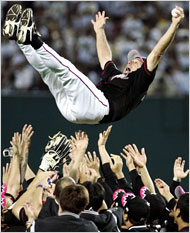 Next thing you know 35 inches of story and picture appear in the Sunday Times. Interesting thing about that picture. It shows Valentine being tossed into the air by his players, a Japanese tradition, after they won the championship in 2005. The players on some of the teams Valentine managed in the major leagues would have tossed him into the air, then walked away, letting him fall to earth himself.
But then, the players would have had no reason to throw him into the air because in 15 years of managing in the major leagues, Valentine never had a team finish in first place. In fact, only Jimmy Dykes managed more games (2,962 to 2,187) without finishing first.

Dykes, however, played on three teams that finished in first place so Valentine’s combined 2,826 games played and managed are the most without finishing first in baseball history. (Valentine’s 2000 Mets played in the World Series but as the wild card. They finished second during the season.)
If you begin to get the idea that I am not a Valentine fan, you are right. Once upon a time, when he managed the Texas Rangers, I found Valentine to be an engaging chap. But his true colors emerged after he began managing the Mets.
First, stories began to emerge about the way he dealt with reporters in Texas. He favored some over others, leaking stories to his favorites, that is, the ones who treated him well in print, and he acted deliberately to divide the writers against each other.
Then in New York, besides continuing his practice of favoring and dividing reporters, he practiced paranoia. I experienced that personality trait personally when I heard during spring training that he was telling other reporters that I had a vendetta against him.
That came as a complete surprise to me because I was unaware that I had done anything to cause him to think I had a vendetta against him.
When I encountered him later that spring, I asked him why he was telling people that I had a vendetta against him. In response, he cited two stories I had written, one in August 1997, the other in February 1999.
The earlier piece was about accusations of other teams that the Mets used surveillance-type video cameras attached to screens in front of the Shea Stadium stands to steal signs from the manager in the visiting dugout and the third base coach. The practice, a member of one team said, began after Valentine became the Mets manager late in the 1996 season.
The second article, written a year and a half later, reported Todd Hundley’s sour view of Valentine from their time together with the Mets. “He won’t leave me alone,” Hundley said among many other harsh things.
Presumably the first piece alone did not constitute a vendetta. Once I wrote the second piece, though, there it was with a capital V.
What Valentine didn’t know was that neither story was my idea. Not that I wouldn’t have been happy to take credit for them, but the ideas came from elsewhere.
The story about the sign-stealing accusations came from Buster Olney, who was covering the Mets for the Times. A player on a visiting team had told Olney about the Mets’ use of the cameras, but Olney felt if he wrote the story it would impair his relationship with Valentine so he asked me to write it.
The idea for the Hundley piece came from an editor, of all things. He had noticed that reporters from other newspapers had tried unsuccessfully to get the catcher to talk about his relationship with Valentine and thought we should take our shot.
On the day I went to the Los Angeles Dodgers’ camp in Vero Beach, Fla., another reporter, Jon Heyman of Newsday, was there, and Hundley spoke with the two of us together. Heyman wrote basically the same story that I wrote, but Valentine didn’t accuse him of having a vendetta.
When I later asked Valentine what the difference was, he said that Heyman had talked to him after we had talked with Hundley and I hadn’t. But, I pointed out to him, another Times reporter who was in the Mets’ camp that day, the same reporter who 10 years later would craft Valentine’s advertisement for himself, asked him about Hundley’s comments, and he had no comment.
That fact, however, meant nothing to the manager. I hadn’t asked him myself so I was out to get him. And that, if you didn’t know, is how vendettas are created.
There was one more element to Valentine’s paranoia where I was concerned. At the time, he was engaged in a long-running, nasty feud with another reporter, Marty Noble of Newsday. Knowing that Noble and I were friends, Valentine decided that whatever I wrote that he viewed as being negative about him was in support of Noble.
He told others that I was Noble’s hit man. To me, he said I was doing Noble’s dirty work. Neither was true, but he refused to understand. Why would a reporter from one newspaper want a reporter from another newspaper writing a story that the first reporter and newspaper didn’t have. It did have the second story, but why didn’t that make that reporter the hit man?
It was all so silly, but that was the self-made muck Valentine wallowed in. The passage of four years did nothing to extricate him from it.
In January 2003 my nephew was traveling with a friend, and they encountered Valentine in the workout facility of a Las Vegas hotel. The friend, who knew Valentine, introduced my nephew to him as “Murray Chass’ nephew.”
“He’s a despicable human being,” Valentine barked.
Since then, Valentine has gone to Japan and cleansed himself, and he is ready to return and lead Team USA to triumph over two-time Classic winner Japan. I know that because I read it in Valentine’s advertisement in the Sunday Times.
