Nolan Ryan is the only club president in baseball history who pitched seven no-hitters, won 324 games, struck out 5,714 batters, including 383 in one record-setting season, and received 98.79 percent of the votes in his election to the Hall of Fame. He also walked 2,795 batters and threw 277 wild pitches, both career major league records, but who’s counting?
Twenty-six other teams have presidents, but none of them played professional baseball, let alone major league baseball. You won’t find the names Larry Lucchino, Randy Levine, Dave Dombrowski, Dennis Kuhl, John Schuerholz, Stan Kasten or Jamie McCourt in any baseball encyclopedia.
Ryan, in fact, is one of only three Hall of Famers who have served as club presidents, the first since 1925. John Montgomery Ward (Monte to his friends) in 1912 and Christy Mathewson in1923 and ‘25, both with the Boston Braves, were the only other Hall of Fame players who were club presidents.
Ryan has started his second year as the Texas Rangers’ president and will outlast Mathewson in becoming the longest tenured president who is in the Hall of Fame.
“I don’t really have a time frame I’m dealing with,” Ryan said in a telephone interview. “Tom Hicks wanted a 4-year contract. I told him that was fine, but I think we agreed if it wasn’t a fit, we would understand. I was coming into a new venture with no experience. From my perspective I’ve enjoyed it immensely. It’s a big challenge. We have a lot of good young talent so I’d like to think I’ll be here to see the kids develop and help turn this into a winning venture.”
The Rangers have not been a winning venture under Hicks, who has owned the team for the past decade. He has made major mistakes, including his dismissal of Doug Melvin after the Rangers won three division titles in Melvin’s six years as general manager and his $252 million signing of Alex Rodriguez, who contributed to no first-place finishes and three last-place finishes in three years.
Hiring Ryan to run his club, though, is not likely to become another Hicks error. Superstar hitters and pitchers tend to fail as managers because they find it difficult to relate to players of lesser talent. A club president, however, is a different animal.
“The unique thing about the position I hold is you don’t find players holding this position,” Ryan said. “A lot of them, once they’re through as players, if they’ve had substantial careers, don’t go back into development.”
Besides lacking the desire to go in that direction, former players usually don’t have the business acumen needed for the job. But Ryan has been a successful banker (though that might be an oxymoron today), rancher, businessman and owner of minor league baseball teams. With Hicks, the Rangers’ owner, seeking minority partners, Ryan could very well wind up as an owner of the Rangers, too.
Those roles would seem to be enough to keep a mere mortal sufficiently busy, but remember, this is a guy who was striking out 301 batters when he was 42 years old and pitching no-hitters when he was 43 and 44.
“As a player I always felt it would be fun and challenging to try and be involved in an organization where you have influence in the direction of that organization,” Ryan said, explaining his decision to take the job.
 “I was far enough removed from the game and was at a point in my life when the Rangers first talked to me that there wasn’t a reason not to do it. I could make the transition without disrupting anything in my life. I felt it was an opportunity that wouldn’t be there again and at my age it wasn’t going to come along again.”
The 62-year-old Ryan, who played the final 14 years of his career with the Astros and the Rangers, said they were the only two organizations “I would have done this for.”
“Obviously there was a tremendous learning curve,” he said, “even though I had been in the game as long as I have. I wasn’t on this side even though I had two minor league clubs.”
“The biggest learning curve is learning your personnel,” the executive said, “and with the position I hold it’s not just the baseball side of it. It’s the business side of it. You have 200 front office people, scouting people, development people, major league staff, all the minor league talent. Obviously I still don’t know all those kids. But I have a better feel than I did a year ago.”
One member of his staff Ryan has come to know well is the general manager, Jon Daniels, who was in high school when Ryan retired after the 1993 season. Daniels, 31, is younger than Ryan’s three children.
“We’re always in communication about what we’re doing in putting the ball club together and about the financial side of it,” Ryan said.
How much does he get involved on the baseball side?
“I observed the amateur side of it when we signed our kids and brought them in,” Ryan said, “how I saw their abilities compared with how we had their ability in scouting reports. “The same with development. Because of my background as a player I’m probably closer to that side than the business side.”
Ryan combined his baseball and business roles in his active recruitment this winter of Ben Sheets, a free-agent pitcher the former pitcher badly wanted to bolster the Rangers’ rotation. The two-year deal, however, didn’t take effect because a physical exam showed that Sheets had a torn flexor tendon in his right elbow.
Ryan was more successful in hiring a pitching coach, Mike Maddux, who had been the pitching coach at Round Rock, one of Ryan’s minor league teams.
Not surprisingly, pitching is Ryan’s primary focus. He talks to the pitchers and works with them on a back field at the Rangers’ spring training complex in Surprise, Ariz. He has emphasized better conditioning for the pitchers and he wants to end the pampering of pitchers that has become a practice throughout baseball. He wants pitchers to have higher pitch counts, and he wants them to work deeper into games.
This is a man, remember, who started 773 games, completed 222 of them and pitched 5,386 innings. No one coddled him, and he didn’t suffer.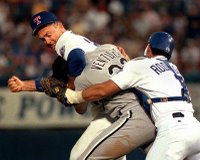
One area Ryan stays away from is the coaching. “I don’t get into the coaching aspect of it because I feel the people we hired have that responsibility,” he said. “We have faith in the people we hired. We have discussions about things we think will help us improve. I’m involved in those discussions.”
Ryan said he also is involved with amateur players, attending meetings before the June draft.
“I listen to our scouts talk about prospects and how they rank them,” he said. “We rank them by their ability, picking the best player on our charts at the time we draft. We don’t rank them by needs.”
Ryan said that during the coming season “I’m going to go out and see some amateurs in the Texas area just so I have a reference on them and be more familiar with them.”
It’s highly unlikely that many other presidents scout amateur players and if they do know what they’re seeing.
“The first thing that Tom Hicks asked me was how the club should be built,” Ryan related. “I told him I thought you build it from within your organization. He said that was the direction they had chosen to go in the spring of ‘07 so they had committed to doing that.
“I was in agreement with it so it worked out well that we had the same philosophy. So from my perspective what I needed to do was evaluate what we were trying to do with the personnel we had on and off the field. I felt we were making progress in getting the people we needed to accomplish that.”
With statistical analysis having become a major part of the game for some teams since Ryan played, I asked him his thoughts on that development.
“We’re in the people business,” he said. “People play the game. I’m a believer in looking at the numbers, but you also look at the player and how he plays the game and his commitment to his career. A lot of things come into play — how they mix with their teammates, what their commitment is to the team and to baseball.”
EUPHORIA OVERTAKES LORIA
 If Jeffrey Loria were driving from his home in New York to his team’s offices in Florida, when he reached Brunswick, Ga., he apparently would say he was approaching Miami.

Perhaps he can be excused, on the grounds of escalating euphoria, from a literal reading of his comments to Miami-Dade commissioners on the brink of their approval of a new park for his Marlins, but Loria said, “I’m approaching my second decade with the Marlins.”
Loria has owned the Marlins for seven years.
HAS ANYBODY HERE SEEN ANDRUW?
Andruw Jones will long be remembered as one of the great enigmas in baseball history. How could a player of Jones’ talents become the player he was last season and he continues to be this year? How could a player be so good that he attracted a two-year, $36.2 million contract from the Los Angeles Dodgers and be so bad that he prompted the Dodgers to release him in January, owing him $21.1 million?
Jones, a Curacao native, had become so bad that he wasn’t even on the Kingdom of Netherlands team in the World Baseball Classic.
ones hit 345 home runs in his last 10 seasons with the Atlanta Braves, slugging a career high 51 in 2005 and following that production with 41 in 2006. He drove in a total of 257 runs those two seasons. And then he dropped off in 2007 at the age of 30 to 26 homers and 94 r.b.i.
Steroids? It might be natural speculation, but Jones’ finest two seasons were years that he was tested for steroids. His worst season came last year after the Dodgers gave him that gaudy contract. After reporting to spring training overweight, he batted .158, hit 3 homers, drove in 14 runs and struck out 76 times in 209 at-bats, one every 2.75 at-bats.
Just as mystifying was Jones’ defensive decline. He was the best center fielder I have seen play, and he won 10 Gold Gloves. Last season he couldn’t win a winter glove.
At the end of last week Jones was in the Texas Rangers’ camp on a minor league contract, trying to hold on as a spare outfielder even though his contract called for the Rangers to release him, at his request, if he wasn’t placed on the 40-man roster by March 20.
Jones gave the Rangers no reason to promote him to the roster because on March 20 he was hitting .258 with one home run and two r.b.i. and had struck out 14 times in 31 at-bats. However, with the assistance of Rudy Jaramillo, the team’s legendary hitting coach, Jones began improving after opting to stay, having four good games (5 hits, 1 strikeout in 10 at-bats) and one bad game (0 hits, 3 strikeouts in 5 at-bats).
Perhaps he can be viewed as a work in progress, but there aren’t many players his age – he’ll turn 32 April 23 – who are works in progress.
A GOOD SON, A BETTER MANAGER SCOUT
Arthur Richman, who was instrumental in the Yankees’ four World Series titles in five years (1996-2000), died last week.
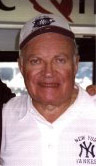 Richman was a former newspaperman and long-time executive with the Mets and the Yankees. Richman, however, was known more as a character than as an executive. What made him a character? Two examples:
He carried in his wallet a list of baseball people he wanted to serve as his pallbearers upon his death, which he talked about often, and he wore a ring adorned with a likeness of his mother’s face, which he proudly showed off to people.
Richman, who died at the age of 83, was devoted to his parents. Long a baseball traveler with both teams, he carried with him a book with memorial prayers he would say for his parents on the designated days on the Jewish calendar.
Because Jewish custom calls for the funeral and burial to occur no later than the day after a person dies, Richman did not have the pallbearer he desired.
“I don’t think any of his original list was there,” said Ben Tuliebitz, the Yankees’ traveling secretary, who was a pallbearer. “It was hard for people to get there.”
Although Richman changed the list from time to time, names that remained on it included George Brett, Johnny Bench, Jamie Quirk, John McNamara and Willie Mays.
Richman was the long-time traveling secretary of the Mets and a media relations executive with the Yankees. It was in the latter job that Richman played a critical role in the Yankees late-century success.
When George Steinbrenner was looking for a manager after the 1995 season, Richman recommended Torre, whom he got to know when both were with the Mets. Steinbrenner hired Torre, and the Yankees won the World Series in four of his first five years.
Subsequent to Torre’s success with the Yankees, according to a man who knew them both, “Richman got mad at Torre because Torre wasn’t giving him enough credit.”
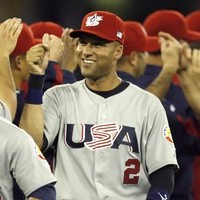
Derek Jeter of the Yankees and Brian McCann of the Braves escaped  the injury attack that struck Team USA in the World Baseball Classic, but then they got hurt in the same half inning of the same exhibition game last Saturday.
In the top half of the first inning of the game at Orlando, Fla., Jeter rapped a grounder near second base that Martin Prado bobbled, then hurriedly threw to Greg Norton at first base, where Norton and Jeter collided and fell to the ground. Jeter remained in the game but left in the fourth.
McCann, the Atlanta catcher, was injured later in the half inning when Mark Teixeira fouled a ball off his hand. McCann suffered a contusion of his right ring finger.
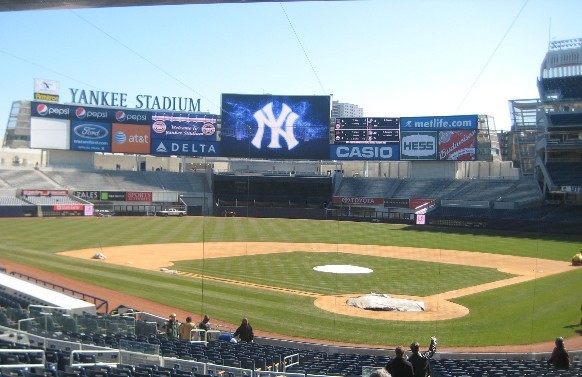
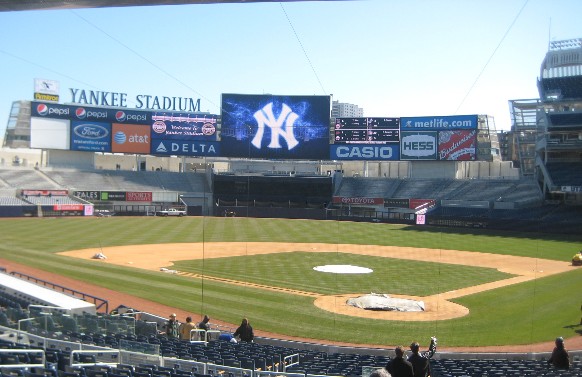
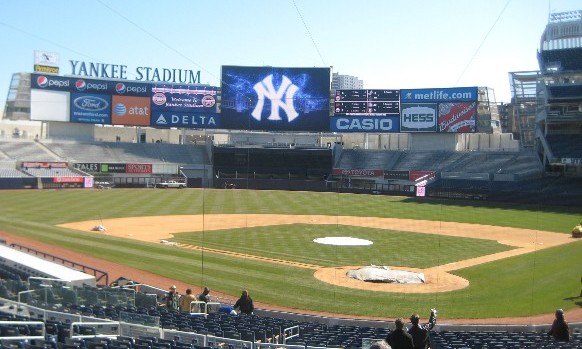
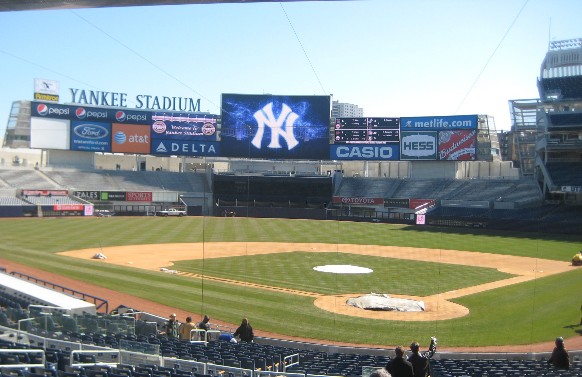
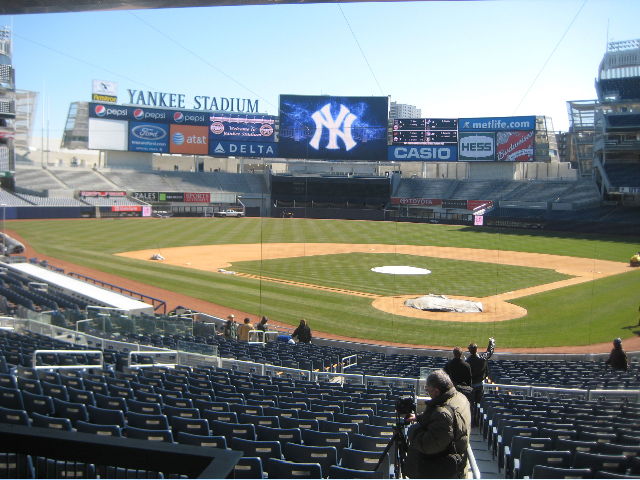
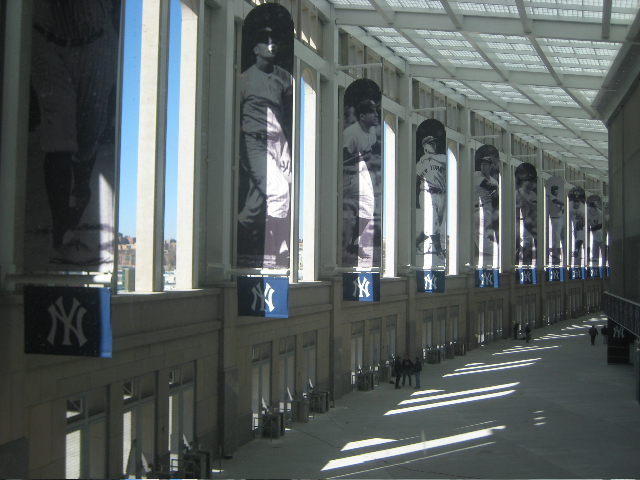
YANKEES’ NEW HOME AS SPLENDID AS OLD
On a tour of the new $1.5 billion Yankee Stadium last week, I was struck by two features:
Internally the stadium looks exactly like the old stadium. That’s what the Yankees wanted, said Lonn Trost, the chief operating officer and tour conductor. They were smart for taking that approach. Why would anyone want to change Yankee Stadium?
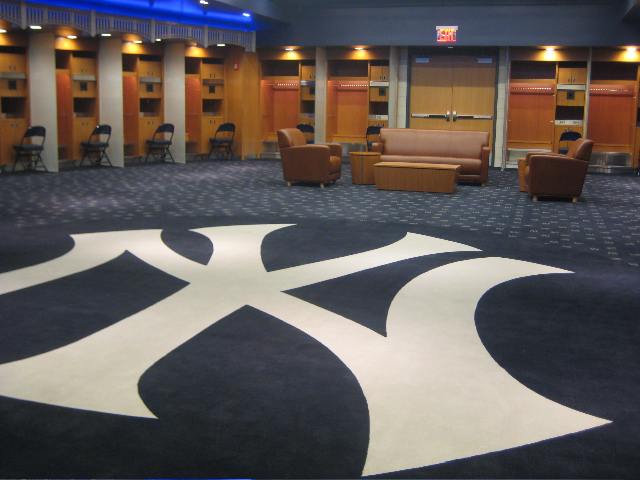
The home clubhouse is so huge and has so many areas off the main clubhouse that players will have plenty of places to hide so that reporters won’t be able to find them before or after games. That’s not good for us, but as Trost said repeatedly as he pointed to various player-friendly features, “The players are our chief asset, and we want them to be comfortable.”
PNC Park in Pittsburgh remains No. 1 in my view among all of the new parks, but I don’t consider Yankee Stadium in the competition. It’s new but looks the same, which means it’s still a magnificent edifice, a palace among sports structures.
Yankee Stadium Great Hall
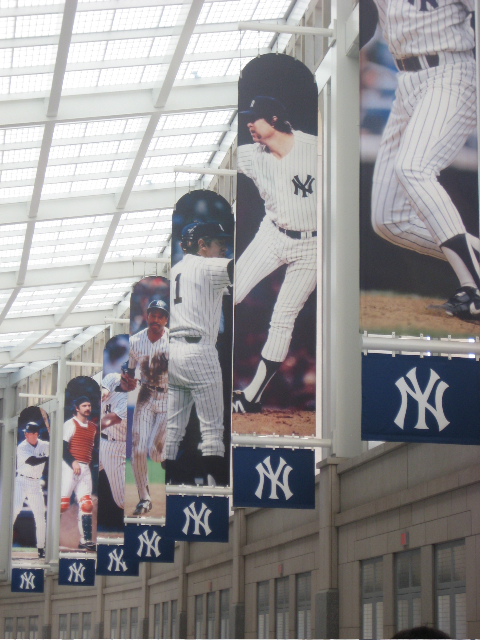
Yankee Stadium Great Hall
Yankee Stadium Clubhouse
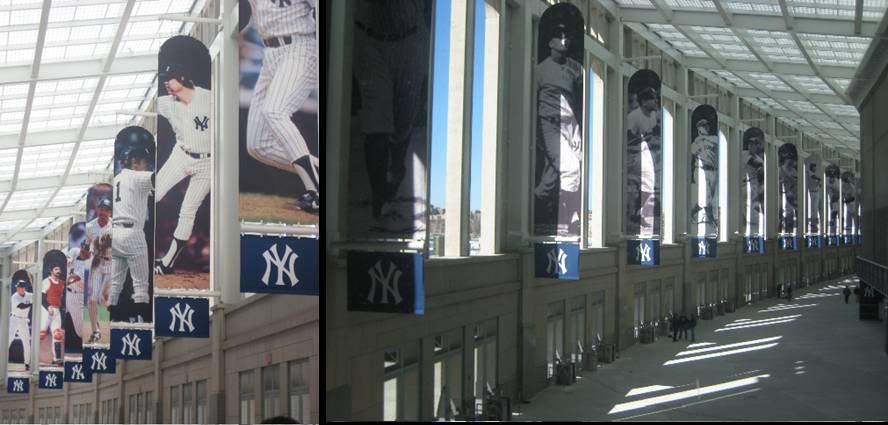
(Yankee Stadium photos courtesy of Matthew Glass)
