As the incoming managing partner and principal owner of the Texas Rangers, Chuck Greenberg will join Larry Lucchino as Pittsburghers playing prominent roles in major league teams. Lucchino is president and chief executive officer of the Boston Red Sox.
Bob Nutting is not a Pittsburgher; he is a West Virginian. As the Pirates’ principal owner, he is overseeing the team’s major league record 18th successive and his fourth successive losing season.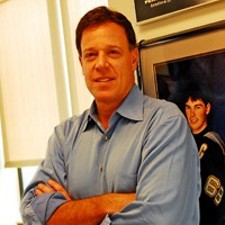
In the interest of full disclosure, I have links to Greenberg and Lucchino. I went to high school with Lucchino’s brother, Frank, and with Greenberg’s mother, Barbara. But having nothing to do with that Allderdice connection, I believe the Pirates would be better off – far better off – if either Lucchino or Greenberg owned or operated the Pirates.
Both Lucchino and Greenberg tried to buy the Pirates but neither succeeded.
Lucchino, an executive with the Baltimore Orioles under the legendary lawyer Edward Bennett Williams, left the Orioles after Peter Angelos bought the team at auction and put together a group that tried to buy the Pirates, but Kevin McClatchy ultimately got the team.
Lucchino subsequently was a top executive with the San Diego Padres and the Red Sox, helping build three World Series teams, including two champions.
Greenberg, a sports lawyer in Pittsburgh, where he helped Mario Lemieux buy the Penguins National Hockey League team, owned a few minor league baseball teams, but as was the case with minor league players, his goal was to make the majors.
Before he began his quest to buy the Rangers, Greenberg explored the possibility of buying the Pirates. Nutting, however, wasn’t interested in selling. No surprise there. Why would he want to sell a commodity that attracted 20,000 buyers a day, no matter how dreadful the product, and was the recipient of serious welfare payments, more than $25 million a year, enough to pay for nearly all of the team’s payroll.
Nutting has been suspected by the players union and some fellow owners of pocketing revenue-sharing proceeds instead of spending the money to improve the Pirates, but club officials have denied the charge, saying they have spent the money on such team-improving expenses as draft-choice bonuses, international efforts, scouting and player development.
They might have convinced the union and the commissioner’s office because they have taken no action against the Pirates as they did against the Florida Marlins early this year in inducing the Marlins to make proper use of their revenue-sharing money rather than face a grievance.
But while the Pirates continue to founder in a sea of failure, Greenberg assumes command of a surprisingly solid Rangers team, the result of the leadership of his partner, Nolan Ryan, the Hall of Fame pitcher and Rangers president.
“Nolan and Jon Daniels have done an extraordinary job,” Greenberg said in a telephone interview, referring to the Rangers’ general manager. “This is not an overnight success. This is a plan that was put in place four years ago.”
That anything good could emerge from Tom Hicks’ ownership of the Rangers is surprising, but he hired Ryan to run the team and that was good enough.
“The baseball operations side is in great shape,” Greenberg said, adding that there are off-the-field matters to attend to. “We want to enroll all of our personnel in a pension plan. It’s a significant disadvantage for people who worked for the Rangers. We’ll give Jon resources to plug holes in scouting.
“The team has lacked continuity and connection to the community. How are we going to change that? I said in the off-season the Rangers are a sleeping giant in Major League Baseball and it’s time to awaken that. There’s a tremendous reservoir of good will and I think we can take advantage of that.”
 As difficult as the process was to buy the Rangers was, Greenberg said, “All this business has been good publicity. At a time when fans usually turn their attention to the Cowboys, this had them riveted.”
Greenberg’s goal is to improve the team’s business operations to match the Rangers’ improvement on the field. He plans to start in the sales and marketing area to increase revenue.
“It was never approached in a way that could sustain success,” the 49-year-old owner said. “That’s what we have a real vision for. In Dallas-Fort Worth you don’t have to rebuild. You reload. I’m totally confident we can contend every year.”
Greenberg has had experience generating revenue for his minor league teams. He owns two in State College, Pa., and Myrtle Beach, S.C., having sold his team in Altoona, Pa., at the end of the 2008 season.
“I’ve been at this since May 11, 2009, when the team wasn’t winning and coming off a string of losing seasons,” Greenberg said of his quest to buy the Rangers. “To work at it so long and hard and to overcome obstacles is very rewarding.”
Although Greenberg reached agreement with Hicks to buy the team, he didn’t actually acquire the Rangers until they went through a bankruptcy auction last week. The price went up, from $520 million to $593 million, but Greenberg didn’t let money stand in the way of his goal.
“We were always very well capitalized,” he said. “We always had the flexibility to do more. There’s always been this undercurrent that we weren’t the highest bidder, that we were undercapitalized. None of that was true.”
There was also an interesting story circulating about Greenberg and Mark Cuban, owner of the National Basketball Association Dallas Mavericks. Cuban, like Greenberg a Pittsburgh native, has wanted to buy a baseball team for several years, and he and Greenberg wound up as the only bidders in the Rangers auction.
The story that circulated the day of the auction was that Cuban and Greenberg had been friends and neighbors in Pittsburgh. Not so, Greenberg said.
“We did not know each other growing up,” Greenberg said. “The first time I met him was in 1999 when I was doing the deal for Lemieux. We had never met. He had just sold his company and was looking for something to buy. Mario wasn’t a fit. We didn’t have any kind of sustained relationship until December, right before our group was selected as the winning bidder.”
They were never neighbors either. They grew up in different, though adjoining Pittsburgh suburbs, and attended different schools.
But Greenberg’s father, David, suggested the possibility that his son and Cuban, three years older, might have known each other when they were young.
“For a very short time,” he said, “they might have been at religious school together at Temple Emanuel in Mount Lebanon, a reform congregation for South Hills.”
As far as Chuck Greenberg is concerned, his desire to own a baseball team might have followed a direct path from Temple Emanuel to Rangers Ballpark in Arlington.
“It absolutely consumed him,” David Greenberg said. “Ever since he was a little boy he wanted to own a baseball team. He called us at 3:30 in the morning Thursday and said we got the team.”