Troy Tulowitzki, Paul Goldschmidt and Giancarlo Stanton are three of the best players in Major League Baseball. The teams they play for are not three of the best teams in Major League Baseball. None of them will represent the National League in the World Series in October.
Despite their teams’ shortcomings, they are among the most highly motivated players in the game. They are accustomed to playing as hard as possible because their teams need their production offensively and defensively to have a chance to win. Those players need no additional motivation to induce them to play at the top of their game.
Yet Commissioner Bud Selig thought they needed additional inducement to bring their most intense efforts to the All-Star game. He believed they would expend those efforts if the league their teams play in could have homefield advantage in the World Series.
Does the commissioner really believe that?
Does he really believe that Derek Jeter, whose broken-down team is unlikely to reach the playoffs, let alone the World Series, needed the promise of homefield advantage to make a diving stop of a grounder up the middle on the first play of Tuesday night’s All-Star game and then get two hits and score the first run of the game?
Does the baseball-wise commissioner really believe that Mike Trout, arguably the best player in the game, whose team could play in October, whacked a triple and a double and drove in two runs, including the tie-breaker in the fifth inning, because homefield advantage spurred him?
If Selig took a lie detector test and answered yes to these questions, the lie detector machine would go berserk, meaning he would fail the test. It wouldn’t even be close.
If Selig were not the commissioner, he would be just as skeptical, just as disbelieving, as I and many others are about his stated reason for linking the outcome of the All-Star game to homefield advantage for the World Series.
Selig has said repeatedly it makes for a better game because players play harder with greater intensity, wanting to gain homefield advantage for the team that wins their league’s pennant
Once upon a time, that thinking among players might have existed. This is a different era. In those days, Warren Giles, the National League president, gave pre-game pep talks to inspire the players to play hard, impressing on them the importance of winning for the league.
There are still two leagues, but there are no league presidents, no one to fire up the troops. Furthermore, free agency has made itinerants of players, many of whom change leagues annually, and daily interleague play has diluted league rivalry.
Somehow it seems unlikely that Selig could address each team before the game and urge each one to beat the other.
So Selig decided that making homefield advantage for the World Series the carrot or the stick (I never remember which is which) would inspire the players. But not all players who play in the All-Star game play for teams with realistic chances of getting to the World Series.
 Take Tulowitzki, Goldschmidt and Stanton, for example. The potent middle of the N.L. lineup, batting Nos. 3, 4 and 5, they combined for 1 hit in 9 times at bat and did nothing to avert a 5-3 N.L. loss. Not that they didn’t try, not that they didn’t try hard, but the A.L. pitchers stifled them. Meanwhile, the N.L. pitchers couldn’t handle Jeter and Trout, who combined for 4 hits in 5 at-bats as the first two batters in the A.L. lineup.
Now what did all of this mean for the FOX ratings, which seemingly have become all that matters coming out of the All-Star game? FOX and MLB announced the results late Wednesday afternoon, both desperately grasping at whatever bit of negative news they can try to make it look positive.
The headline on Major League Baseball’s news release:
“MLB ALL-STAR GAME PROPELS FOX TO DOMINANT PRIMETIME WIN WITH HIGHEST RATINGS AND VIEWERSHIP SINCE 2010”
The headline on the FOX news release:
“ALL-STAR FAREWELL TO DEREK JETER POWERS MID-SUMMER CLASSIC TO FOUR-YEAR RATINGS & AUDIENCE HIGHS”
Those headlines sound exciting, but don’t let them get you carried away. The “fast national rating” was 7.0 and the audience 11.3 million, both subject to change.
The ratings the three previous years were 6.9, 6.8 and 6.9. The audience was 11 million, 10.9 million and 11 million. The middle numbers, recorded in 2012, were the lowest ever for an All-Star game and the lowest in the first 11 years of the FOX-MLB link with the World Series.
A friend who pays closer attention to TV ratings than I do says the increase this year, however slight (1 percent), is significant. I say if that’s the best the link can achieve, MLB should look for a more appropriate way of determining homefield advantage.
FOX noted that this year marks the first time the All-Star game has registered ratings increases in consecutive years since 1993-4.
For this year’s ratings and audience size, both MLB and FOX made much of Derek Jeter’s contribution.
“As Derek Jeter played in his final MLB All-Star Game and Mike Trout became the second-youngest All-Star Game MVP in history,” MLB said, “the 85th MLB All-Star Game became the most-watched Midsummer Classic in four years while generating significant chatter on social media.”
Much was made of Jeter’s last All-Star appearance before, during and after the game. This suggests an idea that Selig and FOX might want to consider. Why not bring back Jeter for an encore appearance next year?
Seriously, folks, let me suggest a legitimate link that makes so much sense Selig and MLB wouldn’t go for it. Give homefield advantage to the league that prevails in the interleague game standings each season.
Selig would have two problems with it. The idea would not have an impact on FOX’s All-Star ratings, and the A.L. has been so dominant in interleague games that the N.L. team might seldom get homefield advantage. Here, from Elias Sports Bureau, are the interleague standings in the years Selig’s All-Star link has existed and the winning league in the All-Star game:
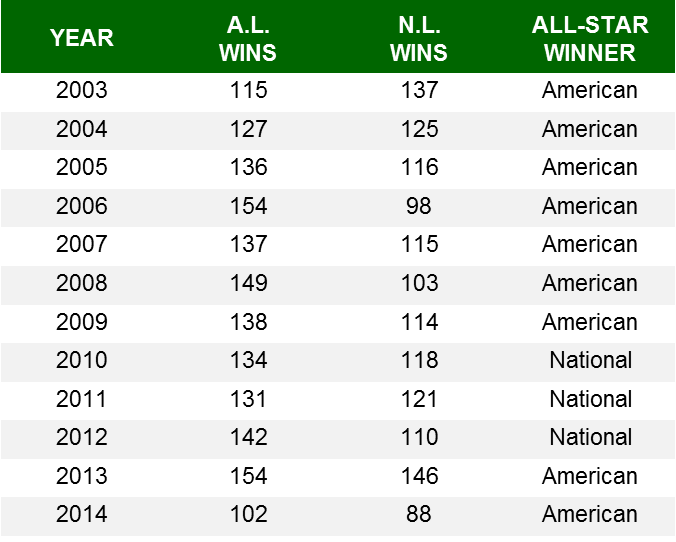
Critics of such a system would argue that the standings could go too late into the season for MLB and contending teams to know where the World Series would start. However, under the current format, teams don’t know where the World Series will start until the league championships are over.
No matter what format has been used, teams, baseball officials, members of the media and fans, if they want to attend the World Series, have always had to make contingency plans.
An interleague determinant won’t help FOX, but the All-Star game and the commissioner’s foolish plan haven’t either.