We have arrived at my favorite time of the baseball season: the All-Star game.
Why is it my favorite time of the season? Certainly not because I get excited seeing the best players in each league playing against each other. Certainly not because I can always count on seeing a scintillating game or even super individual performances.
No, I get tingly all over anticipating the intensity that is produced by the players knowing the outcome of the game will determine homefield advantage for the World Series. I know, too, that Commissioner Bud Selig gets tingly all over, too, because he created this magical connection.
Don’t you wish you had thought of linking this glorified exhibition game to baseball’s ultimate event? Maybe the money-immersed owners would have paid you $25 million a year.
Not everybody, though, can be as clever and as creative, as the commissioner. In the interest of candor, Selig would acknowledge that he didn’t come up with the idea himself. He has long cited Bill Giles, chairman of the Philadelphia Phillies, as having suggested the idea.
Giles confirmed that in a telephone interview Friday. Speaking of Warren Giles, long ago the president of the National League, Bill Giles said, “My father was always very emotional about the N.L. beating the A.L. when he was president of the N.L.”
The elder Giles gave pep talks to the N.L. All-Star teams before the games, and those talks were credited with playing a role in the league’s domination of the game in the 1950s and ‘60s. During one stretch of the Giles tenure, the N.L. won 11 of 12 All-Star games.
“Guys used to play pretty much the whole game,” Bill Giles said. “Then the managers wanted to get everybody into the games.”
Believing the change in emphasis undermined fans’ interest in the All-Star game, Giles came up with the idea of linking the game to the World Series.
“Seventy-five percent of the teams with homefield advantage win the World Series,” Giles said, “so I thought it was a good idea. I think it’s helped some. It creates more interest.”
Selig has said the promise of homefield advantage has made the All-Star game more exciting. I just don’t know which game he’s been watching. If he watched the game two years ago in Kansas City, he saw the N.L. short-circuit whatever interest that might have developed by scoring five runs in the first inning.
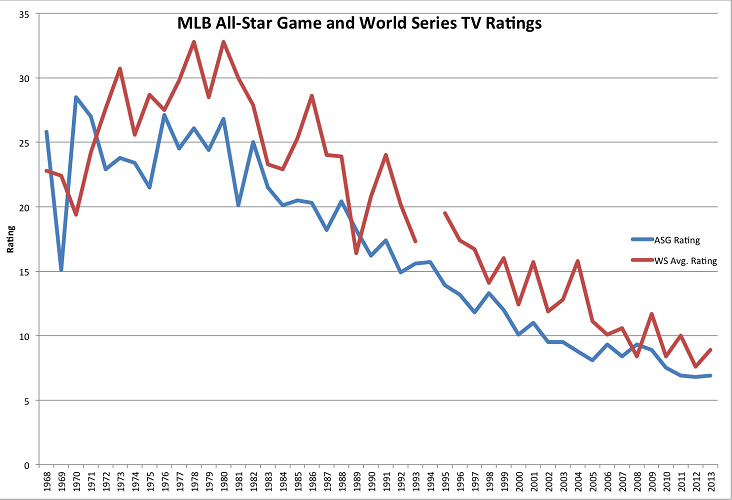
That crushing, unplanned start effectively ended any potential interest and intensity and culminated in the smallest audience (10.9 million) and lowest rating (6.8) in the 11 years the game has determined homefield advantage.
I bring up ratings, of which I am not a fan, because they are the real reason Selig was willing to attach the All-Star game to the World Series. FOX, which was spending a lot of money on baseball, was complaining about its decreasing ratings and wanted the commissioner to do something to spice up the ratings. Thus, the link.
After 11 years, they should go back to the drawing board. That plan hasn’t worked.
In the 11-year existence of the link, the All-Star game has drawn the lowest ratings and smallest audiences in the game’s televised history. That’s every year, not just single-year lows.
Except for the year before the link was forged, the All-Star game drew ratings in double digits. Its ratings have been in single digits every year of the link. What FOX and MLB saw in 2002 that prompted panic was not a warning sign but a sign of things to come.
The same has held for the audience numbers. The data show that 14,653,000 watched the game on FOX in 2002. The link began the next year, and the audience hasn’t reached that total since, declining the last three years instead to all-time lows of 11 million, 10.9 million and 11 million.
Last year’s 3-0 game was more competitive than the 5-run first inning game the year before, but it didn’t do much for the FOX numbers. Ratings went from 6.8 to 6.9 and audience size inched up from 10.9 million to 11 million.
Whatever Giles had in mind when he suggested the idea of the link, the commissioner was eager to adopt it because FOX was looking to raise its ratings for the game and Selig thought the World Series scheme would do the trick.
Now you know why Selig has never been a television programming executive.
As long as I have been criticizing Selig’s foolish creation (that would be since 2003), a friend of mine has dismissed the falling ratings and viewership as a reason for being critical. How do you know the numbers wouldn’t be worse without the link, he keeps asking me?
I don’t know, but if that’s the best argument that can be made for the Selig solution, it would be better to accept that it’s no solution at all and accept the reality that All-Star games aren’t what they used to be and fans don’t wait breathlessly for them to be played.
And maybe if Selig were honest with himself, he would acknowledge that interleague play has diluted the reason why fans used to look forward to the game. They don’t need the game to see A.L. players play against N.L. players. They can see it every day.
RANGERS PLAY TEXAS FOLD ‘EM
It is one of the most astounding streaks of recent years, and it takes the spotlight from other developments that have occurred in division races en route to the All-Star break:
- The Los Angeles are doing a remarkably good imitation of their 2013 version, waking up belatedly and storming into first place in the National League West while the San Francisco Giants squander their 69-day hold on the lead. Last season the Dodgers were nine and a half games out of first with a 30-42 record June 21. They proceeded to win 42 of their next 50 games, a streak that catapulted them into first place by 8 ½ games.
- The Milwaukee Brewers squandered their 94-day run atop the N.L. Central, falling into a first-place tie with St. Louis Saturday.
- The Atlanta Braves lost N.L. East leads they held for three weeks and later a month over Washington, then regained first place two weeks ago, only to have the Nationals catch them again this weekend.
- The Toronto Blue Jays led the American League East for six weeks until running into Oakland and losing all four games of their series the first week of July, ceding first place to the Baltimore Orioles, who swept a four-game series from Texas.
- Not only did Oakland seem safe in the A. L. West, but the Athletics looked like the best team in the league, if not the majors. They reached the final pre-break game with the majors’ best record but with only a game-and-a-half lead over Anaheim’s Angels, who had the majors’ second best record.
- The Detroit Tigers lost their A.L. Central lead in mid-June after having it for the first two and a half months but grabbed it back three days later and now look like they are serious about maintaining it.
None of these twists and turns, though, measure up to the disaster that has decimated the Rangers. Expected to contend for the A.L. West title, the Rangers are desperately trying to finish the season in the A.L. West.
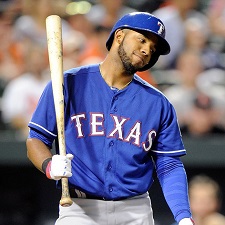 They went into Sunday’s game with 21 losses in their previous 24 games, having plummeted from 7 games out of first to 20 back.
Injuries have sent the Rangers reeling and have left them with little pitching and hitting to sustain them.
They are fifth in hitting but ninth in runs scored and slugging, tied for 10th in on-base percentage and tied for 12th in home runs. What is left of the pitching staff has the worst earned run average, 4.88, and their fielders have committed 68 errors, second most.
But with all of their injuries, the Rangers lead the majors in players (49) and pitchers (29) used and are tied with Arizona for most rookies used (15). Stats Inc. says those 49 players are the most any team has used before the All-Star break, one more player than Kansas City used in 2004.
Three-fifths of the starting rotation is on the disabled list: Matt Harrison (may need spinal fusion surgery), Derek Holland (knee surgery) and Martin Perez (elbow ligament transplant).
Prince Fielder is there with them. He had neck surgery May 27 and is expected to miss the rest of the season. Mitch Moreland, who replaced Fielder at first base, went on the disabled list June 10 with an ankle injury. Carlos Pena, whose minor league contract was purchased so he could replace Moreland, hit .136 in his first 18 games.
In the space of five days the Rangers, Tampa Bay and Houston registered loss No. 50. The Astros got there first, on July2 in their 86th game. The Rays (90th game) and the Rangers (88th) joined the Astros July 6.
In the series immediately after July 6 the Astros swept three games from Texas in their intra-state rivalry. The sweep gave the Astros the better record for a Texas team by one percentage point.