By definition, the usage is not incorrect. I’ll grant that. One of the four definitions listed in my dictionary for the word nation says, “A people who share common customs, origins, history and frequently language.”
In the case of the so-called Red Sox Nation, the inhabitants certainly speak the same language. You and I wouldn’t want to speak it or sound like they do, but it’s not their fault they were born in Boston and surrounding neighborhoods.
What we can blame them for, however, is their obnoxious attitude toward the rest of the country, or, keeping with the theme of this column, other nations.
Red Sox Nation, Red Sox Nation, Red Sox Nation. I’ve heard it so much that I would support a coup d’etat against that particular nation. But what’s worse than hearing the inhabitants of Red Sox Nation talk about it is the scourge of nations theirs has spawned.
A check of Factiva, a newspaper search site on the World Wide Web, finds references to so-called “nations” of 29 of Major League Baseball’s 30 teams. The only sane and sensible team is the Kansas City Royals. If there is a Royals Nation, it has not been memorialized in the pages of United States newspapers.
A believer in baseball’s nationhood might say the Kansas City Star and the Wichita Eagle and the Topeka Capital Journal simply haven’t done their job by bestowing nationhood on the Royals. But the newspapers in a team’s playing area haven’t been solely responsible for creating these insufferable nations.
In the same column in October 1996 the St. Louis Post-Dispatch christened not only Cardinals Nation but also Braves Nation. The Atlanta Journal Constitution, in turn, was first to write about Cubs Nation. The Post-Dispatch, apparently big in the nation-building business, created Astros Nation nine years after its double play with the Cardinals and the Braves.
The Chicago Tribune was first with Indians Nation, and Newsday, a Long Island newspaper, reached cross country to dub Padres Nation. The Contra Costa Times, a northern California newspaper, designated Dodgers Nation, and the Los Angeles Daily News, turning the tables on the team that hijacked the Los Angeles name, was first with Angels Nation.
Tampa Bay, in its short history, has been blessed with two nations – Devil Rays Nation named in 1999 and Rays Nation a year ago, even before the team had played a game with its abbreviated name.
But what does it all mean? Nothing, not a thing, unless you want to say all of those who adopted the use of team names with nation were copycats and creators of trite usages and subsequently clichés. It doesn’t take much imagination or creativity to put the word nation after team names.
The only original usage belonged to Nathan Cobb, a feature writer for the Boston Globe, who in 1986 was the first to use the term Red Sox Nation. “A dubious distinction if there ever was one,” Cobb said in a telephone conversation Tuesday.
Cobb said he learned of that distinction from Dan Shaughnessy, a Boston Globe sports columnist, who researched the term because people had been crediting him with using it first.
“This was so amusing to me,” said Cobb, who by then was a journalism professor at Boston University. “I had the Globe search everywhere to make sure there wasn’t an earlier reference and there wasn’t.”
Cobb’s article appeared in the Globe the day after the second game of the World Series between the Red Sox and the Mets.
“My story was about the geographical dividing line between Mets fans and Red Sox fans in southwestern Connecticut,” Cobb related. “I mentioned the dividing line was between Yankee country and Red Sox Nation was further east. That was the first reference.”
Even if there were a Royals Nation, it would not generate the overbearing attention Red Sox Nation receives. The media fuels it. Factiva lists 9,898 references to Red Sox Nation.
The Red Sox have aided and abetted in the proliferation of those mentions. In 2004, they began conferring citizenship on members of Red Sox Nation. That smart marketing move was followed by the election of a president and regional officers. Larry Lucchino, the Red Sox chief executive, sent Cobb a citizenship card with his name and “founding member” on it.
Hank Steinbrenner, son of George, had it up to here with Red Sox Nation. “They talk about Red Sox Nation,” he said. “We talk about Yankee Universe.”
 Red Sox fans do get carried away with their silly game. Even Cobb thinks so. When I mentioned to him that I wasn’t a fan of the nation thing, he said, “I feel the same. People have asked me can’t you profit from it. I don’t want to be connected to it. It’s overdone. All the teams doing it shows how overdone it is.”
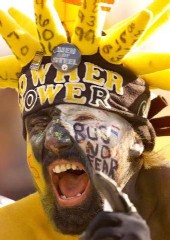
The most interesting aspect of Cobb’s creation is it wasn’t new when he created it, though he didn’t know it. Before there was Red Sox Nation, there was Steeler Nation. That would be the Steelers, who just won the Super Bowl for a record sixth time.
Steeler Nation made its first appearance when the Steelers began winning Super Bowls in the 1970s. In the Steelers’ highlight film, NFL Films’ legendary narrator, John Facenda, dubbed the “Voice of God” for his resonant voice, said, “During the week Pittsburgh Pennsylvania makes the nation’s steel, but on Sunday they become the Steeler Nation.”