There they go again, those agents of government who believe they are above everyone and everything else. Negotiated, legal agreements mean nothing to them. Major League Baseball and its players union learned that several years ago. Baseball teams and corporations with which they have agreements are learning it now.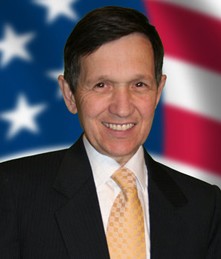
Dennis Kucinich, a Democratic Congressman from Ohio, wants Citigroup to break its naming-rights agreement with the Mets and take back its $20 million a year because it is receiving bailout money from Washington. And if the parties won’t dissolve their agreement voluntarily Kucinich wants the U.S. Treasury Department to terminate it.
Several years ago Federal agents, at the direction of the United States attorney’s office in San Francisco, raided drug-testing facilities in California and Nevada and seized results from tests of major league players even though the union and the commissioner’s office had negotiated an agreement to keep the results of those particular tests confidential.
Kucinich apparently will not get his wish, at least not from the Treasury Department. The department has acknowledged that it has no standing to do what Kucinich wants, but he most likely isn’t finished trying to accomplish his goal of interfering in the business of others. He did not return telephone calls seeking comment on his plans.
The drug-testing results are another matter. That case rages on, nearly five years after the government initiated it by raiding facilities of Comprehensive Drug Testing in Long Beach, Calif., and Quest Diagnostics in Las Vegas.
Prosecutors in the Balco case had sought results from baseball’s first year of drug testing, 2003, even though the testing agreement stipulated that the tests would be anonymous. The initial subpoena applied to all results, but the laboratories balked and the prosecutors narrowed their subpoena to the results for 10 players who had testified before the Balco grand jury, including Barry Bonds, Jason Giambi, Gary Sheffield and Benito Santiago.
But the prosecutors nevertheless wound up with all of the results because they discovered them in their search for the 10 they wanted. Included in what the union would later claim was their ill-gotten gain were the positive test results for 104 players, a treasure trove that could have enabled the government to widen their investigation in their search for steroids distributors.
The government, though, wound up with much more than all of the baseball test results. Because law enforcement officials went through computers to find the baseball results they sought, they also got test results from 13 other sports, three sports competitions and three unaffiliated business entities.
In an effort to force the government to return the baseball test results it had seized, union lawyers filed lawsuits in three different Federal courts, two in California, one in Nevada. They prevailed in all three cases for a lusty 1.000 batting average.
One of the judges found that the government had demonstrated “a callous disregard for constitutional rights,” adding, “I think it’s a seizure beyond what was authorized by the search warrant; therefore it violates the Fourth Amendment.”
But the judicial triple play did not end the case.
The government appealed the decisions and gained a 2-1 victory from the Ninth Circuit Court of Appeals in December 2006. If you think baseball games are long, the two sides in this case had to wait 13 months for a ruling.
The judge who dissented in the decision asked a most relevant question: “What happened to the Fourth Amendment? Was it repealed somehow?”
The Fourth Amendment protects citizens from illegal search and seizure. To the dissenting judge, the government clearly went beyond its subpoena and snatched everything in sight, actually everything that wasn’t in sight because it was all buried in computers.
The union filed an application for the case to be reheard en banc, meaning before the whole court, not just a three-judge panel. A year or so went by, and the appellate panel vacated its opinion, then issued a new opinion with the same 2-1 verdict in favor of the government.
The union again asked for a rehearing en banc, and its request was granted. Before the case was heard, though, the appellate panel again vacated its opinion, but again the verdict stood. Government and union lawyers finally argued the union’s appeal before 11 judges Dec. 18 and 19 in Pasadena, Calif., not at the Rose Bowl but in a courtroom.
A decision is unlikely before the end of the year. Meanwhile, Bonds will probably have had his trial in San Francisco on perjury and obstruction of justice charges and know his fate before the 11-judge appellate court renders a verdict.
 Bonds’ 2003 test for performance-enhancing drugs is part of the government’s case against him. Baseball’s test of Bonds’ urine sample was negative, but after it was seized the government tested it and found it to be positive.
Although the government was entitled to the sample because Bonds’ name was on the subpoena, the sample didn’t necessarily have to exist when the labs were raided. Under its agreement with the commissioner’s office, the union had the right to destroy Bonds’ urine sample and all of the other samples. The union, however, did not destroy the samples and has never explained why it did not.
Because Federal agents found a list of players’ names with numbered codes in their April 2004 raid, they were able to identify Bonds’ sample, setting it apart from three positive tests the government says it has from material seized from other sources. Bonds’ lawyers were challenging the admissibility of those tests, contending the government could not establish that they were from Bonds.
No matter what evidence Judge Susan Illston might not allow, all of the evidence has been made public and it doesn’t help Bonds. Even if he should be acquitted at his trial in United States District Court, Bonds is very likely to be convicted in the court of public opinion. The public isn’t as particular about evidence as a judge might be.
And whether or not he’s convicted, Bonds seems less likely to join Henry Aaron in the Hall of Fame than Mark McGwire in the Hall of Infamy.