Reading about Paul Konerko’s retirement, which could be called the poor man’s version of Derek Jeter’s season-long farewell tour, I couldn’t help but recall the day before the All-Star game in 2002.
On that day, the All-Star media day, when members of the All-Star teams are available for interviews, I talked, among others, to Konerko, the Chicago White Sox first baseman. He had been selected to the American League team as a backup to Jason Giambi, the starting first baseman.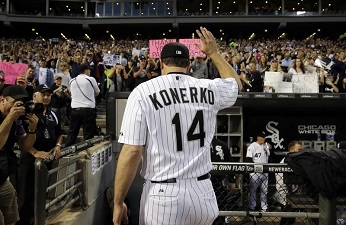
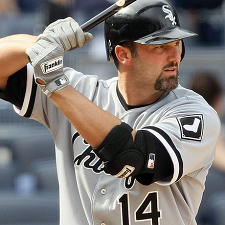
Konerko was having a terrific season, hitting .328 with 20 home runs, 71 runs batted in, a .374 on-base percentage and .571 slugging percentage. Firmly entrenched among the league leaders, he nevertheless seemed to be treated with less respect than other big hitters.
“Do you feel slighted by not being mentioned with those other players?” I asked him. Some of the players I had in mind were Alex Rodriguez, Manny Ramirez, Barry Bonds and Sammy Sosa. Little did I know at the time that those particular players would become poster players for the steroids era.
“That’s ridiculous,” Konerko replied respectfully. “Those guys are on another level. I’m not on that level.”
I told him I disagreed with him, but as events eventually exposed, in one sense I was wrong and he was right.
“He was never suspected of steroids,” said Craig Landis, his long-time agent. “He played in that era.”
In his 17-year career, Konerko had many similarities to Jeter, who played for 19 seasons plus part of a 20th. Jeter, their No. 1 choice in the 1992 draft, played for the Yankees on his first day in the majors and his last.
The Los Angeles Dodgers drafted Konerko in the first round in 1994, then traded him to Cincinnati July 4, 1998, after he played six games for them. Four months and a week later, after he played 75 games for the Reds, they sent him to the White Sox, for whom he played the rest of the 2,268 games of his career.
Both players were team captains. Both were revered by their teammates and loved by their teams’ fans. Both made significant contributions to their teams. Jeter, of course, had a greater chance of playing in the post-season and was a member of five World Series champions. Konerko played for the 2005 World Series champions.
Both wanted to stay with their teams and finish their careers where they were.
“Paul was a free agent after the 2005 season,” Landis related, “and we were talking to other teams. He said ‘I’ve seen guys bounce around, but I’ll tell you what. I’d prefer to be known for being with one team in one city. It would mean something to me if one day they retired my number.’”
The White Sox plan to do that next season. They could have retired No. 14 last weekend during their weekend-long celebration of Konerko’s career, just as the Yankees could have retired Jeter’s No. 2 at their celebration for him.
But why do one or two when two or three will do and bring in an additional sellout crowd? The Yankees, after all, paid Jeter $270 million during his career; the White Sox paid Konerko $129 million. They can’t be blamed for wanting to get some of it back. Furthermore, Konerko and Jeter fans will love to pay exorbitant scalper prices for tickets to the games.
“Giving credit to the White Sox, it takes two to tango,” Landis said. “Both sides have to be receptive. Both sides have to want it and have to put forth the effort to make that happen. But Paul’s instincts were correct. People have said to me he did it right.”
When the 2013 season ended, the agent said, Konerko didn’t know if he wanted to retire or keep playing. He thought about it a lot and decided in December “he was going to play one more year and that was it.” Jeter’s announcement of his planned retirement came in close proximity.
“That’s been Paul’s situation,” his father, Hank, said from Scottsdale, Ariz., where they both live. “Even in Chicago there are two teams so it’s split. I’ll take what he’s gotten. Sports writers have been fair. As testimony to Paul’s luck, he announced he was retiring and just after that Jeter announced his retirement.”
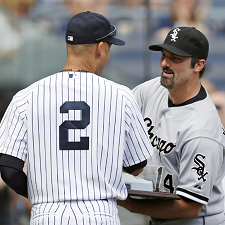 Landis added, “It’s almost fitting that he retired in the same year as Jeter.” Asked about Jeter’s overshadowing Konerko even in announcing their retirements, Landis said, “Paul would say he (Jeter) deserves more attention and accolades. He would say he didn’t deserve the same kind. He was very happy with the White Sox treatment in sending him off. It just wasn’t as well covered as Jeter.”
That coverage is the difference between New York and Chicago, which didn’t acquire its tag as the Second City for nothing.
“Paul is more a regional guy,” Landis said. “He’s beloved in Chicago but not as well loved around the country.”
He is not as well known. “Paul did not seek out attention,” Landis said. “He was the perfect outside guy. He’s a blue- collar guy, non-glitzy, hard worker, roll- up-the-sleeves guy. Paul’s personality fits, blue-collar guy. He doesn’t try to style in uniform. He had no controversies.
“He’s one of the two favorite White Sox in the last 30 years. Harold Baines is the other one.”
That status has enabled Konerko to attain something Jeter doesn’t have – a bronze statue of himself in left-center field at U.S. Cellular Field. The statue was unveiled during the weekend celebration of Konerko.
Landis said Konerko has no immediate plans, including taking a job in baseball. “He may get back into baseball but I don’t see him getting back for a while,” the agent said.
“He’s a golfer and a businessman. He makes his own investments. His father was a businessman and taught Paul well.”
Speaking of his son’s business acumen, Hank Konerko said, “We’ve developed business interests over the year. He can review and critique a business plan better than most. He’s pretty good for a high school graduate.”
 I told Hank about my thinking, at least at one time, that his son wasn’t receiving the recognition that he deserved.
“People say Paul is underrated,” the elder Konerko replied. “I say who’s doing the rating?” Anyway, he added, “He gets paid to play baseball, not to be an action figure,” he said.
I had hoped to talk to the retiring baseball player, but Landis said, “Paul said I’m not doing any interviews. I’m done. I’m retiring. The season is over and my career is over.”
I figured I had one more shot. I asked his father what he thought his son’s reaction would be if he asked him if he would do an interview.
“I think he’d punch his father in the mouth if I asked him,” he said.
Having heard too much recently about incidents of domestic violence, I dropped my pursuit.