In the five-year period 1976-80, the Kansas City Royals and the New York Yankees played each other four times in the American League Championship Series. The Yankees won their first three encounters, and Kansas City fans became irritated at the one-sided outcome. They also grew annoyed and restless that they were being outperformed by their Yankee Stadium counterparts.
While Royals Stadium fans were quiet and respectable, Yankees fans were clamorous and often obnoxious. By the fourth meeting between the teams, in 1980, the Kansas City faithful were determined at least to match the rowdy New Yorkers.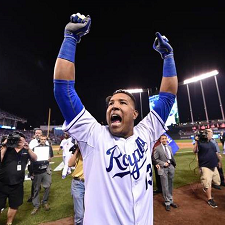
Their effort was admirable but not quite successful. The behavior didn’t come as naturally as it did to Yankees fans. It was forced.
I recall that Kansas City scene because of the Royals’ presence in the playoffs this year and what it took for them to get there. The Royals’ late-season surge, wild-card conquest of Oakland and division-series sweep of the Angels, the team with the league’s best record, have turned the now-named Kauffman Stadium into a sea of raucous ecstasy.
The fans’ reaction has also provided the counter argument to the most recent of the periodic claims that interest in baseball is declining. My response to that claim is tell it to the people in Kansas City. Pittsburgh, too, among others.
Many times in the past 40 years pundits of dubious authority have declared that baseball was in its death throes. In 1976 Bowie Kuhn, the baseball’s commissioner, bitterly opposed free agency, declaring that it would kill baseball. Thirty-eight years later, baseball is very much alive; Kuhn is not.
In the interest of accuracy and candor, Major League attendance fell this season by 288,265. Critics always seize on attendance declines to show that baseball is imperiled. However, with 2,430 games played, this season’s decline represented an average drop of 119 fans a game. On an individual club basis, 17 teams experienced attendance growth; 13 had declines.
In researching this subject, I found a 2011 Yahoo Sports piece in which Jeff Passan, usually a good baseball writer, took the first 320 games of the season, computed that attendance was down 506 per game and projected that season attendance, “barring a bountiful summer,” would fall by 1,229,580, dropping “MLB to levels unseen since the early 2000s….”
MLB attendance that apparently bountiful season rose by 846,579, leaving Passan more than two million off in his projection.
What I find troubling with this kind of problem-finding is it’s too simplistic, too shallow and too ready to denigrate baseball. Let me be very clear about one thing. I am not a shill for MLB or Commissioner Bud Selig. I could have become one like so many others in my profession when I took a buyout and retired from The New York Times.
But I turned down the opportunity because I wanted to be free to offer critical observations of MLB and Selig. He will be the first to tell you that I have done that.
However, baseball remains my sport of choice. I chose it over the National Football League in the late 1970s and haven’t regretted my decision. I would make the same one again if I had to do it.
I guess that’s why I have a problem with pundits who see only doom and gloom.
An opinion piece in The New York Times a year ago carried the headline “Is the Game Over?” The writer, Jonathan Mahler, cited what was healthy about baseball but asked, “So why does it feel so irrelevant, adding that baseball “seems simply to have fallen out of the national conversation….”
In an article in The Atlantic last month, Derek Thompson said interest in baseball was declining because of a decline in hitting and, in turn, blamed the decline in hitting on a change in the strike zone. He noted that Ben Revere of Philadelphia was hitting .313 and leading the National League and was “on track to set an astonishing baseball record.”
Revere did not win the N.L. batting title – Justin Morneau of Colorado did with a .319 average – but was Thompson aware that Carl Yastrzemski hit .301 and won the American League title in 1968, the same year Bob Gibson had the N.L.’s lowest earned run average, 1.12?
Concerned about the state of offense, officials opted to lower the height of the pitcher’s mound from 15 inches to 10 inches. That happened 45 years ago, and fans didn’t flock away from baseball.
Just a week earlier Ben McGrath wrote an article in The New Yorker with the headline “The Twilight of Baseball.” It was gloom following doom.
Maybe it’s only the final flare-up of the flame before the candle goes out, but television ratings for the initial post-season games were impressive. I’m not a fan of ratings, but I cite them because the doom-and-gloomers use them liberally to support their claims.
TBS reported that its telecast of the A.L. wild card game between the Royals and the Athletics was up 12 percent from last year’s wild-card telecast and that the game enabled TBS to win the night’s ratings across all of cable with 5.2 million viewers.
The rating for the San Francisco-Pittsburgh N.L. wild card game on ESPN was up 21 percent from last year’s rating. 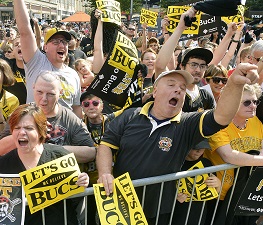 A first-time event on ESPN, the wild card game had a 4.1 overnight rating, matching the highest ever for a wild card game.
The game was a hot item in Pittsburgh, where the telecast’s 22.6 rating was the highest ever on ESPN for an MLB game. The in-person crowd of 40,629 was a record PNC Park attendance, and had the Pirates stayed alive in the playoffs, that record was certain to have been eclipsed.
During the season, the Pirates had a record attendance of 2,442,564, about 6,000 more than they had in 2001, their first season at PNC Park.
The Royals, reaching the post-season for the first time since their World Series championship season of 1985, drew 1,956,482, their highest attendance since 1991.
There are many more attendance figures and ratings I could provide, but the ones I have mentioned here should give you the idea that baseball will not be dying anytime soon.
A final note of fairness:
A friend of mine does not disagree with the dreary forecasts. He says the problem isn’t the number of fans who currently attend games or watch them on television. It is the kids who don’t watch baseball in any form and therefore will not grow up as baseball fans.
I’m not sure that kids do anything anymore but play games and listen to music on their gizmos, and their lack of enlightened efforts in all areas, I fear, will jeopardize their and society’s future. I suppose it’s possible that baseball could become a casualty of that development, but if that happens, you and I won’t be around to lament the loss of baseball.
THE NEW A-RODS
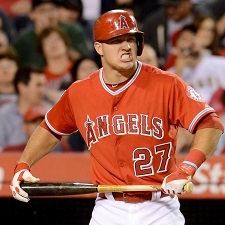 Where is Alex Rodriguez now that he has company in the category of failed, high-priced superstars in the post-season? Rodriguez was long ridiculed for his inability to produce in the post-season, but he never went hitless in a division series, or in any other series in which he batted more than once.
Anaheim’s Josh Hamilton, on the other hand, did not get a hit in 13 at-bats in the Angels’ three-game sweep by Kansas City.
His two slugging teammates didn’t do much better. Mike Trout gave the Angels a 1-0 lead in Game 3 with a home run, but that was his only hit in 12 at-bats, giving him a .083 average. Albert Pujols also hit a home run but had only one other hit and finished the losing series with a .167 average.
A combined three runs batted in and .081 batting average might be one of the reasons the Angels were wiped out after having had the best won-lost record in the American League during the regular season.
MANAGERIAL MENACE IN DODGERS’ DUGOUT
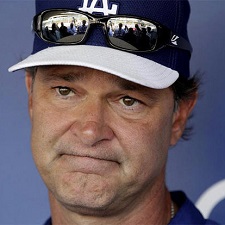 Was that an Edgar Bergen-type manager directing the Dodgers in the first two games of the National League division series against St. Louis?
Don Mattingly wasn’t the only playoff manager who fouled up, but he hit more fouls than any other manager.
I rarely second-guess managers, but it’s hard to ignore what Mattingly and some of his counterparts did in the early going.
In Game 1 Mattingly left Clayton Kershaw in the game too long and in Game 2 he took Zack Greinke out too soon. Fortunately for the Dodgers they overcame Mattingly’s second blunder.
The Dodgers led Game 1, 6-2, when the Cardinals went to bat in the seventh. Kershaw gave up singles to the first four batters and five of the first six. The flurry of hits narrowed the Dodgers’ lead to 6-4, but the manager didn’t make a move until Matt Carpenter unloaded the bases with a double for a 7-6 Cardinals’ lead.
Mattingly brought in Pedro Baez, and a walk and a Matt Holliday home run later, the Cardinals led, 10-6. They won 10-9.
The next night Zack Greinke was pitching a shutout, having allowed only two hits in seven innings, but he had reached the magic number, having thrown 103 pitches, even though only 32 of them had been balls.
That was enough for Mattingly, who called for J.P. Howell and then watched him tie the game in the space of two batters on a walk and a Carpenter home run.
Matt Kemp rescued his manager with a homer in the eighth, and the Dodgers won, 3-2.
I have always been skeptical of Mattingly as a manager, feeling he never did anything to establish himself as a managerial candidate. He has done nothing in his four years as the Dodgers’ manager to remove that skepticism. Like his mentor, Joe Torre, he was not successful until his team had the league’s largest payroll.
His success, though, has been short-lived. The Dodgers lost in the league championship series last year, and Mattingly tried to keep them from getting there this year.