Here they come again. Like clockwork. Wind them up, and they will be there in September fighting for a playoff spot. Despite slow starts to their seasons, the Houston Astros recovered in four of the past five years and were serious contenders by the final weeks. They’re doing it again this season, though this time a little earlier than their usual pattern.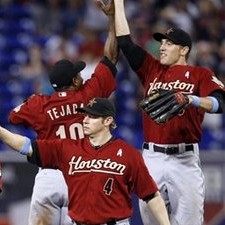
Phil Garner, who as the manager directed some of those comebacks, recounted a conversation he had with his successor, Cecil Cooper, earlier this season.
“He had tough times the first two months,” Garner related, “and he said, ‘I didn’t know it would be that tough.’ I said ‘you’ll be okay.'”
That’s the sort of thing Garner said he told his players in his years as their manager. “When I was there, I used it,” he recalled. “I said, ‘Okay, boys, we’re struggling, but good times are coming.'”
After 65 games this season the Astros had a 30-35 record and were in last place in the six-team National League Central. After they swept a three-game series from first-place St. Louis last week, they had won 19 of their last 30 games and were tied for second, only a game behind the Cardinals.
“We haven’t run off 9 or 10 wins in a row so it never really registered on the radar screen,” general manager Ed Wade said, “but about 8 or 9 series ago we started winning series. People said they’re doing it but against teams that were struggling. Now we’ve stepped up and done it against better teams.”
The pattern has become familiar:
¶ 2008 – On July 24 the Astros had a 46-55 record and were in neither the division nor the wild-card race. But they won 34 of their next 46 games and leaped to three games back in the wild-card standings. Then Hurricane Ike struck Houston.
“Last year,” Wade said, “we had a good race until it was interrupted by a hurricane.”
Ike washed out two home games against the Cubs Sept. 12 and 13 and forced the teams to play the games in Milwaukee, far from a neutral site considering the city’s proximity to Chicago. The Astros lost both games, then three more in Florida and found themselves 5 games back with 10 to play. They never recovered.
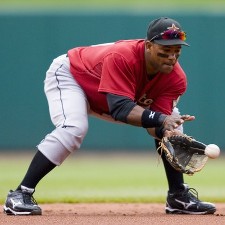 ¶ 2006 – With only 12 games to play, the Astros were five games under .500 and eight and a half games from first in their division. But they won nine straight while the Cardinals lost seven straight, and suddenly Houston was only half a game from first. The race ended there, though. The Cardinals won two of three from Milwaukee, and the Astros lost two of three in Atlanta.
“We had a good run,” Garner said. “We just ran out of time. The season has plenty of time. We started playing our best baseball late. If we had maybe four more games, we might have caught them. That’s how good we were playing.”
¶ 2005 – The Astros struggled to a 20-34 record the first two months of the season, then heard the alarm clock go off and compiled a 69-39 record the rest of the way. They edged the Phillies by a game for the wild card.
“We swept the Nationals in Washington and waited for the Astros-Cubs game to end and ended up out of the playoffs,” recalled Wade, who was the Phillies’ general manager that year.
¶ 2004 – The Astros didn’t get off to a poor start; they were in first place in the N.L. Central on May 21 with a 24-17 record. But they staggered through the middle of the season with a 32-43 record, recovering in time to win 36 of their last 46 games and the wild card by a game over San Francisco.
“I thought it was great managing and it probably still is; Cecil’s doing a great job,” said Garner, the manager of the two wild-card teams plus the near miss in 2006. “Can you explain why a team plays so much better at different times of the year? I can’t explain it.”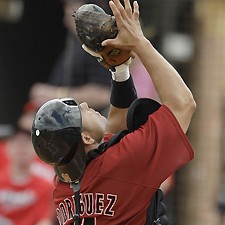
Garner, however, offered a theory. “Ever since the Bagwell and Biggio era,” he said, “they start slowly, then play like gangbusters the rest of the year. The players know how to grind it out as the season gets tougher. Now I think they have the same kind of mix with Tejada and Pudge, and I think Berkman is taking more of a leadership role. I think they have the grit and determination to do it if the pitching holds up.”
Wade credited the Houston players for playing relentlessly in the second half of the season, citing their approach last season.
“These guys showed up to play every night,” the general manager said. “They never got to the point where they mailed it in. Last year we were so far behind at different points in time; we were playing so poorly it would have been easy for them to give up. I have to give credit to the players for the way they approached the game in a very professional manner.
“I don’t think our guys focus on standings early in the season. They come to the park every day with the same attitude and aren’t fazed by whatever short-term success or failure we have. I’ve seen the same this year. The early struggles weren’t as significant as last year, but we put ourselves under .500.”
The Astros have a collection of hitters who have fueled this year’s drive. Lance Berkman, who went on the disabled list the other day, went into Saturday’s game as the team leader in home runs with 18 and in slugging (.525) and on-base (.407) percentages. He had driven in 55 runs, putting him between Carlos Lee (59) and Miguel Tejada (54).
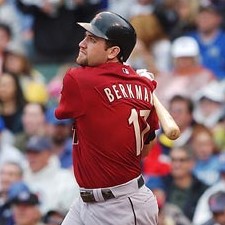 Tejada’s .329 batting average led the team, and Lee was hitting .306 with 15 homers.
“Berkman’s on the shelf right now, but he’s going to be okay,” said Garner, who still lives in Houston and remains a fan of the team despite having been fired with a month left in the 2007 season. “I anticipate him having a big run. Tejada continues to hit the ball well. Lee is a big run producer. He can drive in a run in an important part of the game against a good pitcher.”
Michael Bourn has also contributed significantly as the leadoff hitter, hitting .287 and stealing 37 bases in 45 attempts (82 percent).
“We haven’t relied on one particular player at any time,” Wade said.
DON’T LOOK FOR TRADES HERE
With four teams seemingly in position to scrap the rest of the season for the National League Central title, Ed Wade, the Astros’ general manager, was asked last Thursday if he thought the teams would try to bolster their chances through trades before the July 31 non-waiver trading deadline.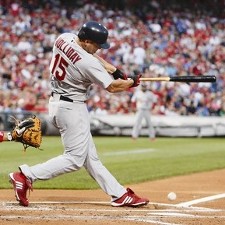
“I would think there will probably be some activity in our division,” Wade said.
That day the Cardinals added infielder Julio Lugo to their roster and less than 24 hours later, they acquired left fielder Matt Holliday from Oakland. In their first two games as St. Louis teammates, Holliday and Lugo combined for 12 hits – 5 singles, 4 doubles, 2 triples, 1 home run.
Wade didn’t expect to do any significant trading himself.
“We extended our payroll to sign Pudge in spring training so we’re not in position to add anybody of substance,” Wade said, referring to catcher Ivan Rodriguez. “We’re also rebuilding our farm system so we aren’t going to give up multiple prospects in a deal.”
Wade said he alerted the Houston players before the All-Star break to the likelihood that he wouldn’t be doing anything significant.
“I expressed faith in the guys we have and explained our situation,” he said. “Randy Wolf is not going to walk through the door at the trading deadline liked last year.”
The Astros acquired Wolf from San Diego nine days before the deadline last year, and he compiled a 6-2 record in 12 starts for them.
NEW NAMES FOR ENCYCLOPEDIAS
 Until May 18 of last season the major leagues had never had a player named Hoffpauir. Then for three weeks this month there were two Hoffpauirs, first baseman-outfielder Micah of the Cubs and second baseman Jarrett of the Cardinals. As far as they know, despite their unusual name, they are not related.
“I feel that somewhere along the lines we may be, but neither of us know,” Micah said. “Last year when he was in Memphis and I was in Iowa, we visited a little before a game. I didn’t get a chance to talk to him during the Cubs-Cards series this season.”
The Cubs-Cardinals series July 10-12 was the last Jarrett played before returning to the minors. “I’m not sure how we would be related,” Micah said. “He was telling me his family comes from the Mississippi-Louisiana area. That’s where my father’s family grew up, western Louisiana and southeast Texas. That’s where my dad was raised. That’s the only thing that makes me think we could be related.”
Micah, 29, was born in Texas, Jarrett, 26, in Mississippi. Hoffpauir, pronounced Hoff-power, is a German name, Micah said.
THE DODGERS’ $47 MILLION MAN EMERGES
 If you blinked, you might have missed it, but Jason Schmidt pitched last week.
Schmidt, a veteran right-hander, signed a three-year, $47 million contract with the Dodgers in December 2006 after several strong seasons in San Francisco. Ned Colletti, the Dodgers’ general manager, was the Giants’ assistant general manager, when Schmidt played there.
But Schmidt started only three games in 2007 before landing on the disabled list with a shoulder ailment and made only six starts the entire season. A shoulder operation on June 20 ended his season.
Three times in 2008 Schmidt attempted rehabilitation assignment but never made it back to the Dodgers. He had another shoulder operation Sept. 10. But on July 20 this season he pitched five innings against Cincinnati, allowing three runs in a 7-5 decision and matching his victory total of his first two seasons with the Dodgers.
PARK’S REINVENTED CAREER
Chan Ho Park, the first Korean to pitch in a major league, has seemingly been around forever, and the way he has revived his career he may last forever. Park, who first pitched for the Los Angeles Dodgers in 1994, has also started games for the Rangers, the Padres, the Mets (one game in 2007), the Dodgers again last year and the Phillies.
But after seven starts for the Phillies this season, as he was about to turn 36 and with a 7.29 earned run average, Park moved into the bullpen. In 21 relief appearances since his last start May 17 Park has registered a 2.78 e.r.a. Subtract one game, in which he allowed four earned runs in one inning, and his e.r.a. would be 1.72.
Park first demonstrated his ability in relief pitching for the Korean team in the inaugural World Baseball Classic in 2006.
CHECKING THE PIRATES’ CHECKLIST
Why do I have this image of the Pittsburgh Pirates’ hierarchy at work? They sit in their office with a big board on the wall in front of them, their players’ names listed on it.
“Jason Bay…check.
“Nate McLouth…check.
“Nyjer Morgan…check.
“Adam LaRoche…check.
“Eric Hinske…check.”
“Okay, boss,” the general manager says with pride and satisfaction. “Only Jack Wilson and Freddy Sanchez to go.”
SILENT BY DESIGN
The Mets’ problems on and off the field have produced the typical overreaction from the news media. Case in point: an article in The New York Times last Friday.
Labeled analysis, the piece emphasized the public absence of the Wilpons, owner Fred and son Jeff, as they have withheld comment on the team’s negative developments. What the reporter, new to the New York baseball scene, apparently doesn’t know is that the Wilpons are following the structure that Fred Wilpon established when he named Omar Minaya executive vice president of baseball operations and general manager in 2004.
Deciding that he wanted Minaya to be the spokesman for the organization, Wilpon withdrew into the background and has remained there since. When Jeff Wilpon early on made some public comments, his father silenced him. The practice has not changed and won’t unless and until Fred Wilpon decides his way isn’t working. He isn’t very likely going to decide that in the near future.