Seldom in recent years has a team flamed out as the Mets have in recent weeks. Two days into this month, they were one game behind Philadelphia. Less than three weeks later, they had plummeted 10 games south of the Phillies. If Mets’ fans want to look for positives, at least they won’t have to fear a 17-game September spiral this season.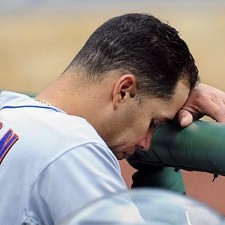
I have to laugh at the idea I raised before the season. This year, I suggested, the Mets could avoid the collapse they suffered in 2007 and again in 2008 by having an 18-game lead with 17 games to play. They apparently found that goal too daunting and decided it would be easier to be 18 games behind the Phillies with 17 to play.
That’s where they are headed, and they have shown no signs of doing otherwise. The team’s performance has utterly frustrated their fans, who want everyone fired if not drawn and quartered. Frustration prompts the fans to become irrational as they search for the appropriate areas to place blame.
They refuse to accept the myriad Mets injuries as a reason for the team’s poor performance. And even if the Mets have incurred one major injury after another, they should have gone out and replaced those players with others of equal ability, as if those players are stocked somewhere waiting to be plucked off the shelf by teams in need.
Let’s be realistic. Teams that reach the playoffs usually are those that have avoided serious or multiple injuries. Good teams that don’t get there often are those that have been shortcircuited by injuries.
Based on the latest figures available from Major League Baseball, the Mets this season have lost 657 days to the disabled list, second most only to the San Diego Padres’ 793 days.
The Mets’ list includes a host of significant players. First baseman Carlos Delgado, shortstop Jose Reyes, center fielder Carlos Beltran, starting pitcher John Maine and setup reliever J.J. Putz are currently on the list.
At other times this season, catcher Brian Schneider and the then right fielder Ryan Church were on the list, as were two replacements for injured players, shortstop Alex Cora and center fielder Angel Pagan (twice), primary starter Oliver Perez, and a substitute starter, Tim Redding.
Fernando Nieve was in the rotation as a substitute starter, tore a thigh muscle running to first base and wound up disabled. Two other replacements, infielder Ramon Martinez and outfielder Fernando Martinez, were also injured and are on the disabled list. Gary Sheffield, whose signing was criticized because of his age but who has been an important part of the offense, injured his leg running in the outfield but was not out on the disabled list immediately.
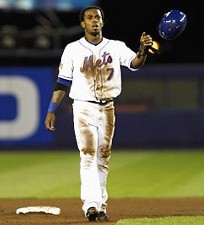 It’s not just the number of players who have served disabled time. It’s how much time they have served. Delgado has been out since May 11, Reyes since May 23, Putz since June 5, Maine since June 12, Beltran since June 22. When Perez was out, he was out for two months.
According to the Mets, they have had their planned pre-season lineup on the field only once this season. That was very early, in their 11th game of the season, when Johan Santana beat Milwaukee, 1-0, on April 18.
The Mets say they have also figured that the Phillies have had their planned lineup start more than 60 percent of their games.
Are teams to blame for their own injuries? Some disgruntled Mets fans would argue that they are, that the players haven’t been properly conditioned. George Steinbrenner used to take that position in the face of injuries to Yankees players, but teams engage in so much conditioning these days that it’s hard to blame the trainers or the conditioning coaches.
If the Mets can be blamed for anything, it might be what appears to be their coddling of Perez, their 27-year-old left-hander, whom general manager Omar Minaya thought had such a promising future that he gave him a three-year, $36 million contract last winter, passing up the opportunity to sign a more stable starter like Derek Lowe or Randy Wolf.
Minaya didn’t like the idea of giving Lowe, a 35-year-old pitcher, the four-year contract he wanted (Atlanta gave him $60 million), and he didn’t think enough of Wolf, a 32-year-old left-hander, who would have been a far more economical signing. Los Angeles gave him a one-year contract for $5 million.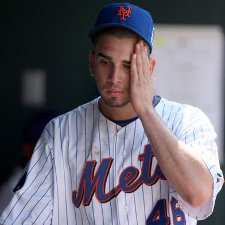
I will admit that when the Mets initially acquired Perez and he produced a 15-10 record in his first full season with them in 2007, I liked his future. He was only 26, he was left-handed (left-handers are thought to develop more slowly) and he had pitched a terrific season for a poor Pittsburgh team in 2004, compiling a 2.98 earned run average, fifth lowest in the league, and striking out 239, fourth most in the N.L., in 196 innings.
Perez, though, has demonstrated no aptitude for improvement. His 2008 season was worse than 2007, and that’s when the Mets should have seriously considered letting him go as a free agent. This year has been only worse as he has regressed into some previous stage of development.
After five starts this season he was sent to the minors, where it was discovered he had a knee problem. Two months later he returned to the Mets with a healthy knee but a still questionable arm. In three starts he walked 17 batters in 17 innings, giving him 41 hits and 38 walks in 38 2/3 innings for the season and a ratio of 19 baserunners per nine innings.
After his third start back the other day, after he walked six and hit a batter in six innings in a 4-0 loss to Washington, the N.L.’s weakest team, manager Jerry Manuel found something positive to say about Perez.
“His pitches had life on them,” he said. “Some of them were okay. He gets away from his sequence and can’t get back to it. I think he’s fine. Obviously 17 walks in 17 innings you have to play good defense. You can’t flinch on defense. You have to play good.”
Defense? How is the defense supposed to stop Perez from walking 17 in 17 innings? A pitcher who walks one batter per inning taxes the defense. He’s throwing a lot of balls, taking a lot of time to get through an inning and has the infielders playing back on their heels instead of being on their toes and ready to field anything hit to or near them.
But even Minaya spoke positively about Perez “He kept the game close,” Minaya said. “He’s improving. He’ll get better.”
I am skeptical about Perez’s chances of getting better. Instead of coddling him, the Mets might want to take a tough-love approach. Bear down, buddy, and throw strikes, or else. Unfortunately there’s not much “or else.” They can’t take his money away, and based on what we have seen of Perez, would he really care if they took his job away from him?
Perez has been part of a pitching letdown in the face of team adversity. Mike Pelfrey has become inconsistent to the extent that the Mets can’t be certain what to expect from him in any given start. Livan Hernandez has struggled some but has done a decent job. Santana is Santana, which is about the only relief the Mets get.
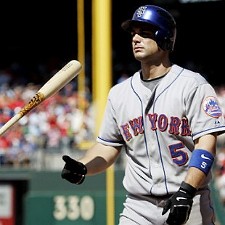 Offensively, the absence of Beltran, Reyes and Delgado has been devastating. Without them, David Wright has not been the same productive hitter, most likely trying to make up for their absence when such a thing is impossible.
Heading into their weekend series in Houston, the Mets had been shut out five times in their previous 14 games. In 10 of the previous 16 games, they had scored no more than two runs in a game. They lost 11 of those games.
The Mets have one of the two puniest offenses in the league, sharing that dubious distinction with the Padres. Each had 244 extra-base hits entering the weekend. No general manager goes out at mid-season and finds players to beef up an injury-devastated lineup, but that’s what Mets fans expect Minaya to do.
“The NY baseball world thinks he’s a complete putz,” one fed-up fan wrote in an e-mail, and he wasn’t referring to J.J.
On top of their on-field problems the Mets have had to deal with two other stories that add insult to their injuries, one questionable, one totally untrue.
The New York Daily News reported that a Mets’ vice president, Tony Bernazard, ripped off his shirt at a meeting with the Class AA Binghamton team and challenged the underachieving players to fight. The story traveled quickly and widely and had columnists calling for Minaya to fire Bernazard.
However, a report in the Binghamton, N.Y., newspaper quoted the team manager and players as saying the Daily News story was overblown. Among other things, the story said Bernazard (at right) singled out shortstop Jose Coronado and called him a vulgar name.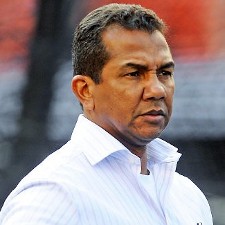
“No, he didn’t call me a name or ask me to fight,” the Binghamton paper quoted Coronado as saying.
The youngster, however, could understandably not want to say anything that could get him in trouble with the organization. It remains to be seen, following a club investigation, what really happened.
From another report, this one by SI.com, came the so-called news that the Mets had rejected a Toronto offer to trade pitcher Roy Halladay to them for four young players whom the report named.
Minaya was perplexed about the source of that report. “I haven’t even talked to them about Halladay,” the general manager said. “They called me and we didn’t exchange names.”
The Halladay and Bernazard reports were difficult enough for the Mets to have to deal with, but the injuries and the losses were far worse.
