The Houston Astros had their best day of the season Tuesday. They didn’t play.
They may have exceeded that status by the time you read this; they may have actually won a game. But they didn’t win any of their first eight games, and in losing those games they didn’t show much promise for improving greatly as the season progresses. What has happened to the Astros?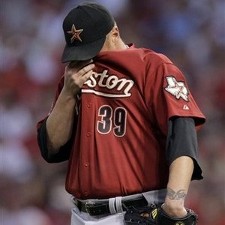
This is a franchise that is only five years removed from playing in its first World Series. Yet as good as that team was and as bad as this team is there is a link between them.
Those Astros were swept in four games by the Chicago White Sox because they didn’t hit. They batted .203 and scored 14 runs, none in a 1-0 Game 4. In losing their first eight games, the 2010 Astros batted .214, the National League’s lowest team average, and they scored a league-low 14 runs,
Their run differential of 30 was the league’s worst as were their home run total of 2, their total bases total of 75, their 57 hits, 8 walks, .282 slugging percentage, .239 on-base percentage and 1 stolen base.
The last team that lost its first eight games, according to Elias Sports Bureau, was the 2003 Tigers, who lost their first nine and then a lot more games, 119 for the season.
Bob Waterman of Elias recalled the Orioles’ memorable 21-game losing streak at the start of the 1988 season. The Orioles fired their manager, Cal Ripken Sr., after the first six games, then went on under Frank Robinson to lose another 15 in a row.
I mentioned that losing streak to Ed Wade, the Astros’ general manager, and he laughed. “Navigating through a seven-game losing streak is bad enough,” he said before the Astros’ eighth game. “Thinking about losing streaks isn’t anything we want to do.”
Wade is in his third year as general manager. He replaced Tim Purpura, who became general manager when Gerry Hunsicker resigned after the 2004 season, ending his productive nine-year tenure.
Hunsicker’s departure triggered the Astros’ decline. The 2005 team that went to the World Series was largely Hunsicker’s creation (he signed Roger Clemens and Andy Pettitte, among others), and his successors have not done the job that he did.
Hunsicker left the Astros because he grew weary of the suffocating hand of the owner, Drayton McLane Jr. Their clashes over players eventually wore Hunsicker down. Their relationship has also been described as a clash of egos, a situation that has existed elsewhere, but when an owner hires a general manager to run his baseball operation, if the owner wants to give the general manager a chance to succeed, he has to stay in the background and let his man do his job.
A good example of an owner who did it and is doing it the right and intelligent way is in Minnesota. Carl Pohlad let Andy MacPhail and Terry Ryan do their jobs, and they created championship teams. Where baseball was concerned, Pohlad had no ego. His son Jim, who assumed command of the Twins after his father died last year, learned well from his father’s example and stays out of baseball personnel decisions.
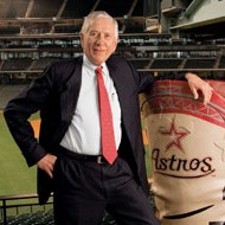 McLane has not recognized that he doesn’t know as much baseball as his general manager should – otherwise, why hire him – and has interfered with the general manager’s ability to do his job.
McLane denied that there was any conlict between him and Hunsicker. “He was there nine years and we had great success,” McLane said in a telephone interview. “If we had problems, he wouldn’t have been there for nine years. We were great friends.”
Why did Hunsicker leave?
“I just think he felt that’s not where he wanted to be in his career,” McLane said.
“I think he had run the gamut of the job and he has chosen not to be general manager again.”
Hunsicker is senior vice president of baseball operations for the Rays, where he seems to be happier and more at peace than he was in the Astros’ operation.
Complicating the sometimes confusing operation is the presence of Tal Smith as the team’s president. A former general manager himself, Smith has long had a curious status in baseball.
When McLane’s predecessor as owner, John McMullen, fired Smith as general manager in 1980 for insubordination, Smith started his own company, Tal Smith Enterprises, whose primary functions were representing other teams in salary arbitration and getting his son, Randy, a job as general manager (with the Padres).
In McMullen’s negotiations to sell the team to McLane in 1992, he got McLane to agree not to rehire Smith, but in 1995 he did. And even when he was an Astros’ executive, Major League Baseball permitted Smith to continue to handle salary arbitration cases for other teams. Conflict of interest? Baseball doesn’t know what the term means.
As the Astros’ president, Smith fired Purpura as general manager in 2007 and replaced him with Wade, a move that was totally expected because Smith and Wade had a long-term relationship.
When Smith was the Astros’ general manager, Wade worked in the public relations department. After Smith was fired, Wade left and joined Tal Smith Enterprises, where he remained until joining the Phillies as assistant to the general manager. He was named general manager in 1997 and served in that role for eight years.
Not long after Wade became the Astros’ general manager, he made a series of questionable trades. In one he sent closer Brad Lidge to the Phillies, for whom he would be perfect (48 saves in 48 chances) in the team’s World Series championship season of 2008.
A month later Wade acquired shortstop Miguel Tejada a day before he was named in George Mitchell’s report on steroid use in baseball. Two months after that deal, Wade signed pitcher Shawn Chacon, who in June of the following season became embroiled in a heated dispute with Wade, grabbed him by the neck and threw him to the ground.
Despite the questionable moves, the Astros enjoyed a winning season in 2008, 86-75, but plummeted to 74-88 last season, suffering from a lack of offensive punch and too much pitching ineffectiveness. This season they picked up where they left off.
Asked what has happened to the Astros since their World Series season, Wade said, “I can only speak to this year. We got out of the gate slowly offensively. We’re in a collective slump and it’s magnified because it’s the start of the season. We’ve had chances to build leads and overcome deficits and haven’t done it.”
Wade noted the absence of the team’s most productive hitter, Lance Berkman, who had arthroscopic knee surgery March 13. That’s something that sets the poor start aside from last year’s disappointing play, Wade said.
“I think it’s completely separate,” he said. “I think the way we’ve struggled with men in scoring position is different from last year. The guys who aren’t producing have good track records. They had good springs, but the bell sounded and we haven’t been productive.”
The Astros may be two tolls of the bell away from being counted out for the season.