The confluence of a series of home runs and other related events the past week stirred memories and thoughts of past home runs and other related events.
Featured in these developments were Chris Davis, Brady Anderson, Barry Bonds and Wladimir Balentien.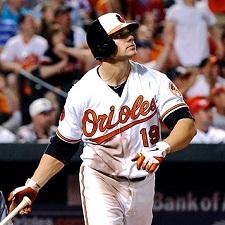
By slugging his 50th and 51st home runs, Davis tied and broke Anderson’s head-scratching Baltimore Orioles’ franchise record and rekindled the long-dormant debate over how Anderson hit all of those home runs in 1996.
By hitting his own pair of home runs, Balentien raised his total to 57, breaking Sadaharu Oh’s legendary Japanese record of 55 and prompting another kind of question: Why hasn’t anyone raised the steroids question?
Maybe it’s because baseball people and fans learned that it’s not the players who are juiced but the balls. In June, the Associated Press reported, Japanese baseball officials said they had the balls made to be livelier without telling the players. The balls, the AP said, resulted in a dramatic increase in home runs.
OK, but Balentien becomes the chief beneficiary of the livelier balls?
He is a 29-year-old native of Curacao, the Caribbean island that produced Andruw Jones, Hensley Meulens and Kenley Jansen. An outfielder, he played 70 games for Seattle and Cincinnati over three seasons (2007-9), and he hit 15 home runs.
There was a time when Japanese pitchers didn’t allow foreign players to break Oh’s record, which he set in 1964. They deliberately walked Oh’s challengers rather than give them a chance to hit home runs.
Randy Bass hit 54 homers in 1985 and Tuffy Rhodes (2001) and Alex Cabrera (2002) clouted 55 each. The walks ensued.
It’s not likely that anyone will break Oh’s career record of 868, but then it was unlikely that anyone would break Henry Aaron’s career major league record of 755. But along came Barry Bonds, who bulked up on flaxseed oil and whacked 258 homers in a five-year period at ages 36-40, including a single-season record 73 at baseball’s senior-citizen age of 37.
Coincidental with Balentien’s Japanese feat, Bonds lost his appeal of his 2011 conviction for obstructing the government’s drug case in the Balco prosecution. Bonds said he planned to appeal the decision of the United States Court of Appeals for the Ninth Circuit, but in the meantime wanted to begin service his sentence, which was 30 days’ house arrest and two years’ probation.
 Bonds clearly got lucky and owes his freedom to his former trainer, Greg Anderson, who refused to testify against him and wound up serving far more time in prison for contempt of court than Bonds will serve.
On the other hand, few people seem to believe Bonds’ denial that he used steroids, demonstrating that you really can’t fool all of the people all of the time. If people believed Bonds, he would be in the Hall of Fame and manufacturers of flaxseed oil would be doing an ungodly amount of business.
At the time Anderson hit 50 home runs, in 1996, no one was talking about steroids or suspecting players of using them, though as it developed, some clearly were. Was Anderson among them? He has always denied it, and the circumstantial evidence isn’t as voluminous as it is in Bonds’ case.
However, his 50 home runs and other offensive statistics from that season stick out like the proverbial sore thumb.
In his first eight seasons in the majors Anderson hit a total of 72 home runs. In his six seasons after his 50 year he hit 88 homers. In 1996 he drove in 110 runs and had a .637 slugging percentage. Before and after, his best single-season numbers were 80 r.b.i. and 81 r.b.i., and his next best slugging percentage was .477.
As weird as the 1996 performance seemed to be as produced by Anderson, equally weird was his reversion to his previous levels of hitting.
Did he decide to use steroids, then decide after a year of use that he didn’t like the threat they posed to one’s health? Did he decide he didn’t like cheating? Did someone close to him who knew he was using prevail upon him to stop?
Efforts to reach Anderson by telephone to ask him these questions and others were unsuccessful. However, he is the Orioles’ vice president of baseball operations and was at the game in Boston when Davis hit his record-breaking 51st home run.
“I love it,” Anderson told the Baltimore Sun. “Chris and I have been really close since he came here. … I feel like a part of it. Having our names mentioned together is thrilling, and actually seeing him do it, I think I have a little more appreciation for the fact that I did it. I think when you’re doing it, I don’t think you think it’s that impressive.
“I know I was obviously having my best year, but I wasn’t thinking, ‘Wow, this is amazing.’ I never thought that. It seemed pretty normal. I found out in subsequent years that it wasn’t normal. But watching Chris do it, you think about the consistency of which you need to hit home runs to get 50. Seeing him do that kind of reminded me of how consistent you need to be.”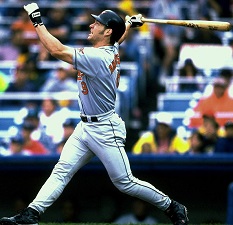
Their careers, Anderson added, have somewhat paralleled each other: both were top prospects and both flourished after trade-deadline deals to the Orioles.
“He’s a really good hitter,” Anderson said. “I told him, ‘Dude, I can see you contending for a batting title one year,’ and he said, ‘Exactly, so do I.’ So the fact that he’s been hitting around .300 all year, I’m as happy about that as anything. But that goes hand in hand. His home runs and his average, same as mine did.”
There is, however, a difference in the prelude to their hitting 50 home runs. Davis established himself as something of a home run hitter in the minor leagues and hit 33 last year in his first full season in the majors. Given the way he has started, Davis isn’t likely to fall to low double-digit homers as Anderson did, plunging from 50 to 18 the next season.