The people who work for Commissioner Bud Selig have obviously taken seriously his recent warnings on the economy. Depending on who is counting, anywhere from 19 to 26 reporters and other people who work for mlb.com are the first to feel the effect of the warnings.
The layoffs, or dismissals because people who are laid off sometimes come back and these people don’t expect to come back, were disclosed by some of the people who lost their jobs. They received the news in the form of layoff packages Friday, and Dinn Mann, an mlb.com executive vice president, told more fortunate employees about the layoffs in a conference call Friday evening.
Matt Gould, vice president for corporate communications of Advanced Media, said 19 employees were let go, but the package the laid off workers received listed 26 positions that were being eliminated. Four of the 26 employees were listed as being offered another role with the company. Those positions were called “multimedia hosts,” presumably video-related hosts.
By reducing its work force of what Gould said numbers more than 400, mlb.com is in step with many newspapers. In the past six months, the newspaper industry has slashed its work force by hundreds, if not thousands.
The notification received by affected workers said Advanced Media “is reducing and consolidating operations and as a result is eliminating certain positions.”
The layoff packages did not cite anyone by name, only by position and age, the routine for such notifications. Besides reporters other jobs named included producer, technical producer, director of entertainment content, streaming media lead, director QA, editorial producer, project manager, director FET, information architect, associate producer, manager IT support, senior visual designer and visual designer.
Bob Bowman, chief executive officer of Advanced Media, said in a telephone interview Saturday night that he did not anticipate a second layer of layoffs.
“I think every growing tree needs to be trimmed,” he said. “Not to minimize the experience the roughly 19 folks went through, but it bodes well for the business and the folks that are there.”
In an earlier interview, Mann said, “We’re trying to stay flat on expenses year over year. When you make room for standard salary increases and what you need to spend on a technological basis, we’re holding true to that. We’re not necessarily in a downturn, but we’re trying to be strategically sound.”
Mann attributed the moves to a combination of factors, including start-up costs for Major League Baseball’s television network. “We’re adding a lot of people to do a lot of things,” he said, “some of it redundant with what we’ve been doing the last seven years.
Some of this is attributable to that, some attributable to growing pains. The economy is among the factors.”
Gould quoted Bowman as previously explaining that “we’ll be reducing some of our prices to enable fans to continue enjoying baseball live on their computers. In turn, you have to make decisions on expenses.”
“Unfortunately we lose some employees in the process,” Gould added.
Gould said prices have not been determined for next season. Last season the basic plan was $80 and the premium plan $120 for watching live games on a computer throughout the season.
Reduced prices are always good for consumers, but why do they have to come at the expense of people who are 40, 50 or 60 years old and will have little chance of finding work elsewhere?
Something seems to be out of kilter here. This is a sport whose revenue reached a record $6.5 billion this year and which Selig deservedly boasts about in his comments on the state of the game. But it’s a sad state when people are forced out into the ranks of the unemployed just so the corporation can make more money.
Advanced Media, of which mlb.com is part, has been a major part of baseball’s dramatic revenue growth. The new television network promises to add many more millions to baseball’s total revenue. Why, then, should people with families to feed have to lose their jobs and have their lives torn asunder?
Mann declined to estimate how much revenue Advanced Media accounts for and how much of that revenue dismissing those 19 or 26 employees of a staff of 400 plus would save.
Gould said Advanced Media doesn’t disclose its revenue but added, “We did experience growth from ‘07 to ‘08, about 20 to 30 percent, but it was not at the rate we’ve had in the past.”
Fantasy Baseball
With the winter meetings upon us, fans need a large dose of caveat emptor. I like that phrase because it’s not often I get to use my high school Latin.
Caveat emptor is a warning that means buyer beware, and I’m not suggesting it for teams in search of free agents this week, though they should always beware. It is issued for fans and the flood of pre-meetings speculation that is offered by people who think of themselves as experts, i.e. (there’s another Latin phrase, short for id est, or that is) newspaper and television reporters and columnists.
As you read and hear names of players who these so-called experts list as players who could be traded during the winter meetings, read or listen with great skepticism. Chances are that very few of the players mentioned will be traded. That’s the way it has always been.
For example, two years ago a swap of stars that was the subject of serious speculation on mlb.com had the Red Sox sending Manny Ramirez to the Padres for Jake Peavy. The Red Sox traded Ramirez to the Dodgers last July 31, and the Padres still haven’t traded Peavy, not that they haven’t tried.
 Peavy is probably the most popular piece of speculation for these meetings but this time with good reason. Shedding his $11 million salary in their determination to reduce their payroll is the Padres’ No. 1 priority.
The pitcher is again mentioned prominently in a meetings preview on mlb.com, but he is only one of 25 names in the preview. His now former teammate, Khalil Greene, also appears on the list, and he has already been traded, on his way to St. Louis as general managers were traveling to Las Vegas.
But how many of the others mentioned in the preview will change teams this week?
Many baseball writers feel compelled to compile such lists before winter meetings because they feel they owe it to fans or they want to show off their expertise. They are fortunate no one compiles a batting average on their accuracy.
Some people would argue that there’s nothing wrong with speculating on which players might be traded. It’s all harmless fun, they would say. But it really isn’t. It’s irresponsible and it’s misleading.
Worse are the trades that are writers’ works of fiction. Needing something to write, a writer decides that player A would be a good guy to trade. Now he has to come up with Player B to complete the deal. When he has the match, he decides it’s a good deal and writes about it as if the two teams were discussing it.
This sort of thing especially occurs during the meetings because the writer is in some exotic resort or hotel and feels he has to justify his newspaper’s expenses.
One well known baseball writer, whom I will not identify, became so outrageous with his creative trading that a general manager decided to leak reported trade talks to him to see how far he would go with them. He went so far as publishing them.
This is not to say that everything that comes before and during the meetings can’t be believed. The reader or the listener just has to be careful with what he chooses to believe.
Years ago I heard two basketball fans talking about the N.B.A. coverage of Peter Vecsey of the New York Post. One of the fans remarked how much he enjoyed Vecsey’s reports.
“But 80 percent of the stuff he writes isn’t true,” the second fan said.
“Yeah,” the first fan countered, “but I enjoy reading it anyway.”
It’s possible that the baseball writers who alert fans to players who could be traded during the meetings are just doing their jobs. They scour the rosters for likely trade possibilities and advise their readers what to look for. But most do it in a way that says “pay attention here; I know what I’m talking about” when they really don’t. The more names a writer mentions the better his chances of being right on one or two of them.
One writer recently circulated among his colleagues a list of about 130 players he said have been identified as possibly being available for trades this winter. I don’t know if he produced such a list last winter, but if he did, was Carlos Quentin’s name on it?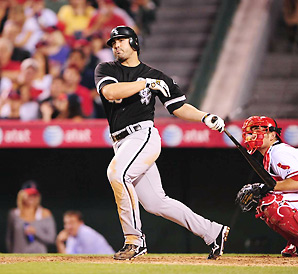
Hardly anyone had heard of Quentin at this time a year ago, but he turned out to be the most significant player traded during the meetings, going from the Diamondbacks to the White Sox for a minor league infielder, Chris Carter.
With 36 home runs and 100 r.b.i. in 130 games before he broke his wrist Sept. 1, Quentin was a serious contender for the most valuable player award, and he was instrumental in the White Sox division title. As it was, he finished fifth in the m.v.p. voting.
At the other end of the spectrum, the most shocking development with a major trade was the Tigers’ inability to ride their stunning meetings trade to that same division’s title. As soon as the Tigers acquired Miguel Cabrera and Dontrelle Willis from the Marlins, they were virtually conceded the American League pennant. But it didn’t happen. They lost their first seven games and never recovered.
Two other teams, on the other hand, made trades before the meetings that helped produce division titles. In fact, the Phillies, who obtained Brad Lidge and the Rays, with the addition of Matt Garza, wound up in the World Series.
If you’re looking for lightning to strike any teams next season, some of the few trades that were made before the meetings sent Matt Holliday to the Athletics, Kevin Gregg to the Cubs, Nick Swisher to the Yankees and Mike Jacobs and Coco Crisp to the Royals.
Will Patience Pay?
As days and weeks roll by and the Mets have not taken any steps to get the starting pitcher they need or the good new relievers to replace their bad old relievers, their fans are getting nervous. They see other teams making moves and ask, in voices of increasing volume, why aren’t the Mets doing anything. General Manager Omar Minaya is trying their patience.
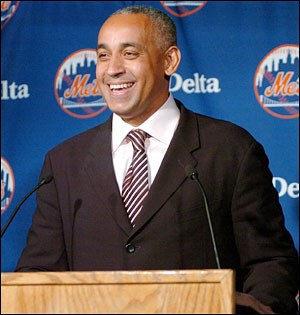 For example, the Braves obtained Javier Vazquez for their starting rotation. The Mets were in talks with the White Sox, but Minaya, who had Vazquez in Montreal and traded him to the Yankees, doesn’t like him enough to give the White Sox the premium young prospect they wanted for him, 20-year-old outfielder Fernando Martinez.
In addition, consider the Mets’ assessment of Vazquez, who has been traded four times in five years: When it’s crunch time, he’s not going to be there.
Teams have signed four relief pitchers, none a closer: Jeremy Affeldt and Bob Howry with the Giants, Trever Miller with the Cardinals and Doug Brocail with the Astros. The Mets had no interest in Brocail because of his age (42 in May), and as ineffective as their relievers were this past season, the Mets feel they are better than the relievers who signed.
In other words, the Mets don’t want to make changes just for the sake of making changes. When the deals they feel are right come along, whether via free agency or trades, Minaya will make them.
For starters, they would like to bring back Oliver Perez, who has pitched for them, sometimes brilliantly, the past two and a half seasons, but his agent, Scott Boras, is looking for five or six years. That would not be a good contract for anyone to give Perez, who needs to be constantly motivated.
The Mets, like the Yankees and the Red Sox, like Derek Lowe, but Boras, also his agent, is said to want $18 million a year – “Barry Zito money,” as one general manager termed it. The Giants made a mistake giving that money to Zito; why should anyone repeat the mistake with Lowe?
Are Pirates Willing to Pay for Wilson?
A report that the Dodgers were talking to the Pirates about their shortstop, Jack Wilson, said the Dodgers wanted the Pirates to pick up a substantial share of Wilson’s salary. Wilson has a $7.25 million salary for the last year of his three-year contract plus a $600,000 buyout of an option for a fourth year.
Asking the Pirates to pay part of a departing player’s salary sounds comical. According to the Players Association’s 2008 salary study, the Pirates had the next-to-the-lowest average salary, $1.2 million, while the Dodgers ranked fifth with $4.37 million. Converted to total payroll, the Pirates’ was $34.8 million, the Dodgers’ $157.4.
Maybe the huge difference is why the Dodgers would want the Pirates to pay a large part of Wilson’s salary, but if the Pirates wanted to spend money, they wouldn’t be trying to trade Wilson in the first place.
Latest Chapter of Manny’s Saga
As interest in Manny Ramirez seemed to remain non-existent, speculation grew that maybe Manny would accept the Dodgers’ offer of salary arbitration, have a huge one-year contract, then become a free agent again a year from now. There are, however, a couple of problems with that idea.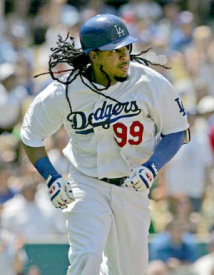
For one, Scott Boras is Ramirez’s agent, and he doesn’t play the free-agent game that way. Extraordinary circumstances would have to exist for him to pursue that plan. But a two-part problem involves Ramirez himself.
First, he would be a year older next winter, 37 going on 38 two months into the 2010 season, and second, he would have to play hard throughout the 2009 season to show prospective 2010 and beyond employees that he is worth the big contract he and Boras would want.
This past season Ramirez saved his hustling play for the last two months, after the Dodgers acquired him from the Red Sox.
Boras may yet pull one of his magic tricks and get Ramirez the kind of contract they want, but maybe Boras erred in getting the Dodgers to agree to delete the two option years in Ramirez’s contract at $20 million a year. After Ramirez carried the Dodgers into the playoffs, the Dodgers would have been happy to pay him $20 million a year for two years.