The man who traded Tim Hudson, Mark Mulder, Danny Haren, Rich Harden and Joe Blanton, not to mention Aaron Harang, Ted Lilly and Corey Lidle, is not likely to add to that list any time soon the pitchers who currently make up the Oakland Athletics’ starting rotation.
Billy Beane won’t be looking to trade them – unless they fail to do the job he expects them to do – because he won’t have to. That is, he won’t have to until they become more expensive.
The Oakland rotation has four rookies and a second-year major leaguer. Their ages are 25, 24, 22, 22 and 21. Their ages and their experience help explain why the Athletics are in last place in the American League West and scuffling for the third successive season. Injuries, Beane noted, provided another reason.
“It’s obvious we’re where we are because of the disabled list,” Beane said. “No. 2, there are no shortcuts. There’s very little margin of error. We came into this season with the youngest pitching staff in baseball, and we’ve become younger.”
Justin Duchscherer, who is 31, was supposed to start, but he has been on the disabled list all season following elbow surgery. He might be back after the All-Star break.
If the A’s are lucky, they’ll have the disabled half of their infield plus the opening-day first baseman back before the break. Second baseman Mark Ellis has a strained calf, third baseman Eric Chavez a herniated disc in his back and Nomar Garciaparra a calf injury.
Joey Devine, who would have had a chance to be the closer, is out for the season after elbow surgery in April.
“Injuries have devastated us,” Beane said. “It’s been a common theme for us. Our margin of error is so small. To be able to compete and rebuild at the same time is difficult. There’s no shortcuts.”
Teams in Oakland’s economic position find it especially difficult to overcome injuries because their depth isn’t deep and they don’t have strong replacements readily available.
For now, though, the starting rotation’s youngsters are healthy. The senior citizen of the rotation, a 25-year-old left-hander, Dallas Braden, is the lone non-rookie. The rookies are left-handers Josh Outman (24) and Brett Anderson (21) and right-handers Trevor Cahill (21) and Vin Mazzaro (22).
Mazzaro (below) is the most recent addition, making his first start last Tuesday in a 5-0 victory over Chicago, allowing three hits in five and a third innings. He was a third-round pick in the 2005 draft, making him one of three Oakland starters who are products of the draft. The Athletics selected Braden in the 24th round of the 2004 draft and Cahill in the second round in 2006.
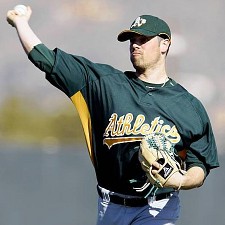 The Athletics obtained Anderson in their 2007 trade with Arizona for Danny Haren and Outman in their trade of Blanton to Philadelphia last July.
Beane had been considered a master of building contending teams with little money, but once the Athletics stopped contending after the 2006 season, people began questioning his practice of trading their best pitchers. For example, he traded Hudson and Mulder in the space of 48 hours in December 2004, got Haren in the Mulder deal, then traded Haren three years later.
“It’s a fair question, and it’s always been a matter of debate,” Beane said when asked about his pitching trades. “We couldn’t afford to keep all those pitchers. We still would have had offensive problems and just had a higher payroll. It would have been the worst situation for us – a higher payroll with no future.”
“And,” he added, “we would have had no farm system. Our farm system had become a bit depleted and we needed the return those pitchers gave us.”
The Athletics have concentrated on developing young pitchers because, Beane said, “if you look at mid and small-markets, the ones that have had sustainable success for any amount of time have done it from developing young pitchers. Look at Minnesota. It’s the most important building block.”
But even if a team develops good young pitchers, it doesn’t have long to compete with them on the pitching staff.
“Once you get these kids up and they establish themselves, the clock starts ticking,” Beane said in a telephone interview. When I mentioned a six-year window because players can become free agents after six years in the majors, Beane said, “That’s not true. You don’t really have six years. For small-market teams to maintain success for six, seven years is pretty hard to do.”
Beane alluded to players’ becoming eligible for salary arbitration after three years. Salaries start escalating significantly at that juncture.
“There is a narrower window now than before,” he said. “It gets shorter and shorter. If you have something in place, you want to take advantage of it as soon as you can.”
The Athletics won four division titles and the wild card once in a seven-year span, from 2000 through 2006. They followed that stretch, though, with two losing seasons going on three. The division has turned upside down with the Texas Rangers, long a loser, catapulting to the top. The Rangers, Beane said, are legitimate.
“Texas has done a great job of securing good young talent the last four, five years,” he said. “They’ve been aggressive internationally, and they signed all their draft choices regardless of cost. This is a good year for them. The Angels have injury problems. I think they’re for real and I think they’re going to get better as the year goes along and the years go along.”
ORTIZ BAT OPENS AN EYE
Well, that sure hasn’t worked. Trying to light a spark under David Ortiz, his struggling designated hitter, Terry Francona dropped him from third to sixth in the Boston batting order.
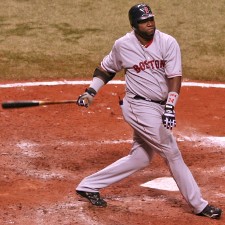
At the time of the change, Ortiz was hitting .195 in 40 games with one home run and 18 runs bated in. Eight games into his new spot in the lineup (before Friday), Ortiz was hitting .152 with 5 hits in 33 at-bats. He had not hit any more home runs, and he had knocked in two runs with the same hit.
At that point Ortiz had created a unique circumstance. He had a total of 187 at-bats, and he was hitting .187. Elias Sports Bureau found no other player who could match that coincidence. Chris Young of Arizona came closest with 174 at-bats and a .172 batting average.
But then life in the batter’s box began to change for Ortiz. He had one hit against Texas Friday night and two hits, including a home run, Saturday night. Signs of life seemed to be stirring in Ortiz’s bat.
GROWING PAINS FOR YOUNG PITCHERS
Fausto Carmona is in the minor leagues again. He can’t seem to stay away despite the sensational season he had as a 23-year-old in 2007 when his 19 victories and 3.06 earned run average were each second best in the American League.
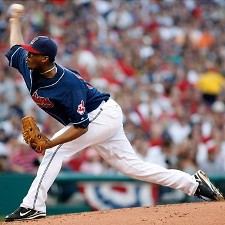 Cleveland sent Carmona to the minors last Friday with a 2-6 record and 7.42 e.r.a. He has continued having difficulty matching his 2007 performance, struggling last season with an 8-7 record and 5.44 e.r.a. He pitched effectively in his first 10 starts (4-2, 3.10) but suffered a hip injury and was not the same after he returned from minor league rehabilitation July 26.
Felix Hernandez was another young right-hander (21) who had an outstanding season in 2007, compiling a 14-7 record for Seattle. But he, too, struggled in 2008 with a 9-11 record even though he lowered his e.r.a. from 3.92 to 3.45. This season has treated him better. At week’s end he had a 5-3 record and 3.22 e.r.a.
Zach Duke of Pittsburgh also is having a better season than the three seasons he endured following his outstanding debut in 2005. In 14 starts as a 22-year-old rookie that season, the left-handed Duke had an 8-2 record and 1.81 e.r.a. But he proceeded to have records of 10-15 (4.47 e.r.a.), 3-8 (5.53) and 5-14 (4.82), and the Pirates wondered if they would see the rookie Duke again.
This may be the year that happens. In his first 11 starts this season, Duke has a 6-4 record and 2.62 e.r.a.
Francisco Liriano of Minnesota hasn’t been so fortunate or effective since his sensational season in 2006. Emerging from the bullpen in mid-May, the 22-year-old left-hander had a 12-3 record and 2.16 e.r.a. But an elbow injury curtailed his season, and he missed all of 2007 after ligament transplant surgery.
Liriano has been unable to recapture his 2006 magic. Last year he had a 6-4 record and 3.91 e.r.a. in 14 starts, and in 12 starts this season he has a 2-7 record and 6.12 e.r.a.
PHILLIES’ NEXT M.V.P. IN WAITING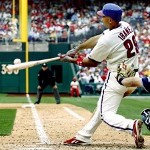
With his terrific offensive season, Raul Ibanez has established himself as the early leader for the National League most valuable player award. Obviously there’s a lot of season left, but Ibanez has been impressive with league-leading figures (entering the weekend) of 54 runs batted in, 145 total bases, 35 extra-base hits and 44 runs scored. In addition, he was second with 19 home runs and a .687 slugging percentage.
If Ibanez should win the award, he would be the third Philadelphia player to win it in four years. But the Phillies wouldn’t set a precedent for having different players win the award so frequently.
The Cincinnati Reds had their players win the award in 1938 (Ernie Lombardi), ‘39 (Bucky Walters) and ‘40 (Frank McCormick), and the St. Louis Cardinals won in ’42 (Mort Cooper), ’43 (Stan Musial) and ’44 (Marty Marion).
CHALLENGE TO POSSIBLE STRASBURG SCENARIO
Major League Baseball holds its annual draft starting Tuesday, and the most intriguing element of it will be whether the Washington Nationals take Stephen Strasburg with the first pick. Strasburg is the hard-throwing pitcher at San Diego State College who scouts say is the best pitching prospect in years.
 I believe the Nationals will select him, whether or not they think they can sign him. Their dreadful season has already discouraged their fans, wiping out the present. If they were to pass on Strasburg, they would be telling the fans forget the future as well.
If they select him and make an earnest effort to sign him, their fans will most likely understand if they are unable to sign him because of the contract demands of his “adviser,” Scott Boras. I say adviser rather than agent because if drafted players have agents, they lose their college eligibility. But an adviser really is an agent.
Last week I wrote that a baseball executive had said if Boras couldn’t get what he wanted for Strasburg he would sign him to a one-year contract in Japan, have him play there next season, then return to the United States as a free agent. The executive cited the Red Sox signing last winter of a Japanese amateur free-agent pitcher, Junichi Tazawa, to a three-year contract.
But Tazawa wasn’t subject to the M.L.B. draft because Japanese players are excluded from it. Strasburg, a United States resident, is subject to the draft.
“Our view is that player would still be subject to the draft,” said Rob Manfred, M.L.B.’s No. 1 labor executive.
Boras has not said anything publicly about his plans for an unsigned Strasburg – he has not returned calls seeking comment – so it’s not known if he will attempt the Japanese evasion trick. But, Manfred said, “If he tried to take a contrary position, that’s an issue we would litigate.”
