On the 20th of next month, the owners of the Boston Red Sox will celebrate the 10th anniversary of their ownership (time sure flies when you’re having fun, doesn’t it?). It has been a decade of mixed results.
In the third year of the ownership, the Red Sox ended their infamous 86-year streak of not winning the World Series, and four years later they won again for emphasis. However, the Red Sox have not played post-season games the last two years, and this year they suffered one of the worst September collapses in history.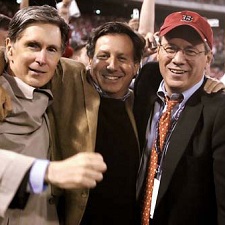
But let’s engage in a harmless fantasy. Before John Henry, Tom Werner and Larry Lucchino could gain ownership of the Red Sox, they had to outbid other interested bidders. Some skeptics didn’t believe they outbid James Dolan, who was supported by John McMullen, former owner of the Houston Astros, but Commissioner Bud Selig favored the Henry-Werner-Lucchino group, and whomever Selig favors in a team transaction wins the prize.
There was at least one other bidder who did not have Selig’s support, a Boston real estate magnate named Frank McCourt. Even though he lost out to Henry-Werner-Lucchino, McCout was not discouraged in his effort to buy a baseball team. Only two years later the resilient McCourt bought the Los Angeles Dodgers from the News Corp. of Rupert Murdoch.
Selig didn’t have a favorite in that race, very likely because it had no other entrants.
However, McCourt’s Los Angeles honeymoon ended after seven years, at about the same time as his marriage to Jamie McCourt was imploding. Frank McCourt has now agreed to sell the Dodgers and take his exist from Major League Baseball.
McCourt is the central character in my little fantasy. What might have happened if McCourt had succeeded in buying the Red Sox?
For one thing, M.L.B.’s ownership lineup would be different, not just in Boston and Los Angeles but in two other cities as well.
John Henry would still own the Florida Marlins, and Jeffrey Loria would own the Montreal Expos, or wherever and whoever they would be by now. Werner, once the owner of the San Diego Padres, would very likely be out of baseball, and Lucchino would most likely be the chief executive of another team in need of resuscitation, perhaps the Washington Nationals, who came into existence as a result of Henry’s purchase of the Red Sox.
Henry’s purchase of the Red Sox triggered a four-city swap. Henry owned the Marlins at the time and sold them to Loria, who relinquished ownership of the Expos to M.L.B., which ultimately sold the team to the Lerner family of Washington, D.C. and permitted a move there.
Had McCourt bought the Red Sox, Henry presumably would still be in Florida, and who knows where Loria and the Expos would be? Loria would not have sold the Expos because he liked owning a major league baseball team, but the team was in an untenable position in Montreal and had to move somewhere for its survival.
Maybe that new home would have been Washington and maybe not. The Expos became the Nationals because the Lerner family became the new owner. Maybe Loria would have wanted to move his team to Oklahoma City, where he once owned a Triple A minor league team.
A McCourt ownership of the Red Sox, however, would have had the most profound effect on the Red Sox themselves and particularly on Theo Epstein.
The Red Sox, under the Henry group, made changes to the team and to its home. After its purchase, the group had to decide whether to renovate Fenway Park or build a new park. An improved Fenway still stands and sells out every game. McCourt, a major real estate developer in Boston, might have decided to build a new edifice.
 Given McCourt’s financial problems operating the Dodgers, he might have had similar problems in Boston, which would have affected the Red Sox ability to acquire expensive free agents.
It’s also likely that McCourt would not have aggressively tried to keep up with the Yankees as Henry, Werner and Lucchino have. McCourt is not a fighter and very likely would not have had the stomach to take on the Yankees.
McCourt, for sure, would not have hired Epstein as his general manager. Epstein should be the most grateful individual for the Henry group’s getting the Red Sox because Lucchino created him. Lucchino knew Epstein as a bright young executive from their time together in San Diego and brought him to Boston, where he became royalty for those two World Series triumphs.
Epstein’s success in Boston, in turn, made him so attractive to the Chicago Cubs’ new owner, Tom Ricketts, that he hired Epstein as his president of baseball operations and gave him a 5-year, $18.5 million contract.
McCourt would have had no reason to know of Epstein and his potential, as Lucchino did, and would have hired a different general manager, who might have been as successful, but no one else had been in 86 years.
The Red Sox are the Red Sox today because of the Henry-Werner-Lucchino triumvirate. They would not be the same Red Sox had McCourt owned them. On the other hand, if McCourt were the owner, Selig would not have been in position to allow the Red Sox and the Cubs to create the fiasco they have made of the Cubs’ compensation for Epstein, who had a year left on his Boston contract.
With the two teams unable to agree on compensation after they hijacked the World Series with their negotiations – in blatant violation of the commissioner’s rules – Selig told them if they didn’t reach agreement by Nov. 1, he would decide compensation for them.
But now, just as he ignored his own policy on World Series silence, Selig apparently let it be known that the deadline wasn’t really a deadline and wouldn’t be enforced. Selig has acted much more aggressively in his desire to get McCourt out of baseball, but then, McCourt was never on his favored owners list.