My favorite Tony La Russa story has nothing to do with his managing. It’s more personal.
It happened during a World Series. I don’t remember which one it was. I just know it wasn’t one in which La Russa was managing. It was one he was attending as a fan, sitting in the stands.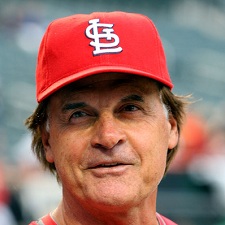
During whatever game it was, I heard my name over the press box loudspeaker system. I was being paged. That seldom happened, and I was puzzled by the page. Who would be calling me, I wondered as I headed for the press box telephone at the opposite end of the box.
Most often when someone is paged during a game, it is a phone call. This, however, was not a phone call. Standing near the phone was La Russa.
“Hey, Tony, what’s up?” I asked, completely mystified about why he wanted to see me and why it was so important that he was doing it during a World Series game.
La Russa quickly apologized for bothering me during the game and said sheepishly, “I have to go to the bathroom and I didn’t want to use the bathroom in the stands.
The bizarre moment came to mind the other day when I heard that the 67-year-old La Russa had announced his retirement after managing for 33 years.
He and the Cardinals’ top executives, who knew he was retiring, had kept his plans so quiet that when Ozzie Guillen gained his release as manager of the Chicago White Sox two days before the end of the season so he could manage the Florida Marlins, La Russa was immediately and widely mentioned as a possible successor. His St. Louis contract expiring, he could return to the team with which he began his major league managing career in 1979.
La Russa’s retirement follows the last year of three other notable stalwarts of the managing business – Bobby Cox, Joe Torre and Lou Piniella. That’s a lot of veteran statesmanship for baseball to lose in the space of 15 months. I had a lot of experience and conversations with those three gentlemen, but none of them matched La Russa’s bathroom ingenuity.
All four of those managers won the World Series, Torre the most with four, all with the Yankees; La Russa with three, two with the Cardinals, one with Oakland, and Cox and Piniella with one each. Cox managed in four losing World Series, La Russa in three and Torre in two.
The economic contrast between Torre’s teams and those of the other three managers is interesting. It’s as if Torre was managing under different rules from the others.
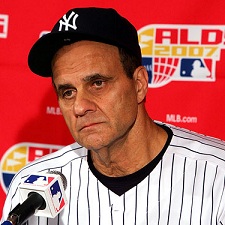 Torre managed the highest-paid teams in baseball history. The payrolls of his six World Series teams totaled $567 million. La Russa’s six World Series teams had a combined payroll of $313 million
To be fair, La Russa’s first three World Series came before payrolls exploded, but looking at another contrast, Torre’s 12 Yankees teams (1996-2007) had payrolls totaling $1.55 billion. From La Russa’s first World Series in 1988 through his last, this year, a total of 24 years, twice Torre’s Yankees’ tenure, the payrolls of his Oakland and St. Louis teams totaled $1.467 billion.
As has been proved time and again, money doesn’t automatically win championships. Good management and good managers do. The Cardinals this year didn’t rank among the top 10 payrolls; they were 11th.
When I related the payroll figures to La Russa in a telephone conversation late Saturday night, he said he found them interesting but added, “I don’t take anything away from Joe. He did a great job there.”
La Russa said he first thought of retiring last June or July.
“Looking at the factors I was paying attention to,” he said, “it was time to end this and let the Cardinals get a fresh face. With about a month to go, Aug. 28, I alerted Bill and Mo” – chairman Bill DeWitt Jr. and general manager John Mozeliak, “I told them, and they asked if I might change my mind. I said maybe, but I doubt it.”
They told no one. “We didn’t want to distract the team as long as we had a fighting chance.”
Closer to the end of the season, La Russa said, he told long-time coaches Dave Duncan and Dave McKay – “I didn’t want them to be surprised in case they had plans of their own” – and Mark McGwire “with 18 days to go because they just had triplets.”
La Russa wasn’t the most beloved manager. He had plenty of critics who said he seemed to think he was the smartest manager and let people know it. Part of that perception came from his use of unconventional strategies, such as having his pitcher bat eighth instead of ninth in the batting order.
But he obviously was a very good manager, climaxing his career with a scintillating September run that catapulted the Cardinals into the playoffs as the National League wild card and carried through to Game 7 of the World Series.
If La Russa had shortcomings, they were in his perception of people. I offer two examples, one centering on McGwire, the slugging first baseman, who played for La Russa in Oakland and St. Louis and served as his hitting coach the last two years. The other example involves the Players Association.
La Russa, who was fiercely loyal to his players, at least those he liked, induced McGwire to return to baseball after he had spent several seasons hiding out following the fallout from his “I’m not here to talk about the past” testimony at a Congressional hearing in 2005.
I spoke to La Russa at the Cardinals’ spring training camp in Jupiter, Fla., the day after that hearing and was disappointed at his reaction to McGwire’s testimony.
Prior to the hearing, McGwire had denied using steroids and La Russa had vehemently defended him against steroids accusations. McGwire’s poor Congressional performance did not soften La Russa’s support.
“I was surprised by it,” La Russa said of McGwire’s approach. “He’s made a statement where he’s denied it. I thought it was a great time for him to make that same statement. He had the biggest stage of all to say it and it looked to me like he was coached in the other direction and it surprised me.”
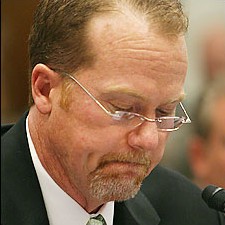 I suggested to La Russa that maybe McGwire had not repeated his earlier denial because he was speaking under oath.
“In my opinion,” La Russa said, “being under oath wouldn’t have changed what he would have said. I don’t take that conclusion; I believed him when he made the statement.”
But did La Russa think the possibility of perjuring himself was the reason McGwire had not repeated his earlier denials? “No, that’s not what I think,” La Russa said. “I just think he was overcoached. That’s what I think.”
Fast forward to October 2009 when McGwire would accept La Russa’s invitation to be the Cardinals’ hitting coach. According to McGwire, he didn’t tell La Russa at the time that he indeed had used steroids, but he said he knew he would have to do that before long.
That day came in January 2010 when McGwire telephoned La Russa before doing a national television interview in which he would admit having used performance enhancing drugs, including steroids and human growth hormone.
In his own, subsequent television interview, La Russa said he didn’t know until the telephone call that McGwire had used steroids.
“I’m really encouraged that he would step forward,” La Russa said, offering a sympathetic spin. “As we go along his explanations will be well received.”
What La Russa didn’t say was how disappointed he was that McGwire had lied to him in denying something he now had admitted. La Russa had gone way out on a limb for McGwire, and McGwire sliced it off, but La Russa didn’t comment on how foolish McGwire made him look.
Last spring La Russa made himself look foolish with misguided comments he made in discussing the pending free agency of Albert Pujols, his first baseman, whose deadline for signing a contract extension the Cardinals had not met.
La Russa blamed the Players Association, telling reporters that union officials had pressured him to hold out for a better contract than he might have wanted.
“I know what he’s going through with the union, and to some extent his representatives, because the representatives are getting beat up by the union,” La Russa said with no knowledge that any of that had happened. “Set the bar, set the bar, and that’s [bunk], really and truly. You’ve got to deal with it. It’s not the way it should be.”
Management officials have long accused the union of pressuring the best players to sign for more money as a way to raise the salary scale for everyone, but union officials have just as long denied it.
Several weeks ago, speaking specifically to that allegation, Ron Shapiro, a veteran agent, who kept Joe Mauer, Cal Ripken and Kirby Puckett with their teams instead of leaving for more money elsewhere, told me, “It’s a common misnomer that the union pushes agents to get the most money. I never had pressure from the union to get more money.”
That’s why La Russa is better off in the dugout – or the press box bathroom. Despite his retirement, he expects to be somewhere doing something. He just doesn’t know where or what.
“I’m going to work,” he said. “I just think the time in the dugout has ended.”
I suggested he might finally want to use his law degree. “I’ve had one call,” he said. “I’m going to check out everything. I’d love to open a book store. I love books. I might do that in addition to something else.”
What else might he like to do?
“I’ve always enjoyed responsibility,” he said. “You wake up in the morning and you’re ready to have at it.”
AVOIDING PETER ANGELOS?
The most intriguing aspect of the Baltimore Orioles’ search for a general manager has been the withdrawal from consideration for the job by two candidates who would have seemed to be eager to get it.
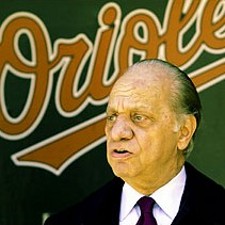 Allard Baird, a Boston Red Sox executive, was Kansas City’s general manager for six years but not since May 2006. DeJon Watson, assistant general manager of the Los Angeles Dodgers, has never been a general manager.
My first thought upon hearing of their withdrawal was that this was a Peter Angelos backlash, that they decided they didn’t want to work for the Orioles’ owner, who has driven other executives out of Camden Yards with his meddling management style.
“I really don’t have anything new to say about the situation,” Watson, 44, said when I reached him on his cell phone. “I’m very humbled to be considered.”
Was Angelos the reason he dropped out of the running?
“I didn’t go there with the idea of not taking the job,” he said. “I went through the process and things changed along the way.”
Watson declined to say what those things were.
Baird, 49, withdrew his name before he was interviewed.
“I took my name out of it,” he said in a telephone interview. Was Angelos the reason?
“I’m not sure many people will believe me because that idea is out there,” Baird said, “but in my situation the attractiveness of it was working with Buck Showalter. l like Buck and what he brings to the table. What it came down to was the way we finished the year in Boston, Ben Cherington, loyalty.”
Cherington is the Red Sox new general manager, Showalter the Orioles’ manager.
The job, whose title is president of baseball operations because Angelos doesn’t like the title general manager, is expected to go to Dan Duquette, former general manager with Montreal and Boston. He has been eager to get back to the game he left involuntarily in 2002.
His last connection to baseball was as director of baseball operations for the Israeli Baseball League in 2008.
ERRORS, ERRORS EVERYWHERE
It seems to me that even if no other Web site or no newspaper knows the rules of free agency, MLB.com should know them. MLB.com, after all, is the official Web site of Major League Baseball. Yet in an article posted Saturday about the Orioles’ general manager search, MLB.com reported that “baseball’s free-agency period began officially on Thursday.”
No, it began officially the previous Sunday, at 12:01 a.m., to be precise.
It ordinarily would have begun 24 hours earlier, but the clubs and the players agreed to delay the start for one day. Free agency, however, did start Sunday as announced in this Players Association news release:
New York, NY, Sunday, October 30, 2011 … Today, the below 148 players became free agents pursuant to Article XX B (2) of the Basic Agreement.
Free agent players are eligible to negotiate and sign with any Club beginning 12:01 AM EST Thursday, November 3.
The confusion in those who don’t understand the rules apparently comes from the Thursday date. That’s when free agents can begin signing with any team. Until that date they could sign only with their 2011 team. But they were free agents and were permitted to talk to other teams, just not negotiate with them.
MLB.com wasn’t the only source of misinformation, In the space of three days, The New York Times committed these errors:
News article: “There are several offensive superstars, like Albert Pujols, Prince Fielder and Carlos Beltran, who are likely to become free agents.”
This appeared in the Tuesday edition of the Times, at which time the players had already been free agents for two days.
Two days later, this headline appeared:
Mets’ eyes are on Reyes as free agency begins
The headline suggested that free agency began the day before or was beginning that day, wrong in either case.