Fresh off a division title in 2012, which amounted to only their second playoff berth since 1995, the Cincinnati Reds had high hopes for the 2013 campaign. And while the Washington Nationals have struggled to maintain a winning record, the high-spending Los Angeles teams have floundered below the .500 mark, and the Toronto Blue Jays have spent the season’s first half dwelling in last place, the Reds are one of the few preseason favorites to have met those expectations.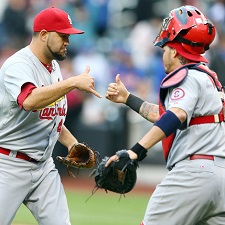
At the All-Star break, they are on pace for 90 wins, which should be sufficient for another playoff berth, especially with two wild card spots available. They rank fourth in the National League in both runs scored and allowed. Their lineup boasts the top two players in on-base percentage, Joey Votto and Shin-Soo Choo, whose .434 and .425 marks, respectively, are the only percentages above .400. As a team, Cincinnati ranks second in the senior circuit in on-base percentage, and its pitching staff is tops in strikeouts. Yet even in their own division, the Reds have remained largely anonymous.
Instead, baseball scribes have spilled ink about the Reds’ division-mates: the Cardinals and Pirates. Although the former was a game away from reaching back-to-back World Series, it wasn’t expected to make it that far again. Key players Rafael Furcal, Chris Carpenter, and Jason Motte all suffered severe injuries before the season began; not a single one of ESPN’s 43 experts, for instance, predicted St. Louis to make the Fall Classic, and the Reds were a near-unanimous pick to win the division.
The Pirates, meanwhile, were last seen becoming the first North American professional sports team to garner a losing record every year for two decades. Poised to finish better than .500 for the first time since Sid Bream’s name became famous, the Pirates last year stumbled to a 16-36 record in their last 52 games, en route to a 79-83 overall mark. They fared even worse than the Cardinals in the preseason prognostication game, with nary a single ESPN personality foreseeing a Pirates’ playoff berth.
With the season’s first half in the record books, however, the Cardinals and Pirates own the top two winning percentages in baseball. Nobody predicted either team to be this good, but such is the allure of baseball: there are always surprise contenders. While it remains to be seen whether the teams will maintain their success through September – the Pirates have been guilty of failing in this regard in the very recent past – the All-Star break seems a good time to analyze how the two leapfrogged the Reds atop the division. Maybe the recipe for baseball success can be found within the cozy confines of the NL Central.
The Cardinals’ lineup has simply been a hitting machine. It tops the National League in runs, hits, batting average, and on-base percentage, and its slugging percentage trails only Colorado’s Coors Field-enhanced mark. With runners in scoring position, it’s been even better, outpacing the second best in the league by 73 points of batting average, 51 of on-base percentage, and 58 of slugging percentage. On an individual level, Yadier Molina and Allen Craig rank 1-2 in batting average in the National League, and they are followed close behind by Matt Carpenter (sixth) and Carlos Beltran (10th); besides St. Louis, only San Francisco has even two players in the top 10.
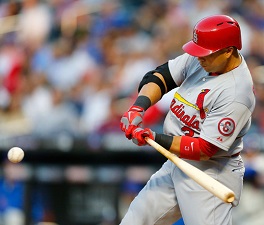 This potent group of batters is a testament to the Cardinals’ minor league system. Six of eight everyday starters have only played for the Cardinals in their major league careers – five drafted by St. Louis and David Freese acquired as a young prospect in exchange for an aging Jim Edmonds. Of the remaining two, Matt Holliday came to St. Louis in a trade for three highly regarded Cardinals’ draftees, making free agent signee Carlos Beltran the lone position player not in the lineup because of the team’s drafting and minor league system. Moreover, the top three bench players were all drafted by the Cardinals, so 10 of the team’s top 11 in plate appearances are at least indirect products of the team’s minor league ranks.
Similarly, seven of the team’s top 10 in innings pitched were Cardinals draftees, and an eighth, Adam Wainwright, has only pitched for the Redbirds after they stole him from Atlanta as the centerpiece of the J.D. Drew trade a decade ago. St. Louis traded for the ninth, Edward Mujica, by shipping first-round pick Zack Cox to Florida last July, and tenth, Jake Westbrook, in a three-team deal at the 2010 trade deadline. All that homegrown cooking has propelled the Cardinals to third in the league in ERA (3.29) and second in starters’ ERA (3.33).
And their vaunted minor league system isn’t done churning out big league contributors. ESPN’s Keith Law ranked the Cardinals’ system as best in baseball in his preseason coverage, and Baseball America tacitly concurred by placing six St. Louis prospects on its preseason top 100 list, tied with Miami and Minnesota for the most. Shelby Miller (#6 on Baseball America’s list) and Trevor Rosenthal (#39) have already excelled for the Cardinals’ pitching staff, and Oscar Taveras (#3) will soon be crushing baseballs in a stadium near you.
But even though the Cardinals’ player development should be the envy of the other 29 teams, clubs hoping to become consistent contenders will be hard-pressed to emulate this system.
In the draft, St. Louis has hit on high picks (starters Miller and Lance Lynn were first-rounders) and low ones (pitcher Jaime Garcia was a 22nd-round surprise, and power-hitting backup Matt Adams has accomplished more at the plate in half a season than most 23rd-rounders do in their careers). But teams clearly try to draft good players, so not much can be learned here.
On the player development side, although no conclusive study has been conducted about the relative efficiency of each team’s minor league system in transforming potential into production, it’s not a stretch to claim that the Cardinals are better at it than the Mariners or Royals. But overhauling the way a team operates its minor league affiliates would take either a drastic organizational or managerial shift, and at any rate, it’s not an overnight change for teams that want to contend soon. And once the pitchers make it to the big leagues, of course, not every team has the luxury of the best defensive catcher in the game to help alleviate their growing pains.
Teams in search of a better model might be wise to turn instead to the Cardinals’ closest competitor for the NL Central crown.
The Pirates parlayed a parade of losing seasons into a procession of high draft picks, nabbing many of their top players in the process. Neil Walker, Pedro Alvarez, and Andrew McCutchen were all first-round picks, as was recent call-up Gerrit Cole. But Pittsburgh has also been entirely unsuccessful in unearthing even a mildly productive player late in the draft; instead, it turned to the shoppers’ market to surround its core with competent counterparts on the pitching side.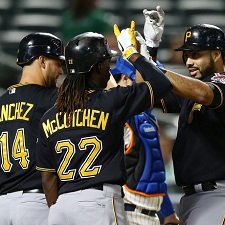
Cole is the only member of the starting rotation to have been drafted or developed by Pittsburgh. A.J. Burnett was unmercifully booted from the Yankees in the 2011 offseason, and the Pirates happily swooped in with the hope that a change in scenery would help the former strikeout king (with Toronto in 2008) regain his peak form. Shelling out a cheap contract for Francisco Liriano’s services bought them a pitcher who had dazzled as a Twins’ rookie in 2006 before undergoing Tommy John surgery, posting a 12-3 record to accompany a miniscule 2.16 ERA, and seemingly every year since his recovery had pitched a few gems to remind people of his potential.
Finally in a position to buy at last year’s trade deadline, the Pirates made only a small splash, trading for the Astros’ Wandy Rodriguez, who had tallied a sub-4 ERA for six consecutive years. While that acquisition wasn’t enough to quell the team’s late-season freefall, Rodriguez has been solid in the middle of the rotation, with a 3.59 ERA at the break. Pittsburgh also traded for Jeanmar Gomez, who had a career 5.18 ERA with Cleveland before exchanging addresses this offseason; in 16 games (eight starts) with Pittsburgh, he’s slashed his ERA to 2.72.
All-Star Jeff Locke, whose 2.15 ERA ranks second in the majors, was twice rated a top-10 prospect in the Braves’ organization by Baseball America before being traded to Pittsburgh for Nate McLouth. The McLouth trade, which also brought prospect Gorkys Hernandez – later traded to the Marlins for first baseman Gaby Sanchez – to Pittsburgh, came on the heels of a number of high-profile instances of the Pirates developing a budding star before shipping him off to an eastern power and receiving little value in return. Trading Jason Bay to Boston, for instance, netted Pittsburgh Andy LaRoche, who hit for a meager .226/.296/.341 slash line (batting average/on-base percentage/slugging percentage) in parts of three seasons with the club; Brandon Moss, who put up a similarly unimpressive .228./.295/.373; and Craig Hansen, who surrendered barrages of runs to the tune of a 6.95 ERA in just 22 innings.
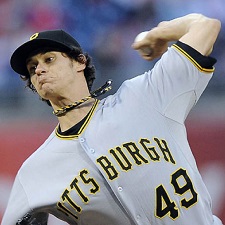 In half a season, Locke has already amounted to the best piece the Pirates obtained from any of their deals. Though he may not stick with the Kershaws and Wainwrights of the world for the remainder of the season, he gives his ballclub a chance to win every fifth day and has been a stellar addition to a rotation filled with castoffs.
The castoffs have outperformed every other pitching staff in baseball as its 3.07 ERA leads the sport. Cobbling together a pitching staff from spare parts requires a whole heap of luck – even the most favorable projections didn’t have relievers Mark Melancon (0.81 ERA) and Jason Grilli (29 saves, tops in the NL) performing their best Rivera-Wetteland impression at the end of games. But by acquiring players who had shown flashes of talent in the past, the Pirates gave themselves a number of options, only a few of which needed to pan out for the team to have a shot at success. That they all have is why the Pirates sit in contention for the best record as opposed to just for a winning mark, but it gives them some wiggle room as regression inevitably rears its ugly head in the second half. Injuries have already stripped the staff of some of its effectiveness, but to be fair, if Liriano hadn’t suffered an injury, it might have been a sign that cosmic forces truly were at work in Pittsburgh’s favor.
For teams that already have a strong offensive core but haven’t the financial means or prospect packages to acquire top pitchers – and with more teams locking up their young stars to lengthy contracts before they can hit free agency, the market is even more threadbare – the Pirates’ plan proves an imitable model.
Consider another NL Central team, Milwaukee, as an example. The Brewers can hit and, with Ryan Braun, Carlos Gomez, and Jean Segura aboard, lay claim to legitimate stars. But their pitching staff has been horrendous, ranking in the bottom three in the league in ERA, quality starts, strikeouts, opponents’ batting average, and home runs allowed. Kyle Lohse is the only starter with an ERA better than 4.60 – for comparison, none of the regular starters for either St. Louis or Pittsburgh has an ERA worse than 4.00. Even a team with as much hitting prowess as Milwaukee can’t compete with this run-hemorrhaging outfit on the mound, leaving it with the second-worst record in the NL.
Milwaukee has had recent success trading for talented pitchers, winning 96 games and reaching the League Championship Series in 2011 on the strength of, among others, offseason trade targets Zack Greinke and Shaun Marcum. But the Brewers sacrificed a glut of top prospects, notably Brett Lawrie and Lorenzo Cain, in the two deals, and Law’s preseason farm system rankings had Milwaukee 29th. Without prized commodities to trade, the Brewers shouldn’t turn to washed-up, back-end starters like Randy Wolf, who managed an unsightly 5.69 ERA in 24 starts with the team last season; instead, they should strive for Pittsburgh-esque deals for inexpensive pitchers with upside and the potential, no matter how slight, to turn into foundational pieces for a winning ballclub.
The recipe is simple: start with a few stars who can anchor the lineup, mix in some players with as-of-yet-untapped potential and hope they maximize it on a consistent basis, and sprinkle on a spoonful of luck. It won’t be easy, but not every team can be the Cardinals.