Let the 2012 American League Most Valuable Player debate be forever known as the first large-scale battle in the WAR War. And much like Bull Run and the Marne, Trout-Cabrera might soon be the site of another skirmish.
Last year’s details have been hashed out ad nauseam, but as a quick refresher, Miguel Cabrera batted third for a playoff team and became the first Triple Crown winner in 45 years, finishing first in batting average (.330), home runs (44), and runs batted in (139). Trout was the best all-around player in the league almost from the moment he was called up on April 28, turning in one of the greatest rookie seasons ever and leading the league in Wins Above Replacement (10.2, via Baseball Reference) by a wide margin; Cabrera finished third in the sabermetric category with a WAR of 6.9.
Both players had historically great seasons and in almost any other year would have been the clear choice for MVP. But only one could win, and the WAR War’s first battle concluded with Cabrera as the victor, garnering 22 of 28 first-place votes to outpace the Angels’ rookie.
Of all the arguments made during the deliberation period, perhaps the silliest in either candidate’s favor was the claim made by some Cabrera advocates that their man deserved the award because Trout, as a 21-year-old, would have more opportunities to win in the future.
Imagine if the same argument had been applied to Fred Lynn during his impressive rookie year. The MVP race in 1975 wasn’t particularly close – Lynn received 22 of 24 first-place votes – as Lynn reached triple digits in both RBIs and runs and led his closest competitors in batting average and slugging percentage. If a similarly worthy candidate had emerged, though, it could have been easy for writers to vote for the challenger under the assumption that Lynn would have chances in future seasons.
But Lynn never again came close to winning MVP. His best post-rookie year finish was fourth in 1979, when he probably deserved the honor – he led the league in batting average, on-base percentage, and slugging percentage and bested winner Don Baylor in home runs (and narrowly edged out George Brett for the WAR title, though that metric had not yet been conceived). Maybe voters would have been more likely to look Lynn’s way in 1979 if he didn’t already have an MVP, but it’s likely that had Lynn been deprived of his trophy as a rookie just because he might have more future opportunities than a competitor, he never would have won one.
Lynn’s rookie statistics were so excellent that it would have been hard for any player to replicate them his sophomore year. It’s understandable that his numbers suffered, but he still hit .314 and was an above-average offensive player.
‘Trout was in a similar situation for 2013, and when he finished April with a mortal .261/.333/.432 slash line (batting average/on-base percentage/slugging percentage) and only two home runs and four stolen bases, it seemed that his sophomore swoon was proceeding as expected. Drawing meaningful conclusions from one month of games is a foolish exercise and fodder for arrest by the sample-size police, but some people actually wondered if Trout’s best days were behind him; extending that line of thinking, he might have already missed his best shot at being named MVP.
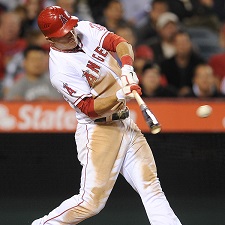 Then the calendar turned to May. The days grew hotter, and with them, Trout’s bat. He improved each of his averages to .327/.409/.664 and simultaneously boosted his power and speed, with eight homers and stolen bases apiece. In June, his power numbers suffered slightly as only three hits left the park, but he still hit .358 with a .433 on-base percentage and added eight stolen bases without being caught. In 43 July at-bats as of Sunday morning, Trout had managed to be even better, with a .372/.460/.767 line and nine of 16 hits going for extra bases.
Overall: a .322/.400/.571 line, nearly identical to last year’s .326/.399/.564, and not a trace of the projected sophomore swoon in sight. He already has more doubles than he did a year ago with as many triples, and he’s on pace for more walks and fewer strikeouts than he tallied as a rookie. Players would kill (or ingest PEDs, come to think of it) for a slump that good.
Chris Davis has experienced the opposite of Trout’s in-season rise. A scorching .356 batting average spanning April and May dropped to .290 in June and .184 in July; correspondingly, his on-base percentage has fallen from .442 in the season’s first two months to .336 in June and a subpar .273 so far this month. His power numbers have persisted throughout the year, but it will be hard to continue swatting home runs if his ongoing decline doesn’t reverse itself.
Most midseason award projections crowned Cabrera as MVP and named Davis the main challenger. The current trajectories of Trout and Davis, however, point to the former being Cabrera’s chief competitor come September for the second year in a row. It has only been a decade since the last time a young star and an all-time great at his peak were the top MVP candidates for multiple seasons: the Albert Pujols-Barry Bonds duels (that Bonds was at his peak from ages 36-39 is a story for a different column).
Pujols’ rookie season in 2001 was actually better than Trout’s based purely on batting statistics (not factoring in baserunning or defense or, perhaps most importantly, the overall hitting environment of the league at the time, by which Trout did more to outperform the league average). The Cardinals’ phenom won Rookie of the Year honors and placed fourth in MVP voting; Bonds, though, assured himself of winning by setting the single-season home run record.
A year later, Pujols had moved up to second, but Bonds won unanimously after leading the league in slugging by nearly 200 points and setting the all-time record for on-base percentage (.582). Pujols had his best season to date in 2003 but again finished second behind Bonds, who tied for the league lead in homers and was the most prolific hitter in baseball. The last of the duo’s battles occurred in 2004 and Bonds completed his four-year sweep by leading the league in batting, on-base percentage (a ludicrous, record-breaking .609), and slugging percentage; Pujols placed third, falling behind Adrian Beltre as well.
Looking back at Bonds’ numbers from that stretch, even knowing he had pharmaceutical help, boggles the mind. Almost as surprising is that Pujols put together an incredible four-year run of his own – his worst totals from any season in the span were 185 hits, 112 runs, 40 doubles, 34 home runs, and 123 RBI, which is a career year for most players – but doesn’t have an MVP award to show for it.
Will we reflect on Trout’s early career in the same way? If so, his mantel might miss the extra hardware, but such a development would be good for baseball. It would mean he and Cabrera will have kept up their historic pace of run production for another two seasons. It would mean having found an answer to Jayson Stark’s recent ESPN.com piece wondering who the “Face” of baseball is – in this case, two faces accompanied by two sweet, right-handed swings and two robust statlines. It would mean giving the casual fan a storyline to follow; though Bryce Harper’s debut coincided with Trout’s rookie breakout and the two seem to abide by all the checkmarks for a lengthy natural rivalry, Harper’s numbers don’t yet approach Trout’s, and Trout-Cabrera might be the better duel for the next few seasons.
The only people it might not be good for are the WAR War’s combatants. As calculated by Fangraphs, Cabrera has accounted for 5.9 wins this year, Trout 5.8, and Davis, the only player within a single win of the leaders, lags behind at 5.0. Baseball Reference’s leader board has more clustering at the top: Manny Machado, who derives much of his value from his fielding prowess; Robinson Cano and Dustin Pedroia, again seesawing for position as best second baseman in the league; and Trout are all within a win of Cabrera.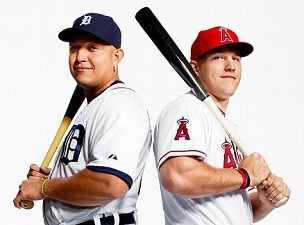
If Cabrera and Trout stay bunched within 0.1 wins of each other, this year’s battle won’t be as violent as last season’s. Writers shouldn’t be such a slave to the numbers that they award one player the MVP because his WAR is a smidge higher, just as they shouldn’t dole out the award based on a few points of separation of batting average or an extra couple runs batted in (some, this site’s proprietor included, would argue that no WAR gap of any size is a sufficient basis for choosing the MVP). But it doesn’t take a stretch of the imagination to foresee Trout continuing his scorching summer at the plate and leveraging his baserunning and defensive advantages to pass Cabrera and top the WAR leader board by a considerable margin.
If that scenario unfolds, we would again have a battle on our hands: on one side, Trout, the WAR leader partly because of his non-hitting advantages, which proponents could reasonably argue implies he does more for the team than his one-dimensional counterpart; in the other, Cabrera, the best hitter on a likely division champion and possibly the first repeat Triple Crown winner in history (especially if Davis’ power numbers suffer as he sputters at the plate).
The two contestants have two more months and around sixty more games to make their cases. Let the battle begin.