Speaking separately to the top two executives of the Los Angeles Dodgers, I asked both the same first question:
Which of your teams will show up in October?
“I only have one team, the Dodgers,” president Stan Kasten said. “I hope the Dodgers show up in October.”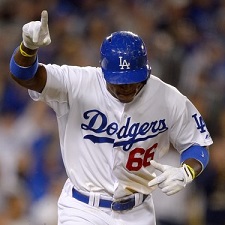
General manager Ned Colletti offered a different answer. “I don’t worry about that,” he said. “I worry about today. It’s a cliché, but I take it one day at a time.”
On the day I spoke with Colletti, last Friday, his Dodgers won again, 4-0, for their 41st victory against 8 defeats in the last 8 weeks, a phenomenal run that has saved the $220 million team from immortal humiliation.
Before that run, the Dodgers had a 30-42 record and were wallowing in last place in the National League West, prompting my question about which team would show up in October.
On Saturday night the Dodgers won with another shutout, 5-0 over the Phillies, for their 10th straight victory, 25th in 28 games since the All-Star break and 42nd in their last 50 games, matching the second best 50-game stretch in post-1900 history.
Elias Sports Bureau research found that the only better 50-game period, 45-5, was produced by the 1906 Cubs. The 1912 Giants, the1941 Yankees and the 1942 Cardinals also had stretches of 42 wins and 8 losses. All of those teams played in the World Series, with the Yankees and the Cardinals winning.
But don’t try to sell history to Colletti. He rejected my suggestion that this eight-week run has not only catapulted the Dodgers into solid post-season position but has also made them a likely World Series participant as well.
“How long have you been involved with baseball?” he asked, knowing the answer to be a long time, like him, and suggesting that we both knew that anything can happen – and has – in the time remaining in the season.
As cautious and as careful as Colletti wants to be, though, the team he has put together at a collective salary of $220 million, most ever in the National League, has blown everyone else out of the water.
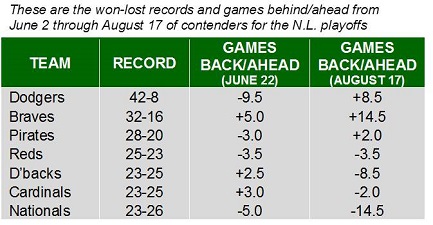
On June 21 the Dodgers were a season-high 9.5 games behind the Diamondbacks in the N.L. West. Before Sunday’s games they were a season-high 8.5 games ahead of them. In that 8-week period the Braves had the second-best record among N.L. playoff contenders, 32-15, which was 9 games worse than the Dodgers.
The Dodgers’ 42-8 stretch is the best in the franchise’s modern history and the best in the majors since 1942, according to Elias. Whatever it is, it has been a truly remarkable turnaround for the Dodgers.
“We had guys who started slowly,” Kasten said. “We also had injuries. That’s not an excuse; everyone has injuries. But we had a carousel of injuries. Every week we had a guy injured and we lost him for a week or two. Once we hit a rhythm with most of our guys on the field we played the way we thought we could play. We finally had a steady, stable lineup on the field.”
And beginning early in June, manager Don Mattingly, whose job status had become a subject of speculation, had Yasiel Puig in the lineup.
 A Cuban whom the Dodgers captured for $42 million, Puig, more than anyone else, has been responsible for the team’s turnaround.
After Saturday night’s game in Philadelphia, Puig had a .364 batting average, .425 on-base percentage and .576 slugging percentage. He obviously doesn’t have enough plate appearances to qualify for the league leaders, but if he did with the numbers he had, he would have the leading batting average and would be second in the other two categories.
Has his production prompted regrets that the Dodgers didn’t promote Puig to the majors earlier in the season?
“We needed a spot for him,” Colletti said. “We started the season with three all-star outfielders. “At the end of spring training, even today, there’s still more for Puig to learn. He’s been getting better on an everyday basis. He had never played every day at this pace. There was a little bit adjustment at this pace, running the bases, throwing to the right base.”
Nevertheless, with his hitting, his outfield defensive play, his strong, accurate arm and his generally aggressive style, Puig gave the Dodgers what they needed. “Puig maybe was a bit of a spark,” Colletti acknowledged.
Gerry Hunsicker, senior adviser to the Dodgers’ baseball operations, likened Puig to a “young wild stallion.”
“From the day we saw him in spring training we knew we had a firecracker on our hands,” Hunsicker said. “He plays with passion. He’s very entertaining to watch. He’s looking on the fly. He doesn’t have a good fundamental knowledge to play the game. We know he’s going to make mistakes. Some of those can cost us. On the other hand he probably was responsible for being the catalyst to jump start the team.”
The Dodgers, though, have no plans to corral the wild young stallion.
“Mattingly has publicly addressed that,” Hunsicker said. “He made it clear he doesn’t want to curtail his enthusiasm.”
Puig’s arrival and Hanley Ramirez’s health have probably been the biggest factors in the Dodgers’ resurgence. “Both of them have been huge factors for us,” Hunsicker said.
Shortstop Ramirez has had a physically troublesome season. Twice on the disabled list, he suffered a strained hamstring and had thumb surgery.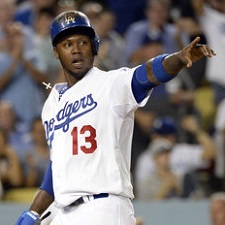
He played his first two games on the last two days of April and played two games on the first three days of May, but then he sat out a month, returning June 4. He missed only a few more games in June, then played every game in July. He jammed his right shoulder Aug. 3 but not badly enough to require a third visit to the disabled list.
The disabled list has also played a role in what otherwise could have been Mattingly’s most difficult problem. Before Puig arrived, the Dodgers had a solid outfield of Carl Crawford, Matt Kemp and Andre Ethier. Throw Puig into the mix, you find that four into three doesn’t work. Injuries, however, took the decision out of the manager’s hands.
“We’ve had one game where the four were on the lineup card,” Colletti said. “Matt got hurt in the second inning. We’ve never played one full game with the four outfielders. We’ve played 120 games and haven’t had all four. And we won’t have all four for some more games so that’s not something we have to be concerned about.”
Although Josh Beckett and Chad Billingsley have missed most of the season and Ted Lilly was released, pitching has not been a problem for the Dodgers, not with Clayton Kershaw (12-7, 1.80), Zack Greinke (11-3, 3.02), Hyun-Jin Ryu (12-3, 2.97) and Ricky Nolasco (4-1, 2.97 in 7 starts since his trade) in their rotation.
Under their new owners, the Dodgers have spared no expense. Recently they signed a relief pitcher, Brian Wilson, who has not pitched in the majors since his elbow operation last year. A veteran closer, Wilson was signed to bolster the Dodgers’ bullpen for the post-season.
His addition adds to the expectations Los Angeles fans have for the league’s wealthiest team.
“We’ve been living with high expectations for a year,” Kasten said.
AN UNWELCOME VISIT
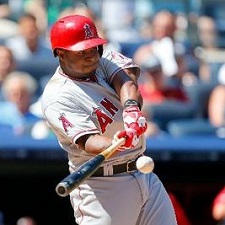 The Yankees will remember Chris Nelson. They will remember how they signed him for 10 games in May, hoping that he would be the answer to their void at third base, where Alex Rodriguez was missing.
Nelson, however, did little more in person than Rodriguez was doing in absentia. The 27-year-old Wilson stroked 8 hits and struck out 11 times in 36 times at bat. His career with the Yankees ended that quickly when they released him.
The Angels signed Nelson. He returned to Yankee Stadium with them last week. In the first three games of the four-game series the third baseman had two hits and struck out five times in 10 at-bats. The Angels lost all three games.
But they won the fourth game, 8-4. Nelson slugged two home runs, one a grand slam, and drove in five runs. Then he left New York again, feeling a whole lot better than when he left the first time.
REMEMBERING KILLER
Bill (Killer) Kane died last week at the age of 75 and looked 105. That’s what smoking, drinking and working for George Steinbrenner can do.
Kane was the Yankees’ traveling secretary for most of the first 15 years that Steinbrenner owned the team. He was fired many times during his tenure, but Steinbrenner always rehired him. He was the poor man’s Billy Martin.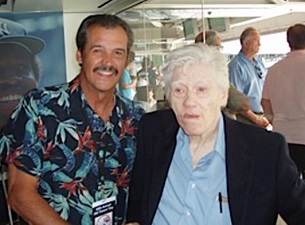
In fact, Kane did something Martin was never believed to have done – threaten to punch the owner’s lights out. The threat, however, was as far as that episode went.
The Yankees hired Kane in 1961, which would turn out to be a memorable year in Yankees history. Kane’s job that year was working with the legendary Mel Allen in the broadcast booth, feeding him statistics.
Unfortunately for Allen, Kane would occasionally give him a wrong statistic. Unfortunately for Kane, every time he did and embarrassed the announcer, Allen would whack him on the head with his scorebook.
I wasn’t in the booth with Mel and Killer, but I was at the other end of the telephone one spring training when I called Killer looking for a player’s telephone number. Another New York newspaper had a pretty important story, and I needed to reach the player to be able to write it.
Sounding like he had been sleeping, Killer answered the phone and said he would look for his list of players’ spring numbers. I thanked him and held on…and held on and held on and held on.
After a while, it became apparent what had happened. Kane, it was believed, had narcolepsy because he was always falling asleep. Knowing there was no way to wake him up, I resigned myself to not getting the number and hung up. The next day Killer did not remember that I had called and he had spoken to me.
Kane died of pneumonia in a Bronx hospital, not far from Yankee Stadium.
A-ROD MAKES ANOTHER MISTAKE
Alex Rodriguez keeps on hiring lawyers to defend him in an upcoming grievance in which he hopes to avoid serving a 211-game suspension that Commissioner Bud Selig has inflicted on him. His newest lawyer, according to newspaper reports, is Joe Tacopina, who was described as “a well-known defense lawyer.”
I don’t know how well known Tacopina is, but he’s not the lawyer Rodriguez should hire. It’s not for me to tell A-Rod what he should do, but since every other writer is dumping on him, I will offer him this piece of advice.
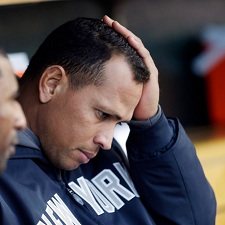 Rodriguez doesn’t need a defense attorney; he needs an arbitration attorney. They are horses of a different color. And if they aren’t, an arbitrator is different from a judge, and a grievance hearing is different from a trial.
“It takes a different kind of lawyer to understand an arbitrator, who is different from a judge,” said a lawyer who is well known but spoke on the condition of anonymity.
Richard Moss, former general counsel of the baseball players’ union, has argued and won many baseball grievances. Among those cases were the Messersmith-McNally grievance, whose outcome created free agency in baseball; the Catfish Hunter breach-of-contract grievance, which Hunter won and became a free agent, and the Steve Howe grievance, which the pitcher won and was reinstated in baseball from a lifetime ban.
“The arbitration process is a lot different from the courtroom process,” Moss said in a telephone interview.
The best – or worst – example I know of a lawyer lacking labor experience getting involved in a labor case was the Messersmith-McNally case.
When arbitrator Peter Seitz signaled to both sides how he was going to rule and urged them to negotiate a settlement, Commissioner Bowie Kuhn, a lawyer, and the owners’ lead lawyer, Lou Hoynes, recommended that the owners ignore Seitz and let him rule.
If he ruled against them, they could take it to Federal court and win on appeal. In their ignorance in labor matters, they apparently did not know that judges rarely overturn arbitrators’ decisions, doing so only if the arbitrator has exceeded his authority or applied terms of an agreement incorrectly.
The owners lost and have been paying for it ever since.