Looking back at 26 years as head of the baseball players union, Donald Fehr acknowledged one instance in which he second-guessed himself.
“After the strike began in 1994, about four weeks into it, in early September,” he related, “it became clear that the clubs intended to force a strike, had no thought of getting an agreement but wanted to break the union. If I had realized that, I would have recommended a strike date mid-September, not early August.”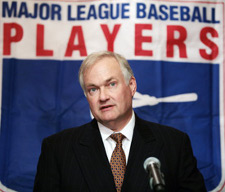
Had the players delayed their strike until mid-September, they would have had an additional five weeks of pay. When they struck Aug. 12, they did so thinking negotiators would have enough time to resolve the dispute and save the end of the season and especially the World Series.
But if they had realized the owners didn’t want an agreement and didn’t care if they lost the World Series, they might as well have played later into the season and earned more of their salaries.
Fehr’s frank assessment of the owners’ strategy puts a slightly different light on what I thought was the owners’ bizarre reaction to the strike. They acted as if they had just won the Super Bowl or a super lottery, giving each other figurative high fives. It seemed strange that the proprietors of the game celebrated the shutdown of their sport. But what they were doing was celebrating the success of their strategy.
What gave Fehr the idea that the owners didn’t want an agreement?
“There were no meaningful negotiations,” he said, citing the owners’ post-Aug. 12 actions. “There were no plans for the World Series.”
Fehr’s belief that the owners wanted to break the union bolsters the belief that the owners, led by Bud Selig and Jerry Reinsdorf, ousted Fay Vincent as commissioner in 1992 because they feared that he would stand in the way of their attempt to break the union.
The owners, however, failed to make a dent in the union’s strength. Not even an astonishing act by Selig, then the interim commissioner, during the last game of the 1996 World Series shook the union.
Before the game, Fehr announced to reporters on the field at Yankee Stadium that the players and the clubs had reached an agreement on the dispute that had caused the 1994 strike. During the game, though, when Selig appeared in the press box and was asked about the agreement, he said, “What agreement? We don’t have an agreement.”
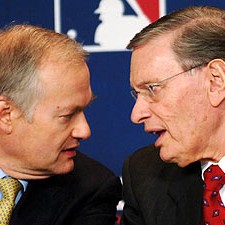 Hearing that, his aides were stunned. They feared that his reaction would blow up the deal. Two of them came to me in the press box and asked if I had to write what Selig said. I explained that I wasn’t the only one who had heard what Selig said; many reporters had heard him. The deal wasn’t blown up, but it took several more weeks before it was finished.
“We had an agreement,” Fehr recalled. “I was astounded when Bud wouldn’t honor that agreement. At least we were able to put it back together in six weeks.”
Fehr spoke about the 1994 strike on one of his last days as the union’s executive director. Michael Weiner, the union’s general counsel, replaced him at the executive board meeting this week in Scottsdale, Ariz.
Fehr retired from the union after serving it for 32 years, twice as long as Marvin Miller’s tenure. Miller hired Fehr in 1977 to replace Richard Moss as general counsel, and then Fehr became executive director in 1983. However, he didn’t replace Miller, as most people think. He succeeded Ken Moffett, who was the short-lived union leader between Miller and Fehr.
Moffett was so short-lived that he is easily forgotten; thus the reason Fehr is remembered as having replaced Miller.
“If I had actually thought about it, I probably would have been a little daunted and certainly if I had known what was coming, I would have been,” Fehr said about following Miller. “But we had just gone through the ‘81 strike and I didn’t think about it in those terms. To be mentioned in the same paragraph as Marvin is remarkable.”
It wasn’t easy following Moss as general counsel either. Although Miller gets most of the acclaim for the success of the union, it was Moss as its lawyer who argued and won the most critical cases, including the Catfish Hunter and Messersmith-McNally grievances.
“Hunter clearly was the most important case in Richard’s tenure,” Fehr said in a telephone interview the day before the executive board meeting. “Hunter was an ordinary contract dispute, but Richard had to find a way to persuade the arbitrator to make him a free agent. He was deciding whether people were paid fairly. Dick argued that you can’t violate the contract and maintain control of the player. Without Hunter, I don’t know if we win Messersmith.”
Fehr came to the attention of Miller and Moss as the union’s young local lawyer in the owners’ appeal of Peter Seitz’s decision in the Messersmith grievance in Federal court in Kansas City. When Moss was leaving the Players Association in 1977, Miller hired Fehr.
“I was a young lawyer who possessed a degree of self-confidence, which was entirely uncalled for at the time,” Fehr said. But he was definitely up for the job. “The way the owners treated players as property outraged me,” he said.
Not long after Fehr became executive director, the owners gave him a chance to do something about the way they treated players. The union accused the clubs of conspiring against free agents following the 1985, ‘86 and ‘87 seasons, and two arbitrators found the owners guilty of violating the collective bargaining agreement. Vincent has always believed that collusion poisoned subsequent relations between the two sides.
“What collusion did,” Fehr said, “was raise the most fundamental question in labor relations. If you make an agreement and they are not willing to adhere to the contract, what do you do? We were able to enforce the contract.”
After eight work stoppages – five strikes, three lockouts – the players and the owners concluded their last two labor negotiations peacefully.
“The memory of ‘94 was still pretty bright,” Fehr said of the 2002 talks. “What we eventually reached in the fall of ‘96 was a revenue sharing deal done largely around concepts we had floated. We had to protect entrepreneurial efforts. Once that was adopted and we went forward, we asked is this good enough that we can tinker with the system and make it work or do we have to do something entirely different? That held in the last two negotiations.”
 Through negotiations and grievances and smooth transitions in changes of leadership, the baseball union has outshined the other sports unions. It’s not even close.
Asked why his union has succeeded in ways the others haven’t, Fehr said, “Without commenting on the others I think what made it stable was the approach to players. Whatever else you can say about us, we believed our job was to educate the players, explain the issues, explain our strategy and approaches and get consensus and then operate on that consensus. When you can do that, you create a tremendous sense of shared purpose, which leads to trust and confidence that the leadership of the organization is moving in the right direction and you’re able to maintain that as long as those things remain true.”
When Fehr was told the purpose of this interview, he had his own thoughts on his departure from his union job.
“Here’s how it should begin,” he said. “Last night the executive board voted to install Michael Weiner as executive director. Fehr no longer is executive director. You will hear cheering all over the country.”