The most negative thing I can say about Donald Fehr is he made it easy for people who didn’t like him to criticize him. Take, for example, his very innocent interlude during a long day of negotiations in the middle of the 1994 baseball strike.
Hours after the day game of a bargaining session turned into a night game, Fehr appeared in the lobby of the Arrowwood conference center in Rye Brook, N.Y. , sat down at the house piano and began playing “Take Me out to the Ball Game.” He would later be criticized for doing something so trivial as playing the piano instead of remaining in the room and continuing to negotiate.
The criticism, of course, was leveled by people – primarily reporters – who didn’t know the first thing about the rhythm and flow of negotiations. It was, some critics said, like Nero fiddling while Rome burned.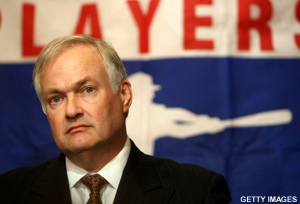
I’d like to be able to say that Fehr’s musical interlude led to an agreement, but the strike continued for another three and a half months, and the players and the owners didn’t reach an agreement on a new contract for nearly two years.
But that night, Dec. 13, 1994, preceded by only about a week, the owners’ decision to implement unilaterally new work rules, and their implementation led to Judge Sonia Sotomayor’s injunction that barred the owners from doing what they wanted and enabled the players to end their strike and return to work.
The piano timeout came to mind Monday when Fehr, who will be 61 next month, announced he was stepping down as executive director of the Major League Baseball Players Association, a position he has held for nearly 26 years.
“I have been the boss for 25 years, which is a pretty long time to do anything, especially to hold a position like this,” Fehr told reporters on a conference call. “I have advised the executive board that it is my intention to step down no later than March 31 next year.”
Fehr, who said he was required to give nine months notice, said he could leave sooner if his successor is named before then. His successor will be Michael Weiner, the union’s general counsel, whose presence will give the baseball union a far more constructive transition than the football players union had earlier this year and the baseball union had when Marvin Miller, its legendary leader, retired in 1982.
Ken Moffett lasted less than a year as Miller’s successor, deposed by the players after he demonstrated less than complete attention to union affairs. Fehr, who had been general counsel, replaced Moffett.
When former commissioner Bowie Kuhn died last year, some of his obituaries noted how the average player salary had risen during his 15 years as commissioner, as if he had anything to do with the increase. If it had been left to Kuhn, the average salary would have decreased.
During Fehr’s tenure, on the other hand, the average salary rose from $289,000 to more than $3.3 million. He had something to do with that increase.
It is almost a given that every other column written about Fehr will criticize him for his allegedly tardy reaction to steroids in baseball. You won’t find that criticism here.
Asked about that charge Monday, Fehr said, “I’ve previously indicated if I had known or understood what the circumstances were, we would have acted differently, but what we’ve put in in the last several years is good for everybody.”
Miller has said he would not have agreed to testing for performance-enhancing drugs, and given my views of testing for anything (except for cause), I would agree more readily with Miller than with Fehr, but Fehr was in a difficult position. Not only was baseball concerned about public reaction to steroids use, but Congress jumped into the fray and made threats that the union found difficult to ignore.
“We were often criticized because we seemed to pay attention to privacy and other issues that run through this kind of a matter,” Fehr said. “I’m confident that taking these things into account was the right thing to do. Other people will say what they say. I didn’t represent anyone but the players.”
Fehr’s willingness to agree to a drug-testing program in 2002 and then amend it mid-agreement countered the frequent criticism that he let Miller pull his strings.
“I never thought I was in Marvin’s shadow,” Fehr said Monday. “I did think I had an extraordinary example to look up to and follow. Marvin told me it was my decisions to make, my responsibility.”
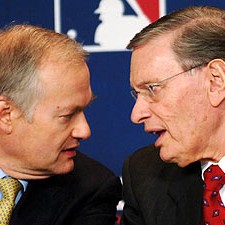 Fehr will leave Weiner with more than a decade of labor peace, a condition he didn’t inherit when he became executive director. Fehr and the owners have negotiated two consecutive labor agreements without a work stoppage. Fehr presided over a brief strike, a lockout and the monstrous strike during which he played the piano.
He attributed the change in the labor environment to the necessity of the two sides to “find a way to work together to do some things that would provide economic incentives.” Even with the economic problems every industry has these days, baseball is flourishing economically. Both players and owners have benefited, and with few short-sighted exceptions neither side wants to derail the smooth, calm relationship.
“I certainly hope the next negotiation will be like the last two,” Fehr said.
If it isn’t, the new union leadership may have trouble inducing a strong stand in the players, very few of whom will have experienced a labor battle. Peace is good as long as it continues.
“Major league players clearly understand what their world used to be like,” Fehr said. “They talk to coaches and managers and former players who lived through it. I have relied on children of former major leaguers who reach the majors. “I wasn’t bashful about asking them for help.”
If strike-threatening circumstances arise, Fehr added, “and a compelling case is made for it, the players will do it.”
Education is still the key ingredient, and baseball’s union leaders, starting with Miller and his general counsel, Richard Moss, have been the best at it.
“One of the jobs of the staff,” Fehr said, “is to say here’s what the owners want; here’s what we think, you guys choose. If circumstances are such that you have to think about a stoppage, the players will do that.”
After he answered my question about the players’ willingness to strike, Fehr said, “You sound wistful for a work stoppage.”
Actually, I wouldn’t mind one more work stoppage. I always found strikes and lockouts challenging and fun to cover, unlike most sports writers. Those circumstances also brought out the best and the worst in the people involved.
I learned early on that union people never lied and owners and their representatives often did lie. With more recent owners’ negotiators, Randy Levine and Rob Manfred, for example, that distinction has faded.
Labor peace and no labor lies – what a novel dual concept.