This is a baseball fantasy. No, not fantasy baseball, that silly game that people play, gorging themselves on players’ statistics, the foolish game about which I have been interviewed for two different documentaries, the game I sometimes feel is played by everyone but me, but that makes me the rational one.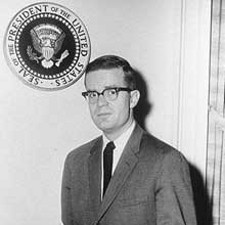
No, this is a baseball fantasy, something that never happened but about which I can fantasize and wish it had. It’s about Ted Sorensen, a man who could’ve been baseball commissioner, like Marlon Brando “coulda been a contenduh.”
Given his political views, the liberal Sorensen probably had as much chance of becoming commissioner as Terry Malloy (Brando) had of becoming a boxing champion in the great film “On the Waterfront.” But I can fantasize, can’t I? That’s what is nice about fantasies. They are your own, and no one can take them from you.
My fantasy began last week when I had lunch with Sorensen, and he told me he had been interviewed in 1964 for the upcoming vacancy in the job of commissioner. Ford Frick, who became best known for constantly declaring “it’s a league matter” so he would have fewer decisions to make, planned to retire after the 1965 season, and the owners began their search for a successor more than a year in advance.
The timing was interesting because until Nov. 22, 1963, Sorensen had been special (very special) counsel to President John F. Kennedy. Sorensen, a Nebraska native, was very close to Kennedy and almost certainly would have stayed with him as long as he was in the White House and most likely longer.
But less than three months after Kennedy was killed, Sorensen resigned as an advisor to President Lyndon Johnson and left the White House. It was during his time with Johnson that Sorensen, then 35, was approached for an interview for the baseball job.
“They did it carefully,” Sorensen recalled. “I got this call from Fetzer asking if I was willing to be interviewed. That was a discreet way of determining my state of mind.”
John Fetzer, owner of the Detroit Tigers, was head of the search committee that was directed to find a successor to Frick.
Sorensen didn’t recall many details of his interview, but one thing stood out. He remembered making “a wiseass remark” about something he had read that morning or the day before.
 “The story said they were considering Curtis LeMay,” Sorensen related. “I said to them ‘if what you want is a retired Air Force general I’m not your man.’ As I left the meeting I reflected on that and thought I might be stepping on the toes of the person who was promoting LeMay.”
LeMay, Sorensen said, favored nuclear war and was not held in high regard in the White House. “Later,” Sorensen added, “he showed his true colors by being on George Wallace’s ticket.”
Sorenson referred to Wallace’s independent run for the presidency in 1968 with LeMay as his vice presidential candidate. Ironically, Wallace nearly picked A.B. (Happy) Chandler as his running mate. But Chandler, a former baseball commissioner, lost out because he had let Jackie Robinson break baseball’s color barrier by playing for the Dodgers.
In that context, LeMay had a much better chance of becoming commissioner than the liberal Sorensen did. But it was another retired Air Force general, William Eckert, who became commissioner in November 1965.
Sorensen said he didn’t recall hearing from the search committee. “I don’t think I did,” he said. “It wasn’t too long after that that I moved up to Cape Cod to start writing my book on Kennedy.”
But what if the owners had hired Sorensen to be commissioner?
To begin with, he would undoubtedly have been a far more competent commissioner than Spike Eckert, who served only three years before the owners realized they had made a mistake and invited him to abandon the post.
With the office vacant – some would say it had been vacant with Eckert in it and would be again when his successor sat at the commissioner’s desk – the owners had difficulty reaching a consensus on a new man and finally compromised on a one-year term for the National League attorney, Bowie Kuhn, who in the next 15 years would prove the assertion that not all lawyers are bright.
With Sorensen as commissioner, Major League Baseball would have avoided the embarrassment of Eckert and had no need for Kuhn, who lacked vision, foresight, fairness and just about anything else a capable commissioner should have in his makeup.
Kuhn, it should be remembered, said free agency would be the death of baseball and was all in favor of going to court to fight the Messersmith-McNally arbitration decision that created it. Baseball has flourished in the era of free agency with club revenues reaching record numbers.
Kuhn, it should be remembered, attempted to portray himself as the commissioner of the players as well as the owners, only to be caught sneaking around the office of management’s chief labor negotiator so union officials wouldn’t see him when they arrived for a negotiating session.
Kuhn, it should be remembered, was commissioner for five work stoppages, including the 50-day strike of 1981. After that debacle, Kuhn crowed that the owners had demonstrated a resolve the players had not expected and declared that the owners had prevailed. He forgot to mention that the strike ended only when the owners’ strike insurance ran out.
Obviously no one knows how baseball would have fared with Sorensen as commissioner. But if I had been an owner, I would have been willing to take my chances with the Kennedy counselor, if for no other reason that he went on in his life to be a wiser and better lawyer than Kuhn was.
“Considering my career since then,” Sorensen, who at 81 is still an active lawyer, said when I asked him if he regretted not being asked to be commissioner, “I had a very interesting international law practice and as much fun as baseball might have been, my law practice made a better contribution to society.”
Kuhn’s legal legacy was a failed law firm that he started and a flight to Florida to avoid paying the firm’s outstanding bills.