Whoever said that April is the cruelest month must have played for the Baltimore Orioles. The Orioles were so bad this April that they made it easy – make that mandatory – for everyone to remember their 1988 April. That April they lost the first 21 games of the season, 6 under manager Cal Ripken Sr., then 15 more after they fired Ripken and replaced him with Frank Robinson.
Other teams have good Aprils, but they can be as disconcerting as 21-game losing streaks in the first month of the season. People who have followed baseball for many years should know better, but they allow themselves to be fooled. Not people in uniform or in front offices, but those who watch games.
A team that is expected to be bad might rise above its level of mediocrity and have a good first month, but it’s unlikely that it can extend that performance into more weeks or months. Last season the Royals led the American League Central after April games were played. Their record was only 12-10, but it was better than the record of any other team in the division.
However, nine games into May the Royals tumbled out of first – permanently. At the end of the season, they were in a more familiar place – tied for fourth for a second successive season after five consecutive finishes alone in last.
The Royals were not unusual in squandering an April lead. More teams than not that have led their divisions or the wild-card standings at the end of April have no longer occupied that position after 162 games.
In the 15 years of the wild-card era, 1995 through 2009, April leaders (divisions and wild cards) retained their leads at the end of the season 57 times, but in 63 instances they did not. Broken down by leagues, A.L. April leaders have fared better than their N.L., counterparts: A.L. 31-29, N.L. 26-34.
Looking at the history by divisions, wild cards and leagues, the numbers look like this:
- Division leaders 51 won, 39 did not (A.L. 27-18, N.L. 24-21)
- Wild card leaders 6 won the spot, 24 did not (A.L. 4-11, N.L. 2-13)
Last season’s A.L. races provide a glimpse of the reasons why no one should take April standings too seriously. At the end of the first month, the Blue Jays and the Red Sox were in a virtual tie for first in the East and the wild-card standings, the Royals led the Central and the Mariners were on top of the West.
The Red Sox won the wild card, but the others went home for the winter. What happened to them?
“I don’t know; it’s hard to speak for everybody else,” Alex Anthopoulos, the Blue Jays’ general manager, said. “I think most people understand it’s early in the season. We’ve seen it in Toronto often. They come out of the gate fast and then the wheels fall off.”
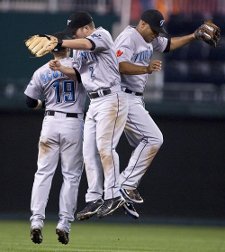 “Last year,” Anthopoulos recalled, “we had such a good start that I think we had the best record in baseball at one point. Then everything went cold. We had been doing everything right, hitting, pitching and defense. But everything went bad together.”
On May 12 the Blue Jays had the best record in the majors – 23 wins, 12 losses – and 11 days later were still in first place. But then they began losing and slipping, and on June 28 they slipped into fourth place, where they remained for the rest of the season.
Despite the bad things that might happen subsequent to the early days in first place, Anthopoulos said, it’s better to have a good first month than a bad first month.
“It can be a confidence builder,” he said. “It can build morale. When a team is playing well, it can always have a good impact on a club. It can propel a team and jump start a team.”
But, the general manager added in a cautionary way, “I don’t think you can put too much stock in the first month. I don’t know if you can read too much into the first month.”
But that thought could apply to a bad first month, too. “Just look at the Astros,” he said, “where they started, and now they’ve come around. They’re playing a lot better. It’s still early and there’s a lot of baseball left. The tough part about having a bad first month is you have five months left and you can’t repeat it.”
Omar Minaya recalled the 2003 season, his second as general manager of the Montreal Expos. At the end of that April the Expos were tied with the Braves for the lead of the N.L. East and the N.L. wild-card standings.
“We felt we could compete with other teams, like the Marlins, moreso for the wild card,” Minaya recalled. But major injuries undermined that plan.
“We lost Vladimir Guerrero and Tony Armas with injuries,” Minaya related. “We lost Vlad for two months.”
Nevertheless the Expos were tied with the Marlins for the wild-card lead just before Labor Day. “We thought we were going to beat them,” Minaya said, “and they ended up winning the World Series.”
Of the April lead, Minaya said, “You can discount spring training because guys are working into shape, but those first 30 days can mean a lot. There’s a confidence factor. It gives you a feeling of confidence if things go well. You feel we can compete.”
A bad month, on the other hand, isn’t necessarily reason for despair, he said. “It doesn’t mean if you don’t have a good start, that you’re going to have a bad year,” he said. “You’re talking about a difference of four or five games. In a week you can win 5,6 in a row.”
Minaya cited the 2005 Astros as a prime example of how a team can find redemption in the long season. The Astros were 14 games under .500 on June 7 but wound up in the World Series as the N.L. wild card.
These are this season’s April leaders:
- A.L. East: Rays
- A.L. Central: Twins
- A.L. West: Athletics and Angels (tie)
- A.L. Wild Card: Yankees
- N.L. East: Mets
- N.L. Central: Cardinals
- N.L. West: Padres
- N.L. Wild Card: Giants
Will any or all of these teams be in the same positions in five months? If you’d like to check, clip and save this list.
Are any of these teams unlikely occupants of these positions? How about the Mets, the Padres, maybe the Giants and the Athletics?
Asked about the Mets’ surprising presence in this group of April leaders, Minaya said, “I think we have a good team, but as well as we have played we have the ability to play better.”
THE ETHIER EFFECT
You might recall the statistic known as game-winning run batted in. It appeared in box scores for a while. I never liked it because I didn’t like the way it was figured. I thought to be meaningful a game-winning r.b.i. it should have to come in the 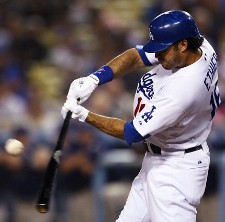 late innings of a game, not the first inning when it was considered a game-winning r.b.i. if it drove in the run that gave a team a lead it never relinquished.
But Major League Baseball’s public relations department came up with a statistic last week that is worth noting. It told of Andre Ethier and the percentage of his runs batted that won a game, tied a game or put the Dodgers ahead.
For his career, Ethier had produced 47.3 percent, 151 of 319, of his r.b.i. in those circumstances. Of the top 20 active players in r.b.i., Albert Pujols had driven in 47.3 percent and Vladimir Guerrero 47.6 percent in those situations. The percentages of the other 18 were below Ethier’s.
Even more impressive, though, since the start of the 2008 season, Ethier was 26th in r.b.i. But he had produced 112, or 56 percent, that won or tied games or put the Dodgers ahead. Only three other players in the group of 26 were above 50 percent: Jorge Cantu 55.3, Adrian Gonzalez 54.9 and Ryan Howard 50.8.
All of that information was disseminated last Thursday. In the Dodgers’ 6-2 victory over the Pirates Friday night, Ethier slugged a two-run home run in the first inning that put the Dodgers in front, 2-1. In the 5-1 Saturday night victory, Ethier clouted a three-run homer in the third inning that wiped out the Pirates’ 1-0 lead.
PELFREY GOES POOF
 In his first four starts for the Mets, Mike Pelfrey allowed only two earned runs in 26 innings for a major league-low 0.69 earned run average. In start No. 5, against the Phillies Saturday, Pelfrey extended his scoreless innings streak to 27 with three shutout innings. In the fourth inning, however, the Phillies battered Pelfrey for six runs, ending his scoreless streak and blowing up his e.r.a.
For Pelfrey to get back to 0.69 from his new e.r.a. of 2.40, he would have to pitch 74 successive scoreless innings.
In that last start, Pelfrey failed to keep pace with the Rockies’ Ubaldo Jimenez, who won his first five starts and allowed no more than two runs in any of them. According to Elias Sports Bureau, Jimenez is only the second pitcher in major league history to win five games in April and pitch a no-hitter in one of them.
The other pitcher to achieve that combination was my No. 1 candidate for the Hall of Fame, Jack Morris, who won five games and pitched a no-hitter in April, 1984 against the White Sox.
That was the season the Tigers began with a 35-5 record en route to the World Series championship. Morris had a 9-1 record in the 35-5 stretch.