A couple of weeks ago a reader sent an e-mail commenting on a column about Bud Selig and steroids in which he felt I had taken a political shot at former President George Bush. The reader said I had “broken a rule” that is followed “religiously” by the writer on whose recommendation the reader had come to this Web site.
The writer was Bob Smizik, a Pittsburgh newspaper sports columnist turned Internet columnist, like some other people I know.
According to the reader, Smizik refrains from making political comments. That certainly is his prerogative. That also might be the writer’s and the reader’s preference, which is all right. But that’s an individual choice, and this individual chooses to follow his own policy.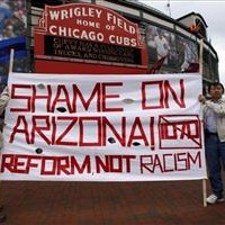
Actually, I don’t know that I even have a political policy. I do know that I rarely have made political comments in my columns, but I reserve the right to make them because there might be times when they are called for. Now, for example, when I am writing about the new Arizona immigration law as it affects baseball.
Can I write about the law without saying it’s a bad law? Isn’t that a political comment? No, I cannot, and yes, it is. But it’s easy to say it’s a bad law. It’s harder to say what, if anything, Major League Baseball should do in reaction to it.
Critics of the law have already called on MLB to take the 2011 All-Star game away from Arizona. They have urged fans to stay away from Diamondbacks games in Phoenix.
Derrick Hall, the Diamondbacks president, said a group called “Boycott Diamondbacks, which is part of “Boycott Arizona,” sprang into action as soon as the Arizona governor signed the bill, singling out Ken Kendrick, the team’s managing partner, whom the group said financed the legislation with contributions to state legislators.
“He is opposed to the bill,” Hall said. “The Kendrick family has contributed for years to Democrats. His father has been dead for 30 years and was a Democrat. Ken is opposed to the bill. He never gave any money to anyone in the state legislature, which is what their claim is.
“We’ve heard from so many Hispanic leaders in the community, saying ‘This is so misdirected. You’ve always been on our side.’”
Hall said the Diamondbacks have been targets of demonstrations in Denver and Chicago, and he expected more such action in Houston at the team’s next road stop.
There is another side.
“It is extremely controversial but extremely polarized, too,” Hall said. “I received calls from season-ticket holders saying 70 percent of our fans favor the law. As an organization, we never take a stance. We believe the Federal government should be more involved.”
The Federal government, however, appears unwilling to rush in to solve the immigration problem. A baseball official said he was told there’s no will in Washington to take up the immigration issue in the next year or two.
Under the Arizona law as it was adopted April 23, police were directed to question anyone they thought might be in the country illegally. A week later, under pressure of a threatened economic boycott, the legislature amended the law to say that police could stop and question a person only if he was suspected of violating another law. That was the way seat-belt laws used to read in some states.
Arizona Governor Jan Brewer said the amendments should ease concerns about racial profiling, but opponents, who challenge the law as discriminatory, remained unconvinced. The law requires immigrants to carry their alien registration documents at all times, and police can ask to see them.
 Meanwhile, the controversy rages outside Arizona.
One day earlier this week the commissioner’s office received more than an estimated 1,000 telephone calls on the issue, and 100 percent favored the law. The calls had been generated by right-wing talk radio shows whose hosts gave out the telephone number to their listeners. Opponents had also publicized the number and urged people to call.
The players union, which last week issued a statement critical of the law, also received telephone calls.
Hall called ill-conceived the “amount of pressure being put on the commissioner to move the All-Star game considering how hard we worked to get the game.”
Among others, two San Francisco, Calif., officials wrote a three-page letter to Selig asking that the All-Star game be moved from Phoenix if the law is not repealed.
But Selig is not moving the game so quickly. A homeowner in Arizona himself, the commissioner is well aware of the issues in the controversy, including the fact that the majority of the state’s citizens apparently favor the law. Does that make it right or acceptable? No, but it gives Selig pause to act on moving the game.
In addition, one MLB team plays in Arizona and 15 of its 30 teams hold spring training in the state. Any severe steps MLB were to take could adversely affect those business operations by risking alienation of many fans.
Selig is likely to remain silent on the subject for the time being, waiting for possible developments with the law. It has already been amended and could undergo additional changes as state legislators consider further fallout.
With time, other sports entities will also come under pressure to take action. If they remain united in their non-reaction to calls for boycott, though, baseball will feel less heat.
More heat on baseball will very likely come from its players than its fans. The union doesn’t view itself as a political organization, unlike the AFL-CIO, but as one union lawyer said, “we take positions on matters that have an impact on our members.”
Michael Weiner, the union chief, issued a 325-word statement last Friday that demonstrated that position.
“The recent passage by Arizona of a new immigration law could have a negative impact on hundreds of Major League players who are citizens of countries other than the United States,” Weiner said. “These international players are very much a part of our national pastime and are important members of our Association. Their contributions to our sport have been invaluable, and their exploits have been witnessed, enjoyed and applauded by millions of Americans. All of them, as well as the Clubs for whom they play, have gone to great lengths to ensure full compliance with federal immigration law.
“The impact of the bill signed into law in Arizona last Friday is not limited to the players on one team. The international players on the Diamondbacks work and, with their families, reside in Arizona from April through September or October. In addition, during the season, hundreds of international players on opposing Major League teams travel to Arizona to play the Diamondbacks. And, the spring training homes of half of the 30 Major League teams are now in Arizona.
“All of these players, as well as their families, could be adversely affected, even though their presence in the United States is legal. Each of them must be ready to prove, at any time, his identity and the legality of his being in Arizona to any state or local official with suspicion of his immigration status. This law also may affect players who are U.S. citizens but are suspected by law enforcement of being of foreign descent.
“The Major League Baseball Players Association opposes this law as written. We hope that the law is repealed or modified promptly. If the current law goes into effect, the MLBPA will consider additional steps necessary to protect the rights and interests of our members.
“My statement reflects the institutional position of the Union. It was arrived at after consultation with our members and after consideration of their various views on this controversial subject.”
If the law isn’t repealed or amended significantly to reduce possible misguided pressure on Hispanic players, will they act in their own behalf? They have reason for doing so, but I don’t think they will.
The players, though, aren’t alone in their view of the law. “I don’t think anyone thinks this law is a good idea,” a management person said.
If my self-identified right-wing reader objects to any political comment in this column, I will defend myself by explaining that I was a political science major in college and have little practical use for it in sports writing in the many years since.