The argument could be made that the Twins and the Tigers played one of the most scintillating games ever in a meaningless circumstance, and there was nowhere for the post-season games to go but down so they did.
That is not to say there weren’t any exciting games in the abbreviated division series phase of the post-season (three sweeps and a four-gamer, matching 2007 for the fewest division series games):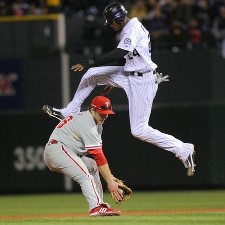
The Phillies, in the ninth inning, matched the Rockies’ three-run outburst in the eighth and ended that series with a 5-4 victory.
The Phillies scored a run in the ninth for a 6-5 Game 3 victory.
A three-run rally in the ninth gave the Angels a stunning 7-6 victory over the Red Sox in that series finale.
Alex Rodriguez cracked a two-run home run in the ninth inning, pulling the Yankees into a 3-3 Game 2 tie with the Twins, and Mark Teixeira won it with an 11th-inning homer.
The Dodgers scored two ninth-inning runs after Matt Holliday missed a two-out line drive and edged the Cardinals, 3-2, in their Game 2.
And then there was my favorite play of the post-season (it probably won’t be topped in the league championship series and the World Series): Dexter Fowler hurdling Chase Utley to avoid a baseline tag, a first-time feat (for me, at least) that sparked a three-run rally and a momentary 4-2 lead.
Had the Rockies held that lead and gone on to win the series, that play would have joined the pantheon of great post-season plays. It still belongs there but won’t get the attention and the acclaim it otherwise would deserve.
Amid all of these exciting events, though, there has been some very bad baseball played in this post-season. Baserunners, closers and umpires have been guilty of poor plays, or in the case of the umpires, bad calls.
The bad calls have produced an outcry for expansion of the replay system that Commissioner Bud Selig instituted late last season. That system deals with home runs, but in the aftermath of calls and non-calls in the division series fans and writers want more.
Do not include me among them. Maybe a wrong call is unfair, but baseball has survived Don Denkinger’s wrong call in the 1985 World Series and Richie Garcia’s errant ruling in the 1996 American League Championship Series. When players stop making mistakes, baseball can institute a system to guard against umpires’ mistakes.
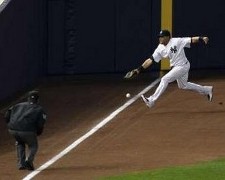 Were the calls by Phil Cuzzi on Joe Mauer’s bloop down the left field line and Jerry Meals’ non-call on Utley’s infield single worse than Holliday’s failure to catch James Loney’s line drive for the last out of the game?
The antidote to such wrong calls isn’t more replays; it’s better umpiring.
The Angels questioned a call by Greg Gibson at third base in the first game of their series with the Red Sox, but there was a lot of questionable reaction to the play having nothing to do with whether Mike Lowell tagged Torii Hunter before Hunter’s foot reached third base.
With the bases loaded, Juan Rivera hit a grounder to third. Lowell threw home to force Bobby Abreu and Victor Martinez fired the ball back to Lowell, who tagged the sliding Hunter for what Gibson said was a double play. But Lowell could have avoided the ensuing controversy by stepping on third for a force out. As a runner on second base with the bases loaded, Hunter remained in a force situation when Abreu was forced at home.
No one in the TBS television booth raised that issue; no one in the TBS truck whispered in the announcers’ ears to mention it on the air. I called Buck Martinez, one of the announcers, the next day to ask him about the omission of mention of a force play, and he said it was possible that Victor Martinez’s throw to third discombobulated them (he did not say discombobulated; that’s my word).
In that scenario, catchers almost always throw to first for the double play there so no one was expecting Martinez to throw to third. That’s a reasonable explanation, but if the announcers were too surprised to think of it, one of their technical people sitting in the truck in a more detached environment should have thought of it.
The players, on the other hand, didn’t have anyone to bail them out, and they couldn’t come back half an inning later and atone for their mistakes or their oversights.
The players who committed baserunning blunders, for example, had no recourse, and there were more of those than there should have been. Brett Gardner of the Yankees, Troy Tulowitzki of the Rockies and Shane Victorino of the Phillies were all doubled off base on line drives, all in scoring position, as in where were they going?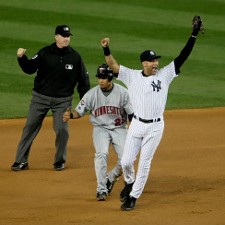
Gardner, pinch running, was at third with one out in the 10th inning of a 3-3 game and broke too soon on Johnny Damon’s line drive to short. Tulowitzki had just doubled home the Rockies’ first run, slicing the Phillies’ lead to 2-1 in the sixth inning of Game 4, and was doubled off on Garrett Atkins’ line drive to third. At least when Victorino was doubled off third on Ryan Howard’s liner to first, the Phillies were ahead, 5-0. Not that Victorino deserved to be excused.
Two Twins runners had no excuses for their blunders, especially considering the difficulty the Twins had with the Yankees.
In the fourth inning of a scoreless Game 2, A.J. Burnett hit two consecutive batters, Delmon Young and Carlos Gomez, with two-out pitches, and Matt Tolbert followed with a single to right. Gomez, however, squandered a certain run by rounding second too far, falling down and being tagged out scrambling back to second before Young reached home plate.
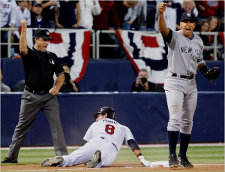
In Game 3, with the Yankees leading 2-1, Nick Punto led off the eighth inning with a double. Denard Span then hit a bouncer up the middle that Punto apparently thought was headed for center field. As he rounded third with thoughts of scoring the tying run, Derek Jeter snared the ball and threw home. Punto was out diving back into third.
 The Cardinals’ Colby Rasmus erred on the bases when, in game 2 against the Dodgers, he doubled home a run in the seventh inning for a 2-1 lead with no one out but got greedy, tried for a triple and was out.
Like Gardner for the Yankees, Reggie Willits was a pinch runner for the Angels, running for Juan Rivera after Rivera’s two-run single against Jonathan Papelbon slashed the Red Sox lead to 5-4 with two out in the eighth inning of Game 3. Immediately, though, Papelbon picked Willits off, shortcircuiting the Angels’ rally.
The Angels, however, resumed their rally in the ninth inning as Papelbon faltered for the first time in 18 post-season games. In 17 previous appearances he had allowed no runs in 26 innings. This night, though, the Angels rocked him for three two-out runs, the last two on Vladimir Guerrero’s bases-loaded single that produced a 7-6 Angels victory.
Papelbon was not the only closer to fail in the division series. Huston Street of Colorado and Joe Nathan of Minnesota did, too.
Street blew a 4-2 lead in the ninth inning of Game 4. Ryan Howard doubled home two runs and scored on a single by Jason Werth.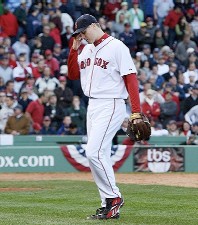
Nathan gave up a 3-1 lead in Game 2 against the Yankees. Mark Teixeira singled, and Alex Rodriguez homered.
Fernando Rodney of Detroit served as the forerunner for the closers’ failures. In the playoff game against the Twins he gave up the tying run in the 10th inning and the losing run in the 12th
At the division series rate, we could see many more baserunning and closing missteps in the league series and the World Series. Umpires could also miss more calls. But just as players don’t get do-overs, umpires shouldn’t get a chance to get it right.
I can’t imagine anything worse – even wrong calls – than sitting through reviews of plays to determine if a ball was fair or foul, if a runner was safe or out, if an outfielder caught or trapped a line drive.
Yes, it’s unfortunate if an umpire’s wrong call creates an unfair situation. But the way to avoid bad calls is for umpires to work harder to get their calls right. If league officials find an umpire getting calls wrong, send him back to school and let him write on the blackboard 100 times “I will get the calls right.”
