Many club executives did good jobs this year. Brian Cashman of the Yankees could be executive of the year for spending the Yankees back to the playoffs. John Mozeliak of St. Louis and Ned Colletti of Los Angeles could be executive of the year for trading their teams into the playoffs.
Dan O’Dowd of Colorado could be executive of the year for making a managerial change that sparked the Rockies into the playoffs. Nolan Ryan could be executive of the year for changing the pitching culture in Texas, helping turn the Rangers into a contender.
But maybe the most legitimate executive of the year is one whose team didn’t make the playoffs. The Seattle Mariners are not and were not in the playoffs because they didn’t win their division championship or the wild card. They did not even finish second to compete for the wild card.
What they did, though, was show the biggest improvement in their won-loss record in the major leagues this season, 10 games better than the Yankees, the only team in the American League playoffs that improved their record.
The Mariners went from a 61-101 record in 2008 to 85-77 this year. It is, according to Elias Sports Bureau research, one of the seven biggest improvements in the last decade (* denotes playoffs):
- 2008 Rays +31 wins*
- 2004 Tigers +29
- 2005 Diamondbacks +26
- 2000 Mariners +25*
- 2001 Angels +24
- 2005 Tigers +24
- 2009 Mariners +24
Jack Zduriencik is the architect of the group that transformed the Mariners from big losers into respectable winners. He has been the general manager for a year, and he has done a terrific job. How did he do it?
“Not having been here a year ago and probably realizing that the club underachieved in losing 101 games, there were probably a lot of things,” Zduriencik said. “There’s a whole new front office, a whole new coaching staff and some trades that were beneficial. The manager did a great job in the dugout. We changed the mindset, worked hard at it. We wanted to create an atmosphere where players wanted to be here.”
Zduriencik cited “tremendous leadership” from Ken Griffey Jr. and Mike Sweeny, a significant all-around contribution from center fielder Franklin Gutierrez and the closing success of David Aardsma. But he also acknowledged that the Mariners achieved their turnaround despite an offense that was weaker than last year.
“I sat here a lot of times scratching my head saying how did we win this one,” Zduriencik said.
The Mariners had the league’s lowest batting average (.258) and on-base percentage (.314), scored the fewest runs (3.96 a game), drew the fewest walks (421) and were next-to-last in slugging percentage (.402), total bases (2,228) and hits (1,430).
“Ichiro had a phenomenal year; he continued to do what he does – hit, hit, hit,” Zduriencik said, referring to Ichiro Suzuki, who hit .352, nearly 70 points higher than the next highest average, .283 for Gutierrez.
Russell Branyan and Jose Lopez powered the offense with career highs in home runs and runs batted in, 31 and 76 for Branyan, 25 and 96 for Lopez.
But it was the pitching staff that propelled the Mariners, posting the league’s lowest earned run average, 3.87, the only A.L. e.r.a. under 4.00 and nearly a whole run below last year’s 4.73. The Mariners also allowed the fewest runs, 4.27 a game; the fewest hits, 1,359, and the lowest opponents’ batting average, 247.
In their 162 starts, the team’s pitchers also had the lowest e.r.a., 3.89, and the lowest opponents’ batting average, .248.
 The oddity of the achievements of the pitching staff is that the Mariners had only one pitcher with double-digit wins. Felix Hernandez won 19 games, and no other pitcher won more than eight. Hernandez, of course, had a great season and is one of the leading candidates for the Cy Young award.
His value to the Mariners is seen in their record in games he started, 25-9, and in games he started after they had lost, 15-4.
Erik Bedard was the No. 2 starter, but he suffered a shoulder injury, didn’t pitch after July 25, had surgery Aug. 14 and finished with a 5-3 record and 2.82 e.r.a. in 15 starts. He was actually on the disabled list twice, as were third baseman Adrian Beltre and catcher Kenji Johjima. Carlos Silva, who was in the starting rotation at the start of the season, missed more than half the season, as did outfielder Endy Chavez.
“We had an enormous amount of injuries,” Zduriencik said.
But the Mariners overcame them, and Don Wakamatsu, baseball’s first Asian-American manager, kept the players focused on winning games whatever the setbacks.
“The players really enjoyed playing for Don,” Zduriencik said. “We wound up third in the division and if you had been here the last day you’d think we had won. Players enjoyed playing here. Fans enjoyed watching us play.”
Where do the Mariners go from 85 victories?
“That’s a very good question,” Zduriencik said. “It’s going to be a challenge. I didn’t measure this season on wins and losses. I told the players that in spring training, but what was important was that the players played up to their abilities. The goal was to look at it at the end of the year and be able to say I’m proud of you.”
In his previous jobs, particularly with the Milwaukee Brewers, Zduriencik was instrumental in drafting and developing good young players, including Prince Fielder and Ryan Braun. Do the Mariners have future Fielders and Brauns in their system?
“Not immediately,” Zduriencik said. “I wish we did. We have some kids we like in ‘A’ ball, but there’s not a Fielder or a Braun.”
With so many other general managers responsible for their playoff teams’ success, it’s unlikely that Zduriencik will be named anyone’s executive of the year. However, it wasn’t long ago that he received that honor. In 2007, recognizing his successful efforts with the Brewers, Baseball America made him the first non-general manager to receive its major league executive of the year award.
DODGERS FACE (Mc)COURT BATTLE
My one meeting with Frank McCourt, owner of the Los Angeles Dodgers, was for breakfast the morning of an owners meeting in New York a few years ago. One of the subjects I recall that we discussed was Arte Moreno’s hijacking of the Los Angeles name for his Angels.
As I have written more than once, I think it is ridiculous for baseball to allow one team to appropriate another team’s city for marketing purposes. When I expressed that view to McCourt and asked why he didn’t fight Moreno’s brazen, presumptuous act, the Dodgers’ owner said he had more important battles to fight.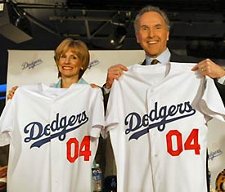
I got the feeling that McCourt was not a fighter. Now, though, we’ll find out how much of a fighter he is. He is about to become involved in a battle far more difficult and bitter than a geographical grab. Last week McCourt and his wife, Jamie, the Dodgers’ chief executive officer, announced that they had separated after 30 years of marriage. They said nothing about divorce, but that’s next on their agenda.
“This is going to be a messy divorce,” said a person who said he has known “for a long time” that the separation was coming.
Divorce is difficult enough without it being played out on a stage as big as the Dodgers and Major League Baseball. The McCourts’ play will be bigger and more dramatic than the one that led to the sale of the San Diego Padres. That one featured the divorce of John and Becky Moores and serves as a backdrop to the McCourt scenario.
A lawyer for Frank McCourt said McCourt events will be nothing like those that emerged from the Moores’ divorce, but he is either spinning fast or he is naïve.
“This is nasty,” said the person who is close enough to the McCourts to know what is happening, emphasizing the nastiness by adding, “Whew,” or some sound like that.
The initial issue seems to be ownership of the Dodgers. Frank’s lawyer has been quoted as saying that Frank is the sole owner of the team and is the control person for M.L.B. purposes.
“It’s a fair statement that he is the sole owner,” the person close to the McCourts said, “but that has nothing to do with what happens in court.”
Ah yes, court, where these things usually end up. “This will have to be determined in court,” the person said. “California is a 50-50 property state. This will be a difficult legal situation.”
The 50-50 remark refers to the division of property in a divorce. Unless Jamie McCourt signed a document rejecting any claim to the Dodgers, even in a divorce – and even then she could try to challenge it – it would seem she is entitled to half ownership of the team. But that will be up to a judge.
The McCourts were married in 1979, and the person close to them said they went together for many years before they were married. A photo of them from those years would be captioned “in happier times.”
ONCE UPON AN EARTHQUAKE
 Twenty years ago George Steinbrenner called Fay Vincent and told him never to do it again. “He chewed me out,” Vincent recalled the other day. “He said don’t you dare go on television again without a tie.”
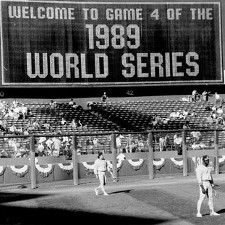
Twenty years ago last Saturday a 7.1 earthquake struck San Francisco and disrupted the 1989 World Series between the Giants and the Oakland Athletics, delaying Game 3 for 10 days.
Vincent, who had become commissioner the previous month after Bart Giamatti died, held a news conference the next day and appeared on the Today show with an open collar and no tie, a reasonable appearance given the no-lights circumstances at his hotel. I was impressed with Vincent’s nerve to go tieless.
One of his predecessors, Bowie Kuhn, was commissioner for 15 years and never appeared in public sans tie, even in the most casual of situations. Seeing Vincent without a tie told me something that I liked about him, and I like him to this day.
But back to the earthquake. As potentially dangerous as it was – my wife, who was at home, still gets chills when it is mentioned – the events of the next 24 hours turned the assignment into one of the most fascinating, if not the most, days of my career. It certainly was different from the game I had expected to cover.
I was in the auxiliary press box above the third base stands when the quake hit. Never having experienced an earthquake, I had no idea what the rumbling was about. It sounded like fans stamping their feet on the floor of the stands.
But a local knew immediately. “Earthquake,” he shouted.
The press box, hanging from the upper deck of stands, lurched forward. I was later told that if it had continued moving forward for a few more seconds, that is, if the earthquake had continued rumbling for a few more seconds, the press box would have kept going right off its mooring and crashed into the stands below. That’s the part my wife doesn’t like to hear.
Some reporters, locals, I would guess, thought quickly enough to race out the door of the press box. Not me. I was only a few feet from the door, but I stayed right where I was. Not that I had time to think, but I must have figured the story was in the press box and I wasn’t going to abandon the story.
Once the press box settled back where it started, I left and went down to the field, where the commissioner had remained at his box seat.
“The memory that has lasted the longest is two-fold,” Vincent said over the telephone. “Everyone involved in the earthquake – police, players, fans – everybody behaved very well. There was no panic. Everybody behaved well. It was a tough night.
“The second is of Isaiah Nelson, the police commander, who took charge. He came over and said this game should be canceled. We have a real problem. We have 53,000 people here, and it’s going to get dark. I said, okay, we’ll cancel the game. He said that’s great. He said you stay here, don’t leave. Stay visible right here in your seat, which I did, and we got through it.”
Twenty years later Vincent still praised Nelson for his cool direction in the disaster. He also recalled another incident involving Nelson.
“About six months later,” Vincent related, “he was on his motorcycle coming from Candlestick, skidded, went out of control and crashed. He hit the barrier that had been erected after the earthquake. That road had collapsed. They put up the barrier. He had forgotten about it and was going way too fast. He broke his neck and died.
“I wrote a piece about him for the Washington Post op-ed page. He hadn’t been given enough credit for being the unsung hero that night.”
I didn’t encounter Commander Nelson that night, but I spoke to the commissioner and any players and coaches I could find and returned to the press box to call in my notes to the news desk. By then, it was dark and the press box continued to be a perilous place, but the telephone was still working and there was one stadium light that I was able to use by stepping out of the press box, reading my notes, then going back to the phone.
When I finished my work at Candlestick, I somehow drove to the marina district to report on the fires and collapsed houses there. I incredibly found a payphone that was working and called in more notes. While I was on the phone, a young man, an out-of-town college student as it turned out, came by distraught because he wanted to call his parents to tell them he was all right but had no money to use the phone.
When I finished speaking with my office, instead of hanging up, I asked the young man for his phone number, punched it in on my telephone credit card, handed him the phone and left to go back to my hotel. There would be an early candlelight news conference to cover later that morning.
