Pat Gillick has been trying to retire for 20 years – or so it would seem – but Major League Baseball teams don’t want to let him. The Hall of Fame executive might not have meant it every time he left a job with the announcement that he was retiring, but I don’t think he planned to be working on a daily basis at his age, which happens to be 77.
Gillick was a natural when the Philadelphia Phillies needed a temporary replacement for David Montgomery, the team’s managing partner, president and chief executive officer, who needed additional time to recover completely from surgery for jaw cancer.
Gillick has been the club’s senior adviser to Montgomery and general manager Ruben Amaro since he retired as general manager following the 2008 season, the year the Phillies won the World Series. Last week he agreed to assume Montgomery’s role.
“For a month or two,” Gillick said Wednesday, possibly underestimating the recovery time Montgomery will require.
Given the Phillies’ underperforming ways of the past three seasons, particularly this year with the majors’ third highest payroll, $180 million, the idea that Gillick should perhaps return to his previous role of general manager was easy to raise.
After registering victory totals of 92, 93, 97 and 102 from 2008 through 2011, the Phillies have stumbled to 81 and 73 and had a winning percentage through Wednesday that would produce 74 this season.
Gillick made it clear that he has no intention to blame Amaro for the decline in the team’s play. Nor will he consider a change in general managers. In other words, the Phillies will not see Gillick’s return as general manager.
“Right now this is an interim situation,” Gillick said by telephone from Atlanta. “I’m keeping the seat hot. There are baseball decisions to make. Ruben will make them. If there’s something I don’t agree with, we’ll have to discuss them. Usually we’re on the same page.”
Gillick didn’t spell it out, but if everyone was on the same page, no one was exempt from contributing to the team’s decline.
“The last three years we’ve gone through a rough period,” Gillick said. “Some of our players are older players. We have to give our kids time to develop. We’re trying to win and trying to rebuild at the same time, which is a difficult process.”
Some of the Phillies’ veteran players haven’t performed up to previous levels, Gillick said, citing Ryan Howard as a prime example. Howard missed much of the previous two seasons with injuries and this season is hitting only .224 with a .379 slugging percentage.
“Some of the injuries we can replace,” Gillick said, “but some of the key performers we haven’t been able to replace.” Returning to a competitive status, he added, will not be accomplished easily and quickly. “It’s not going to be done overnight,” he said. “It’s a challenge for us and we’ll continue to work at it.”
Gillick has been better than most at building championship teams, which is why Philadelphia fans would be delighted to see him assume command beyond the next few weeks or even months.
Gillick was the first general manager of the expansion Toronto Blue Jays and oversaw their two consecutive World Series championship teams in 1992 and ’93. Gillick left the Blue Jays after the ’94 season, saying he was retiring, but it was believed he saw the team going into decline and decided that was a good time to leave. The Blue Jays have not returned to the post-season since.
Gillick next surfaced as general manager of the Baltimore Orioles, staying three years (’96-’98) and advancing to the post-season twice, as the wild-card team in ’96 and American League East champion in ’97.
Fed up with the massively interfering hand of owner Peter Angelos, Gillick left the Orioles after the ’97 season, and they didn’t see the playoffs again until they gained a wild-card spot in 2012.
Seattle, where Gillick and his wife Doris still live, was the next stop on the Gillick general-manager train after a one-year “retirement.” He served as the Mariners’ general manager for four years (2000-’03), engineering trips to the post-season as the wild card once and the A.L. West champions once (with an all-time record 116 wins). The Mariners haven’t played a post-season game since 2001.
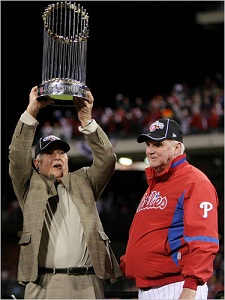 After leaving the Mariners, Gillick managed to remain retired for two years before the Phillies lured him back. He agreed to a three-year contract (2006-’08) and proceeded to direct the Phillies to the National League East title in ’07 and the World Series title in ’08.
Unlike Gillick’s previous teams, the Phillies hung around the post-season after his departure, losing to the New York Yankees in the 2009 World Series and to the San Francisco Giants in the 2010 N.L. series.
Gillick was on the road with the Phillies when we talked, taking an eyes-on approach, which managing partners, presidents and C.E.O.’s seldom do, but he reiterated that he hasn’t been watching with thoughts in mind to make changes.
“I don’t think there will be big changes,” he said. “Ruben was my assistant for three years and I’ve known him. We’re usually on the same page.
I come up with different ideas and creatively try to do some things we haven’t done. Maybe change a guy’s position, make a reliever a starter or a starter a reliever, things you can try internally.
“We all have input; we’re all in this together. But Ruben is the general manager. He’s in charge. He’s the guy who makes the ultimate decisions. You can advise and offer your input, but once you do, he has to make the decisions.”