Members of the Baseball Writers Association of America began voting players into the National Baseball Hall of Fame in 1936 with a 10-vote limit on their ballots. As no single year has seen more than five players reach the 75% threshold for induction, 10 players per ballot exceeds the realistic number of players a voter might expect are worthy of Hall of Fame recognition that year. 
The 10-player limit did not pose a problem to voter Murray Chass, whose aversion to voting for players accused or suspected of steroid use eliminated many popular names from consideration. Instead, he checked boxes next to four names on his 2014 ballot and left his six remaining slots blank.
SB Nation’s Rob Neyer criticized Chass for not using those extra spaces for players the former has deemed worthy of the Hall. “[H]e can’t seem to find room on his ballot, or in his heart, or deep within the recesses of that powerful intellect, for Curt Schilling, Mike Mussina, Tim Raines, Alan Trammell, or Larry Walker,” Neyer wrote, adding that Chass “doesn’t seem to have any sort of handle on the greatness of baseball players.”
The problem with this thinking, though, is that—Mussina excepted, as 2014 is his first appearance on the ballot—none of the players Neyer mentions came close to being elected last year, when 61% of the voters couldn’t find room on their ballots or in their hearts or deep within the recesses of their powerful intellects for Schilling, and 48% couldn’t find room for Raines—who needed six years to be named on even half of the submitted ballots—and 67% couldn’t find room for Trammell—who has languished below 40% in all 12 of his appearances on the ballot—and 78% couldn’t find room for Walker.
And the 10-vote limit cannot be cited as reason for voters not finding room for these borderline candidates (or, in the case of someone like Walker, not even borderline because he isn’t even within sight of the 75% threshold) in their previous attempts because the complaints about an overstuffed ballot didn’t appear en masse until this year, when surefire candidates such as Greg Maddux and Tom Glavine were added. The players Neyer mentions have cases that should be considered, and it’s possible that some of their careers are underappreciated by the writers, but that the majority doesn’t consider them worthy suggests that it should be more than a matter of voters simply seeing that they have spots left over in their allotment of 10 and deciding that they need filling.
Maybe the majority of writers don’t “have any sort of handle on the greatness of baseball players,” but then it’s a more widespread and deeply ingrained problem than just convincing one or two or five or even a hundred writers that a player like Trammell, who fell 236 votes short of election a year ago, should definitely receive a vote.
It’s fair to question a group that gives nearly twice as many votes for Jack Morris as Schilling, who seems to me a superior candidate in nearly every statistic, postseason performance included. It’s fair to want some alterations to a system that punishes some voters because they can only cast votes for 10 candidates out of a group of 12 or 15 they want to check off. And it’s fair to be irritated by a process that designs to highlight the best and most accomplished players in the sport’s history but instead has become a highly visible symbol of the contentious clash between traditionally valued (e.g. batting average and pitcher wins) and more recently appreciated statistics—from ones as simple as on-base percentage to metrics even more “advanced” than wins above replacement.
 It’s also fair, however, to think that when popular opinion holds that a player’s credentials aren’t sufficient to warrant a Hall vote, shaming the voters abstaining from checking off that candidate’s name is an ill-advised recourse. That’s not to suggest that a player receiving less than 50% of the vote doesn’t merit consideration—more than a dozen BBWAA inductees, most recently Bert Blyleven and Jim Rice, had a sub-majority showing on their first ballot appearance—but rather that Neyer might want to reconsider his Hall standards at the same time as he’s effectively telling 70% of the electorate to reconsider theirs.
Writers have spent the past month illustrating the rational, compelling cases for the non-Madduxes of the ballot. That’s fine; people are entitled to construct their personal Hall of Fame standards and apply them to the candidates. And maybe for those writers, Raines and Trammell and Walker surpass those personal standards.
But there’s the rub: each writer and each voter has the ability to determine his own benchmarks. The ballot gives no instruction on what makes a player Hall-worthy; there is no standardized “70 WAR=vote” or “X average or Y on-base percentage + Z home runs=vote” formula. And throughout 78 years of BBWAA voting, the writers have shown that collectively, their standards are incredibly difficult to meet.
Consider the position players who have been enshrined in the Hall. Organized by career WAR, per Baseball-Reference, you have to go down 42 spots to find the first, Arky Vaughan, who started his career in the 20th century and was forced to rely on the Veterans Committee for induction. Only Barry Bonds, Jeff Bagwell, and Lou Whitaker accumulated more WAR than Vaughan yet have escaped BBWAA election. Bonds, of course, was left off two-thirds of the ballots a year ago due to his steroid connections, but Bagwell is well on his way to election and Whitaker, like Vaughan before him, was a talented middle infielder who slipped through the cracks of the voting process.
Conversely, many of the Hall’s most questionable honorees were spurned by the BBWAA. Of the 30 position players in the Hall with the fewest WAR, only four were voted in by the writers, with the other 26 being voted in by various iterations of the Veterans and Old-Timers Committees. Only Roy Campanella, Pie Traynor, Rabbit Maranville, and Lou Brock are the exceptions, and even they make some sense as sportswriter selections, with Campanella a three-time MVP whose MLB career was cut short by the bookends of segregation and a car accident; Traynor viewed as the best-ever third baseman at the time of his selection; and Brock the all-time stolen base leader when he was inducted (Maranville’s election remains a mystery and a blemish on the writers’ voting record).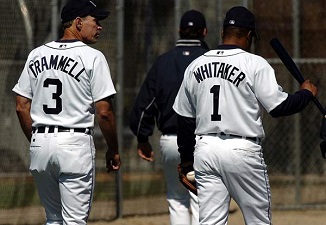
Put another way to emphasize the disparity between how writers have viewed the Hall of Fame standard as compared to other committees, if the BBWAA were the only entity able to elect players, Tony Perez’s career WAR would rate him as the 10th-worst position player in the Hall. With the other committees making additions, however, Perez ranks better than 59 other players.
Since they started voting for the Hall of Fame eight decades ago, the writers have done a consistently commendable job identifying the top players worthy of recognition, and they have always shown a preference for a smaller, more restrictive Hall. I’m not suggesting that Trammell and Walker are akin to the Lloyd Waners and High Pockets Kellys generally acknowledged as the worst players enshrined in the Hall, but it’s nothing new that players outside the top tier—the so-called “inner circle” Hall of Famers—are having trouble receiving votes from the BBWAA.
Dazzy Vance was the last player who retired before the Hall’s creation to be elected by the writers; after retiring in 1935, a year before the first ballot, he was part of 1955’s four-player Hall class. Since then, with the backlog of a half-century’s worth of great players exhausted, the BBWAA has never elected more than three players in a single year, and the writers have voted in even three players just four times in the intervening 58 years—and in each of those four instances, the third honoree passed the 75% threshold by a very narrow margin.
The average number of votes per ballot bears out this shift. Before 1958, when the ballots were filled with every worthy player since the turn of the 20th century, they always held an average of more than eight names and exceeded nine most years. And with such luminaries as Cy Young, Rogers Hornsby, and Jimmie Foxx needing multiple attempts to break 75%, the effort to contribute as many votes as possible was reasonable. Starting in the early 1960s, though, that average began to decline, hovering in the mid-sevens for two decades before falling below six for the first time in 1987—and it hasn’t risen back above seven since.
This year’s voters might halt these trends. If the percentages tabulated by Baseball Think Factory, which tracks the votes of writers who publish their ballots, are accurate indicators of the election’s results, the BBWAA will select four players with more than 80% of the vote this year—the first time since the inaugural ballot that so many will better 80%—with a fifth falling mere decimal points short of the 75% cutoff for election.
 Already, then, this election may prove nearly unprecedented in the number of players receiving such overwhelming support from a traditionally stingy cadre of voters. And with Randy Johnson, Pedro Martinez, and John Smoltz added to the 2015 ballot, plus typical gains by Mike Piazza and Jeff Bagwell, both of whom Baseball Think Factory projects to finish close to 75% this year, there’s a chance at setting the record for most players elected in a two-year span (currently eight, in the ballot’s first two years).
Whether it’s good for the Hall is another story.
The 2013 voting results, even without giving any one player 75%, showed an uptick in votes, with the 6.60 names per ballot the highest mark in a decade. This year’s early returns suggest that the rise will continue for at least another round of voting, but whether the current stretch of more votes per ballot and potentially more players elected per year is a short blip or an indicator of a larger shift in voter activity still needs to be determined. In any case, to accuse current voters of not checking off enough players on their ballots suggests a desire to relax election standards in a manner contrary to how the BBWAA has selected honorees since the Hall of Fame’s creation.
Some voters and online writers would seem to prefer a broader Hall field with players such as Trammell and Walker receiving more votes, and perhaps it’s time to give them increased consideration. But it would require a seismic change in how players are elected or how voters judge “the greatness of baseball players” for down-ballot candidates to merit consensus Hall consideration.
EDITOR’S NOTE: An earlier version of this column incorrectly stated a change in historical voting rules, which is described on baseball-reference.com but could not be confirmed elsewhere.