Baseball writers get enough criticism for their Hall of Fame voting from bloggers and fans without one of their own piling on, but they have asked for it and I am piling on.
Seventeen players made repeat appearances on the Hall of Fame ballot this year. Two of those players saw their 2013 vote totals increase, Craig Biggio by 39, Mike Piazza by 26.
The other 15, however, suffered voter falloff, some seriously. In all, they lost 545 votes from a year ago. With 571 writers voting, two more than last year, 15 players who were deemed Hall of Fame worthy a year ago lost their Cooperstown luster.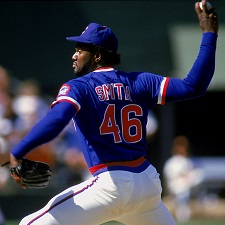
How does that happen? How does a writer put an ‘x’ in the box next to a player’s name last year, silently saying he belongs in the Hall, and then this year declaring with an empty box this player was not a Hall of Famer?
I can understand a voter reassessing a player’s attributes, statistical and otherwise, and deciding he really belongs. But how do you do that in reverse? I overrated him initially, and he really doesn’t belong?
“I don’t know how to explain it,” said Jack O’Connell, secretary-treasurer of the Baseball Writers Association. “The ballot was thin last year. This year people just seemed to vote for the first three guys.”
But O’Connell noted that the 571 voters averaged 8.4 names per ballot, which was higher than usual. There nevertheless should have been room for players who received votes last year.
O’Connell recalled that a similar development occurred in 1999, when Nolan Ryan, George Brett and Robin Yount were elected in their first time in the ballot.
Four-hundred-ninety-seven writers voted, and 17 holdover candidates received 395 fewer votes than the year before. None of the 17 players suffered triple-digit declines.
The most glaring example of this year’s voting trend was Lee Smith. In the eyes of 272 voters, Smith was a Hall of Famer in 2013. A year later he was a Hall of Famer to only 171 voters, a remarkable decline of 101 votes.
What had poor Lee Smith done in the interim? Outside of our view, he must have relieved in 50 games and squandered his team’s lead in each game. How else to account for his plunge in Hall of Fame consideration?
This is what I don’t understand. If 272 writers thought Smith Hall of Fame worthy in 2013, why did 101 of them reverse their opinion in 2014?
It’s not as if Smith was new to the voters. This was his 12th year on the ballot. In the first 11 years his lowest vote percentage was 36.6 percent in his second year. He had gone beyond 45 percent each of the past four years, reaching 50.6 percent two years ago.
In this vote he plummeted to 29.9 percent.
Other declines:
- Alan Trammell 72 votes
- Larry Walker 65
- Edgar Martinez 60
- Curt Schilling 54
- Fred McGriff 51
- Jack Morris 34
- Tim Raines 34
- Mark McGwire 33
- Sammy Sosa 30
- Jeff Bagwell 29
- Don Mattingly 28
- Rafael Palmeiro 25 and out
- Roger Clemens 12
- Barry Bonds 8
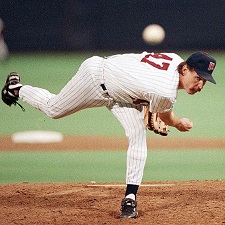 Morris suffered the largest loss because this was his 15th and last year on the ballot. In the previous five years, the winningest pitcher of the 1980s had watched his percentage climb toward the 75 percent level needed for election.
Morris reached his ballot-high 67.7 percent last year, but his 1 percent increase over the previous year wasn’t high enough historically to insure his election in his final year. Instead like 14 other players, he fell victim to three newcomers on the ballot, the three who were elected – Greg Maddux, Tom Glavine and Frank Thomas.
Instead of being elected himself, Morris joins Gil Hodges as the only players to receive more than 60 percent of the votes in any year and not be elected subsequently. Hodges also failed to be elected by the Hall’s veterans committee. Morris will be eligible to be on the expansion era ballot in three years.
Because most of the repeaters lost ground, it’s hard to say that the steroids suspects continued to slip in the balloting, except we know that Palmeiro won’t be on future ballots because he received only 4.4 percent, short of the 5 percent needed to remain on the ballot.
McGwire’s 11 percent was the lowest of his eight-year candidacy. Sosa slipped perilously close to the ejection button, receiving 7.2 percent. Clemens went from 37.6 to 35.4 and Bonds from 36.2 to 34.7.
If Biggio, who was two votes short of election this time, can get through the next year without a serious steroids snag, he is virtually certain to be elected. More than a dozen players have told reporters that Biggio used performance-enhancing drugs, but he never tested positive, was never suspended and did not appear in the Mitchell report or Balco or Biogenesis documents.
The issue of Biggio, steroids and the Hall of Fame came up in a conference call Thomas had with baseball writers after his election was announced.
“If he used,” Thomas said, “he doesn’t deserve to get in. If he didn’t, he deserves to get in.”
Piazza, also a steroids suspect but not a proven user, advanced from 57.8 percent in his first year to 62.2 percent. He denies – not surprisingly but also not convincingly – in his book published about a year ago that he used steroids, and if he can avoid damaging revelations he eventually should gain election.
When Thomas, 6-foot-5, 275 pounds, was asked about himself and steroids, he said, “I was always the biggest, strongest guy since I came into the league. I never thought about that nonsense. Staying away from that was very easy for me because of my background in college football.”
He said he saw films at Auburn that showed the dangers of steroids “and that stayed with me the rest of my life.”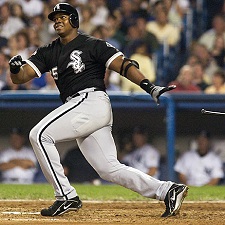
“I don’t fault anyone for what they did,” he added. “I did it the right way and that was right for my family. I can go home and rest and not go through what other guys were going through.”
Thomas didn’t mention any players by name, but he said there was “one guy in particular we all know who he is who was a Hall of Famer before” he got on steroids.
Asked later about Bonds and Clemens specifically, Thomas said, “As for what they did I don’t think any one of us will know. I know I did it the right way and that’s why I have a smile on my face.”
Thomas said he has attended events with Hall of Famers and “they don’t want” anyone in who has cheated. “The Hall of Fame means a lot to them and they don’t want them in.”
Like this year, the top candidates for the election next December are not steroids suspects, and they are pitchers. They are Randy Johnson, John Smoltz and Pedro Martinez.
I can’t wait to see how they affect the voting. Most of this year’s repeaters will be next year’s repeaters. Some of them could wind up with minus vote totals.