Just when we need George Mitchell, he’s off in the Middle East trying to solve an irresolvable problem. Actually, Mitchell and I were in the Middle East at the same time, and I should have taken advantage of our proximity to ask him what he’s going to do, if anything, about baseball’s latest scandal.
For what Major League Baseball paid him and his law firm for his steroids investigation – $25 million or more – Mitchell can extend his probe and find out who was responsible for putting the new Yankee Stadium on steroids.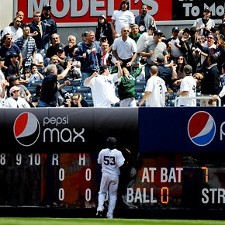
I mean home runs are flying into the new stands so frequently that it’s a dangerous place to venture into. It certainly isn’t safe for Yankees’ pitchers, and they play for the home team. With a home like that, who can wait to get on the road?
In the four-game series that opened the new stadium, the Cleveland Indians and the Yankees each slugged 10 home runs. In the corresponding number of games a year ago, the Yankees and their opponents each hit three home runs. The increase has everyone excited and not in a positive way.
The Yankees were so concerned or just plain curious that they hired a second engineering firm to study wind current at the new stadium.
The Yankees did not ignore wind currents. Part of the $1.5 billion cost of the new palace went to an aeronautical engineering firm to make a comprehensive wind study. The new Yankee Stadium faces in the same direction as its predecessor, and the engineering study said right field and center field would play the same way, at least in the summer. None of the engineers expected a major change with balls hit to right field.
Yet long balls have been hit to right field.
The Yankees don’t understand it so they have brought in another engineering firm to study the wind. They seem to be going to a lot if expense to do what we as kids used to do cheaply. We had two ways of checking the wind. Throw a blade of grass into the air and see what the wind does with it. Or wet an index finger and stick it in the air until you feel the wind blowing on the wet side of the finger.
Neither of the methods is likely to tell George Steinbrenner why balls are flying out of Yankee Stadium, but I’ll bet when the younger Steinbrenner was a football coach he walked onto the field before a game and either tossed a blade of grass into the air or stuck a finger in his mouth, then into the air.
But what’s the big deal anyway? At least the guys hitting the home runs aren’t fueled by steroids. We know that because they are tested for steroids. Has anyone tested the stadium for steroids? Don’t ask me how to do that. Ask Gary Wadler, who some day will have his likeness captured in bronze with the words “steroids zealot” etched on the surface.
No one questioned the dropoff in the Yankees’ home run production in the Bronx as they neared the close of the old stadium. They hit 126 in each of two successive seasons, 2004 and 2005. Then they hit 111, 107 and 92.
Now only a few games into the new stadium, theories abound about what is going on. The theories include juiced baseballs. Does that mean just like specially autographed balls are used in the World Series, baseball had balls made especially for the opening of Yankee Stadium and those balls are livelier? Don’t think so.
That the gush of home runs is viewed as a problem is interesting. Just a few years ago fans were excited about the increase in home runs generally, and they didn’t care if the balls flying over stadium fences were getting a chemical boost.
Should it matter now if balls are wind aided? There’s no rule against wind. Wind is not on a list of government-banned substances. Wind is pure and treats all teams and hitters the same. Wind plays no favorites.
At Wrigley Field in Chicago, both the Cubs and their opponents benefit or suffer when the wind is blowing in off the lake or out. It’s just that no one ever expected wind to be a factor in the Bronx. Where does it come from, the Harlem River?
 Can you imagine what Babe Ruth could have done with balls hit to right field getting caught in a jet stream? Heavens, he might have hit 60 home runs.
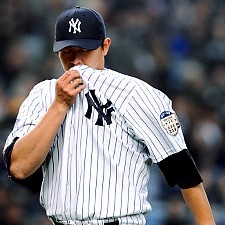
Rather than getting caught up in home runs flying out of Yankee Stadium, the Yankees should be concerned about the pitchers who are throwing the baseballs that are flying out of Yankee Stadium. They should be concerned about the 23 hits and 23 runs Chien-Ming Wang has allowed in 6 innings.
Those are scary numbers, unfit for human consumption. Having signed CC Sabathia and A.J. Burnett, the Yankees thought they had solved the pitching problems that have plagued them in recent seasons. They did not think Wang would have such problems returning from a foot injury that reduced his season to 15 starts last year.
The Yankees are not taking Wang’s start lightly and simply shrugging it off. They are skipping his next scheduled start and having him go to Tampa instead for remedial work.
Theories abound for Wang’s problems, too, among them the release point in his delivery is higher than it used to be, affecting his ability to throw his good sinker, and his foot has prevented him from doing enough running to get his legs sufficiently strong to throw with the same velocity he used to throw.
If the Yankees can figure out what Wang’s problem is, they should be able to fix it. They have enough pitching coaches to deal with Wang. Fixing the home run issue is something else. They have engineers to deal with that matter, but a solution is not necessarily imminent.