The Chicago Cubs haven’t won a World Series in 100 years, and the Florida Marlins are working on their third World Series championship in 13 years.
Whoa, slow down. The season is only two weeks old. It’s far too premature to be talking World Series. I recall how in 1948, when the previously woeful Pittsburgh Pirates were playing extremely well at some point but early in the season, my father wrote a letter to Rosey Rowswell, the Pirates’ radio announcer, applying for World Series tickets.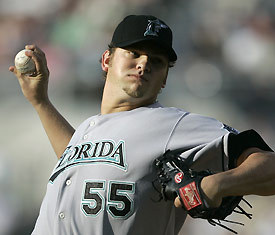
“You’re too optimistic for me, brother,” Rowswell replied, and the Pirates finished fourth that season.
The Marlins, though, have a World Series history even though their 2009 team bears no resemblance to either of the teams that created that history. No player from 1997 or 2003 is on this year’s team. But those championships came six years apart, and this is six years since the second one.
Given that 24 weeks remain in the season and baseball history is filled with teams that had terrific starts to their seasons but faded quickly, the Marlins have a lot of ground to cover before they can start making post-season plans. But they have won 10 of their first 11 games, and even though five of those wins came against the woeful Washington Nationals they swept a three-game series from Atlanta and won two of three games from the Mets.
The Marlins have played so well that they won Saturday’s 11-inning game against the Nationals even though Josh Johnson (above), perhaps their best pitcher, gave up six runs in six innings and saw his earned run average rise from 0.57 to 2.91.
Johnson (25; 2-0, 2.91) is part of the best young rotation in the majors, joined by Chris Volstad (22; 2-0, 1.50), Anibal Sanchez (25; 1-0, 1.64), Ricky Nolasco (26; 1-1, 6.60) and Andrew Miller (23; 0-0, 6.43). The rest of the team is young, too. Unless Alfredo Amezaga or Ross Gload is in the lineup, no one is even 30.
Besides World Series championships, the Marlins’ history is best known for roster decimation. Subsequent to each World Series title, they have shed their best players, who also happen to have been their highest-paid players. H. Wayne Huizenga and Jeffrey Loria, the respective owners of the World Series champions, wanted no part of a big payroll.
Now, though, a new park is on the way, and Loria has no excuse for shedding any more players because of their salaries. What the Marlins have done each time they have slashed payroll is they have done their homework, done a good job scouting minor league players and have received good young players in return for their high-priced stars.
For example, Sanchez and shortstop Hanley Ramirez came from Boston for Josh Beckett and Mike Lowell, Miller and center fielder Cameron Maybin came from Detroit for Miguel Cabrera and Dontrelle Willis and Nolasco came from the Cubs for Juan Pierre.
En route to their World Series triumphs, the Marlins won the wild-card spot in the National League playoffs, then roared by two division champions in each instance before defeating the Indians and the Yankees. Never a division champion but twice a World Series champion. The Marlins, whose $36.8 million payroll is the majors’ lowest, would be thrilled to follow that path this year.
BONIFACIO AND GANG
Many players serve as replacement players every season, and I don’t mean the kind who replaced striking players in spring training of 1995. That form of replacement player (a.k.a. scab) is nearly extinct. First baseman Kevin Millar of Toronto and relief pitchers Ron Mahay of Kansas City and Jamie Walker of Baltimore are the only players of that ugly era left in the majors.
No, the replacement players referred to here are players — free agents, trade acquisitions or rookies — who have been brought in to replace incumbent players or fill holes. It happens in abundance every year, and this year is no different. Sometimes the replacements represent an upgrade, sometimes not.
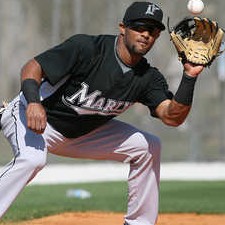 Let’s start with my favorite replacement. These days statistically oriented observers are enamored of such “names” as VORP, OPS and PECOTA. I like names, too, but they are the names of people who play the game, not the numbers that supposedly define them. The names have no significance other than their sound, and for the lyrical sound of his name my favorite is Emilio Bonifacio (at left).
Born in the Dominican Republic just about 24 years ago, Bonifacio is the Florida Marlins’ third baseman, replacing Jorge Cantu, who was moved across the infield to replace Mike Jacobs, whom the Marlins traded to Kansas City for reliever Leo Nunez. Bonifacio came to the Marlins in a five-player trade with Washington.
The infield replacements have been instrumental in the Marlins’ strong start as they try to do in the National League East what Tampa Bay did in the American League East last year. Bonifacio batted .347 and Cantu .378 as the Marlins won 10 of their first 11 games. A switch-hitter, Bonifacio batted .412 right-handed and .313 left-handed.
With the middle infielders, Dan Uggla and Hanley Ramirez, the team’s leading run producers with a combined 22 runs batted in, the infield has fueled a strong start to the season.
The sad-sack Seattle Mariners also got off to a strong start, winning 8 of their first 12 games with a mixed contribution from replacement players. And the Mariners surely have a lot of replacement players.
New members of the starting lineup are Russell Branyan at first base and Endy Chavez, Franklin Gutierrez and Ken Griffey Jr. in the outfield (with Griffey the designated hitter sometimes). Chavez, who joined the Mariners in the J.J. Putz trade with the Mets, was the team’s top hitter in its good 12-game start, batting .383 with 18 hits and 22 total bases.
The others, however, were not yet significant contributors. Branyan was hitting .273, Griffey .233 and Gutierrez .229. Griffey drove in only two runs (with two home runs) and Branyan three runs.
Orlando Hudson (at right), on the other hand, was at the forefront of the Los Angeles Dodgers’ 9-3 start. One of the last front-line free agents to sign a contract, the second baseman batted .354 and led the Dodgers with 17 hits and 29 total bases.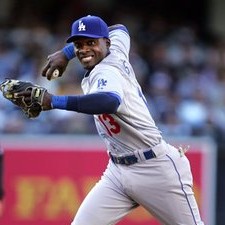
The San Diego Padres matched the Dodgers’ start, tying them for the early National League West lead, and they also had some replacements, though none as significant as Hudson.
David Eckstein (.295) and Luis Rodriguez (.240) made up the new middle infield, and Heath Bell, with 7 saves in 7 chances in 7 games, was the new closer, replacing Trevor Hoffman, the career saves leader.
The San Francisco Giants, with a new veteran starter and a brand new infield, weren’t doing as well. They staggered to a 3-8 start with Randy Johnson losing his first two starts under the weight of an 11.42 earned run average and the new infield all struggling at bat: Travis Ishikawa .172, Emmanuel Burriss .212, Edgar Renteria .189, Pablo Sandoval .195
With a .231 batting average and a .359 slugging percentage, Ivan Rodriguez, a last-minute sign following his World Baseball Classic performance, isn’t doing much to help the Houston Astros. However, the oft-injured Mike Hampton won one of his first two starts and has a 2.45 e.r.a.
In Chicago, the Cubs didn’t expect Milton Bradley, their new right fielder, to get one hit in 19 at-bats (.053), but he didn’t expect to suffer a strained groin in the first week of the season.
The St. Louis Cardinals have again lost their best starting pitcher, Chris Carpenter to injury (torn oblique, out 4 to 8 weeks), but their basically new infield is intact. Joining Albert Pujols are Skip Schumaker (.268), Khalil Greene (.234) and on a part-time basis Brian Barden (.409).
Philadelphia and Atlanta have new outfielders, and they are at opposite extremes. Raul Ibanez was hitting .375 for the Phillies and leading them in total bases with 32, but Garret Anderson was hitting only .174 for the Braves.
The Yankees have the most expensive replacements, $423.5 million worth of them, in fact. A. J. Burnett has quickly demonstrated his value, winning his first two starts and not incurring an injury.
CC Sabathia has made three starts with mixed results, but one statistic stands out and requires further scrutiny. In his most recent game, the Yankee Stadium home opener against Cleveland, he threw the relatively high total of 122 pitches and lasted only 5 2/3 innings. That’s no way for a $23 million-a-year pitcher to work.
Mark Teixeira, who has replaced Jason Giambi at first base, had only 6 hits, half of them home runs, in his first 31 at-bats (.194), but the Yankees’ most literal replacement was hitting even worse. Cody Ransom, who has replaced Alex Rodriguez at third, had only 5 hits in his first 36 at-bats (.139).
Like Ransom, Nick Green (.278, 5-for-18) has become an injury replacement, playing shortstop in Boston in place of Jed Lowrie, who injured a wrist and fears he may be out for the season. Julio Lugo, who had lost at least part of his job to Lowrie, is recovering from knee surgery.
Pat Burrell, Tampa Bay’s new designated hitter, has started slowly, hitting .225 (9-fot-40). Another designated hitter, Jason Giambi, was hitting .250 for Oakland. The Athletics had assorted other replacements. Left fielder Matt Holliday was hitting .244 and leading the team in runs batted in with 9. Shortstop Orlando Cabrera was hitting .256 and Nomar Garciaparra, playing first and third, had a .179 average.
Bobby Abreu, a last-minute addition to the Angels’ roster via free agency, was hitting ,341. Kendry Morales, who spent parts of the previous three seasons in Anaheim, was named the Angels’ first baseman this season, replacing Teixeira, but at .244 was hitting more like the 2009 Teixeira than the 2008 version.
CALL ‘EM WHAT THEY ARE
When the owners voted in 1995 to use scabs as replacements for striking players (at The New York Times we weren’t allowed to use the word scab; it was considered to have a derogatory connotation), Peter Angelos, the Baltimore owner, was a holdout. He refused to sign replacement players and field a replacement team.
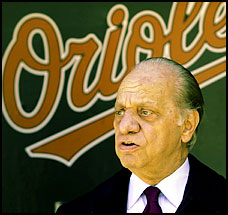 At the time, he explained his position by saying if the clubs went ahead playing the schedule with replacements, the playing streak of his modern-day Lou Gehrig would end, and Cal Ripken would be deprived of a chance to break Gehrig’s record of 2,130 consecutive games played.
That seemed to be a reasonable explanation, but skeptics suspected another reason. Angelos was a negligence lawyer who had become wealthy representing union workers in asbestos cases. By using replacement players in his baseball business, the suspicious-minded felt, Angelos would be acting against the interests of the baseball players union and undermine his representation of other unions.
The owners’ threat to start the season with replacement players either was a bluff that failed, or the owners came to their senses and decided not to implement the scheme.
Fourteen years later Kevin Millar, Ron Mahay and Jamie Walker remain from the players who were signed as replacement players. Like all replacement players, they have been refused union membership and do not receive shares of the union’s licensing program. The union, however, has always provided its services in representing replacement players in grievances.
Interestingly, two of the three remaining replacement players have played for and been paid by Angelos. Millar played for the Orioles for three years, 2006 through 2008, and Walker is in his third season with them.
BREAKING UP AGAIN
They once represented the Mets’ potential future outfield, but now they are scattered in three different organizations. However, they are no longer all in the major leagues.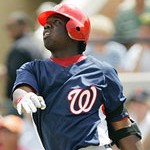
The Washington Nationals last week demoted Lastings Milledge (at right) to the minors, the result of a punchless start to the season and questionable behavior, leaving Carlos Gomez of Minnesota and Endy Chavez of Seattle from the trio the Mets traded for Johan Santana, J.J. Putz, Brian Schneider and Ryan Church.
Milledge, who was late for a team meeting the day before the season began, had only 4 hits in 24 at-bats in 7 games for a .167 average. He batted .268 as the Nationals’ center fielder last season after they traded Schneider and Church for him.
Gomez may not be far behind, He was hitting .125 (4 for 32) in 11 games as Minnesota’s center fielder. Chavez, however, has been exceptional as Seattle’s left fielder. He was hitting .383 (18 for 47) in 12 games with .442 on-base and .468 slugging percentages. He led the Mariners with 17 hits and 20 total bases.
PITCHING GENERALLY
 For World War II buffs, the boxscore of last Thursday’s game between the St. Louis Cardinals and the Chicago Cubs was pure gold. The names Marshall, Patton and Wainwright appeared in the pitching lines.
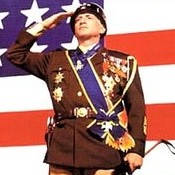
Those were the names of three famous American generals in the war, each one known for memorable events and developments: George C. Marshall, George S. Patton Jr. (pictured as played by George C. Scott) and Jonathan Wainwright.
The pitchers, Sean Marshall and David Patton of the Cubs and Adam Wainwright of the Cardinals, are less well known and have yet to achieve anything memorable, unless you count the contribution of four post-season saves in an emergency role by Wainwright in 2006.
The same boxscore had an added touch for military history students. Kyle McClellan relieved Wainwright for the Cardinals. George McClellan was a Union general in the Civil War, though not admired by President Lincoln. But then Patton had his problems, too.
D’BACKS GO DVD
Earlier this year I lamented the demise of the print versions of the American League Red Book and the National League Green Book. They had been part of my research library since I began covering baseball.
A few readers wrote and ridiculed me for my old-fashioned, outdated approach to these things. The books are on the Internet, they said; print them out and have your printed books, if you must, but you can access the same information on line. Get with the 21st Century, they said without saying it exactly that way.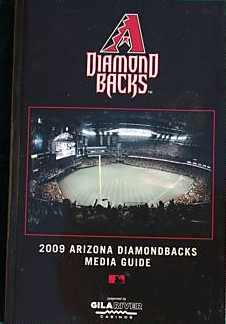
Their reaction to this item will be similar. I received in the mail not long ago a DVD from the Arizona Diamondbacks. It wasn’t a highlight film of the 2008 season or a belated film of their 2001 World Series triumph.
“Enclosed is a copy of the Arizona Diamondbacks’ DVD media guide…,” said the enclosed letter from Shaun Rachau, vice president of communications. “The DVD contains PDF files of all the same material in the D-backs printed media guide…
“Feel free to copy all of the PDF files on to your computer hard drive or simply put the lightweight DVD into your carry-on bag. I can assure you that the DVD will be easier to travel with or create less clutter on your desk compared to our 372-page printed media guide.”
If I had reason to travel for Diamondbacks games, I might take Shaun up on his suggestion because the thickness and weight of media guides have become ungainly. But sitting at my desk, I don’t mind having a media guide on it. In fact, I prefer it, especially if it’s a spiral guide because then the guide would stay open to whatever page I wanted.
The Diamondbacks had another reason for creating the DVD, which Rachau explained in the letter. It was devised, he said, in “tune with Major League Baseball’s green initiatives.” (That’s not green as in Green Book.) The team has printed 2,000 fewer guides than last year.
The reduction in the number of printed guides, he wrote, “allowed us to use 38,000 less sheets of 25 ½ x 38-inch paper that weighed more than 3,400 pounds.” So the Diamondbacks are helping baseball writers and the environment.
The printed guides are still available, Rachau wrote, and you can bet I will be requesting one. Despite my old-fashioned ways, I applaud the Diamondbacks for their pioneering effort. But I am glad they are the only ones who have come up with the idea this year.
