The Yankees seem to have figured it out finally. Three years after their aborted effort to add Phil Hughes to their starting rotation and a year after they assigned him to the bullpen, he is in the rotation and has the best record of any pitcher in the rotation.
In fact, he has the best winning percentage among American League starters and is tied for the most wins with 10. Yet his road to this juncture has been filled with potholes.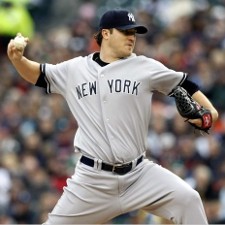
The Yankees have guessed right and wrong with Hughes, but considering developments with the team and the pitcher, they have been more right than wrong, which means they have been more lucky than good.
The Yankees and Hughes were unlucky in 2007, his rookie year. In his second start Hughes had a no-hitter through 6 1/3 innings but injured his hamstring and had to leave the game.
The next year Hughes began the season in the starting rotation as the youngest pitcher in the majors. He failed the test, though, compiling a 0-4 record and 6.62 earned run average in 8 starts.
By spring training 2009 Hughes had fallen behind Joba Chamberlain.
“Joba was ahead of Hughes on the depth chart,” general manager Brian Cashman said. “Hughes was an emergency starter at Triple A.”
After he was recalled from the minors in late April of that season, Hughes filled in as a starter but eventually migrated to the bullpen and became the setup man for Mariano Rivera. Chamberlain, meanwhile, was disappointing in his starting role, compiling a 9-6 record with a 4.75 e.r.a. He was not the pitcher who dominated batters as a reliever.
That Hughes was still with the Yankees in 2008 and ‘09 was a mistake, according to some Yankees critics.
Before the 2008 season, the Minnesota Twins offered the Yankees Johan Santana for a package of players, Hughes included. The Yankees rejected the proposed deal.
After the Yankees signed CC Sabathia and A.J. Burnett the following off-season, Cashman explained that their pending availability was the reason he opted to pass on Santana, one of the best pitchers in baseball.
Officials of other clubs were skeptical of that explanation. “There was no guarantee Sabathia was going to be available,” an executive of another club said. “He could have signed with Milwaukee or been traded and signed. It’s easy to say that after the fact.”
Another official who was familiar with the Yankees’ thinking at the time said that Cashman acknowledged Santana’s ability and his value but felt he wasn’t worth both the prospects, primarily Hughes, he would cost and the money the Yankees would have to spend to keep him from becoming a free agent after the season.
“He got totally lucky,” the official said. “How could you predict that CC would go to New York?”
One way would be to give Sabathia a $161 million contract. So the Yankees gave Sabathia more money than the Mets gave Santana, but the Yankees still had Hughes.
Given the way Hughes has pitched this season and that the Yankees won the World Series without Santana last year, they have to be credited with making the right decision in 2008.
But what about their decision to have Chamberlain start and Hughes relieve last year? That was contrary to the prevailing view in baseball about the way the two pitchers should be used.
It seemed to set Chamberlain back, perhaps both physically and mentally. Jerking him back and forth between relieving and starting seems to have affected his effectiveness.
How did Hughes’ time in the bullpen affect him? Did it hinder or delay his development as a starter? Or might it have helped him? Cashman votes for the latter.
“No doubt about it,” Cashman said. “His time in the bullpen basically helped him stuffwise. He was a work in progress. When he went to the bullpen and was able to do what he did, it finished off his development. He gained the confidence he was missing. Instead of thinking ‘I think I can do it,’ it became ‘I know I can do it.’ The relief experience helped him realize he could get any major league hitter out. That finished off his development.”
While Hughes has blossomed with a 10-1 record after beating out four others, including Chamberlain, for the No. 5 starting assignment, Santana has raised questions with his pitching this season.
 The 31-year-old left-hander has lost velocity from his fastball, and his strikeouts-to-walks ratio is not what it used to be.
Prior to this season, Santana had 3.66 strikeouts for every walk. This season that ratio has dropped to 2 to 1, with 62 strikeouts and 31 walks. The change in ratio is linked to his decrease in velocity.
The Mets attribute the drop-off to the elbow operation Santana had last September. It was minor surgery, but any operation requires an adjustment period for velocity and command.
The Mets are constantly evaluating Santana and so far have no reason for concern. They feel Santana’s velocity will pick up with time, and he will once again become the dominant pitcher he has always been.
The Yankees wish Santana no hardship, but they are happy with their 2008 decision and look forward to many more productive seasons from Hughes.