The thought struck Davey Johnson as he responded to a question about the dismal state of the team he used to play for and manage. What can the Baltimore Orioles do to reverse the string of losing seasons they have endured since Johnson left as their manager?
“Get Gillick back, maybe Gillick will bring me back,” Johnson said. “We can start over.”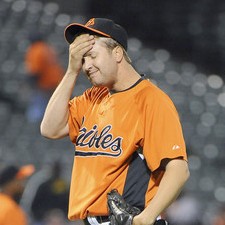
The Orioles turned into a disaster area after Johnson resigned following the 1997 season and general manager Pat Gillick followed a year later. The Orioles won the American League East title in 1997 but haven’t been able to win half of its games in any of the 12 seasons since.
Worse, in the last five seasons, the Orioles have lost more games than the year before. And this year they are well on their way to a 13th successive losing season and, losing at a rate that would produce only 45 wins for the season, a sixth straight with more losses.
Is this any way to run a Major League Baseball team? It apparently is if the owner is Peter Angelos. I tried to reach Angelos to ask him how and why he has allowed the Orioles to deteriorate from their status as the best organization in baseball. He did not call back, however.
The Orioles were the best for a long time. Ken Nigro, a former baseball writer for the Baltimore Sun (that’s a newspaper, and if you ask what’s a newspaper, you’re the reason the industry is dying), recalled that he covered the Orioles for 12 years, and in 10 of those years the Orioles won 90 or more games, they won 88 in another season and the 12th year was the strike season of 1994.
Nigro also recalled that other teams referred to the Baltimore style of play and operation as “The Oriole Way” and used it as a model for themselves.
From 1963 through 1985, a 23-year span, the Orioles had 22 winning seasons. They finished first eight times and played in six World Series, winning three of them. They had only four managers in that time but Earl Weaver for most of that time.
Perhaps most impressive, though, was they had two dozen 20-game winners, including four in 1971. Some player will break Joe DiMaggio’s 56-game hitting streak before some team will match that achievement.
Having no legitimate link to that heritage, these Orioles are trying to resurrect themselves through pitching, though it is taking them longer than they anticipated.
In a September 2006 telephone call he did return, Angelos heralded the future of the Orioles’ pitching.
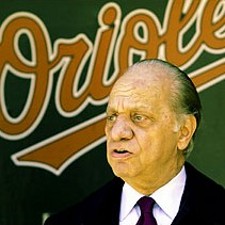 “I think we have the makings of a first-class pitching staff,” he said. “We have four young pitchers who are doing well. If their talent and commitment hold true, I think in a year or two they’ll be one of the best pitching staffs in the American League.”
Angelos, who apparently was not familiar with the frailty and unpredictability of young pitching, was prematurely optimistic. The pitchers he was counting on did not develop “in a year or two,” and the pitcher who headed the group, Erik Bedard, was traded in February 2008 to Seattle, where he has not pitched this season because he is recovering from shoulder surgery.
Yet the Orioles are committed to their pitching plans. “That’s where we’re focusing,” said Andy MacPhail, the president of baseball operations.
The Orioles have three parts of their future in the starting rotation – Brian Matusz, 23, left-hander (2-7, 4.67 in 14 starts); Chris Tillman, 22, right-hander (0-3, 8.40, 4 starts); Jake Arrieta, 24, right-hander (2-0, 2.77, 2 starts). Are they in the rotation because they belong there or because the Orioles needed them there?
“With Matusz and Arietta this is where they belong,” MacPhail said. “Their minor league performance indicated that. Tillman is 22, but he accomplished what he needed to in the minors.”
“We have some more pitching coming, we think,” MacPhail added. “My belief is you’re not going to attract pitching to come to Camden Yards, and the A.L. East is expensive. It’s better developing your own pitching and spend on hitting.”
Orioles’ critics complain that Angelos isn’t willing to spend money, and at times he has demonstrated that trait. But the Orioles began this season with an $81.6 million payroll, which is in the middle of all major league payrolls and is in the middle of the division, behind the Yankees and the Red Sox and ahead of the Rays and the Blue Jays.
Of course, some perspective needs to be added to that last fact. The Yankees $206 million payroll is two and a half times greater and the Red Sox $162.7 million payroll is nearly twice as much.
To add further payroll perspective to the division disparity, when the Orioles won the division title under Johnson in 1997, their payroll was $55.7 million, second in the majors to the Yankees’ $59.6 million. Those payrolls aren’t so neighborly any more.
“When I went there and they got Gillick out of retirement,” Johnson recalled, “he brought in some good players, I thought they were going to be good for a while.”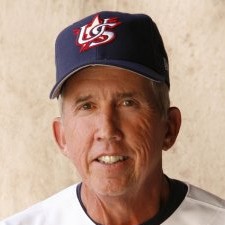
The Orioles, who had won the wild card the previous year, edged the Yankees for first in the second year of Johnson’s three-year contract. Johnson sought a contract extension but didn’t get it and resigned on the day he was named A.L. manager of the year.
“That was weird, wasn‘t it?” Johnson said.
What happened between Johnson and Angelos that led to their breakup?
“Peter wanted us to win it all,” Johnson said. “I’m sure that was part of his displeasure that we didn’t win it all. My second year we went wire to wire ahead of the Yankees, but we came up a little short.”
The Orioles have come up a lot short ever since. A promising future evaporated as Johnson left and Gillick followed a year later, weary of wrangling with Angelos.
General managers came and went until three years ago today (Sunday) Angelos brought in MacPhail to change the course of the team. But no miracle yet.
Some people questioned MacPhail’s sanity in going to work for Angelos, but MacPhail felt he knew Angelos well enough from having worked with him on labor matters for the commissioner’s office.
MacPhail was general manager of the 1987 and 1991 Minnesota Twins, who won the World Series, but as chief of the Chicago Cubs was more effective increasing attendance at Wrigley Field than he was producing a World Series winner.
Now he is working on a seemingly impossible mission. Running in reverse was not what he had in mind, but injuries to second baseman Brian Roberts (4 games) and left fielder Felix Pie (8 games), the first two batters in the lineup, have short-circuited the offense, which is last or close to last in most important offensive categories.
“We are just abysmal with runners in scoring position,” MacPhail said. “We’re not scoring enough runs. We have a nucleus of young players who have taken a step backward in their sophomore year, which happens in our sport.”
It is a truism in baseball also that when teams keep losing games they also lose fans. In the first nine years of Camden Yards, excluding the strike season of 1994, the Orioles drew more than 3 million in attendance nine times, exceeding 3.5 million five times. The past two years the attendance has fallen short of 2 million, and it figures to fall short again this year.
“I live two blocks from the stadium and I see the devastation,” said Nestor Aparicio, operator of a talk radio station, who is a leading critic of Angelos and the Orioles. Several years ago he organized a mass in-game walkout at Camden Yards.
“It begins with the owner and ends with the owner,” Aparicio said of the Orioles’ problems. “You can’t attract talent and can’t attract managers,” he said. “You can’t win.”
Has MacPhail’s presence helped? “Andy has done a good job of standing in the way and taking the bullets for Peter,” Aparicio said.
LOOK WHO’S COMING TO LUNCH
The Orioles are holding a 40th anniversary luncheon Saturday to honor their 1970 World Series championship team. The days leading to the luncheon have not passed without controversy.
 The dispute, two people familiar with it said, began when Jim Palmer told the Orioles he wanted to bring as a guest the team’s original batboy from that season. The Orioles said the batboy could attend but would have to pay $250 for a ticket. At least that was the story making the rounds of people close to the 1970 champs.
The batboy, Roy Firestone, can probably easily afford to pay the price, but that wasn’t the point to Palmer, who was said to have threatened not to attend if Firestone had to pay. That part of the story definitely is not true, a club official said.
Firestone is the noted ESPN interviewer who has also appeared, according to his Web site, at more than 2,000 venues as a performer, monologist, musician, humorist and impressionist.
In a telephone interview, Firestone said he grew up in Miami, where the Orioles held spring training, and served as a batboy for three springs, starting in 1970 when he was 15 years old.
Firestone is the batboy Palmer wanted to take to the luncheon, and Firestone plans to attend, but he wouldn’t discuss the controversy or even acknowledge that there was one.
“I’m not going to comment on it,” Firestone said. “I’m a fan of the Orioles. Whatever the situation, however it’s resolved, Bill Stetka (club official) is trying to be helpful. I don’t want to get into a hissing match with the Orioles.
I gave them my credit card.”
“Palmer is a good guy,” Firestone added. “I’m going there for one reason. I want to see my friends. I’ll do whatever I need to do to see my friends.”
Stetka, reached Saturday night, said there was never any intention of keeping Firestone away.
“We had sold out the luncheon when Roy asked about coming,” Stetka said. “Jim simply asked if he could bring Roy as a guest. He did not threaten not to attend. He never threatened anything. Roy is coming.”
Stetka explained that the number of guests had to be limited because each one will pose with the players. “How long can you have 18 guys standing there posing for pictures?” he asked.
Stetka said 13 players and coaches from the team have died.
RECALLING GUIDRY AND GOODEN
Much is being made, as it should be, about Ubaldo Jimenez’s 13-1 record in his first 14 starts this season. The performance of the Colorado Rockies’ right-hander, however, recalls performances of two New York pitchers, Ron Guidry and Dwight Gooden.
In 1985 Gooden compiled a 24-4 record for the Mets. A 1.53 earned run average went with it. After Gooden’s first 10 starts that season, he had a 6-3 record and nothing spectacular seemed to be happening.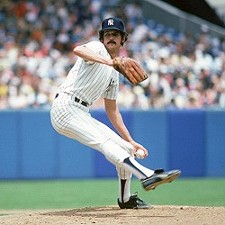
In his next 18 starts over three months, however, Gooden won 14 times without losing, becoming a 20-game winner Aug. 25 with a 9-3 win over San Diego. The 20-year-old right-hander lost his next start, a 3-2 decision to San Francisco, but finished with a flourish, winning his last four decisions.
My favorite pitching performance was Guidry’s 25-3 with a 1.74 e.r.a. for the Yankees in 1978. Starting the season at the age of 27 and finishing it at 28, the left-hander had a perfect record, 13-0, after 17 starts. It wasn’t until start No. 18, July 7 in Milwaukee in the last series before the All-Star break, that Guidry suffered a loss, a 6-0 decision to Mike Caldwell.
Four weeks later Guidry pitched a complete-game 5-hitter against Baltimore but lost, 2-1, to another left-handed Mike, last name Flanagan.
That loss made his record 15-2, and he reeled off seven more victories, reaching 22-2, before the Toronto Blue Jays knocked him out in the second inning of what would become an 8-1 loss. The pitcher who beat him? Yet another left-handed Mike, this one Willis.
Guidry made three more starts during the regular season and won them all. Two of the opposing pitchers were Mikes, but both were right-handed, Paxton and Torrez. His start against Torrez came in the playoff game against Boston, and that became his 25th victory.