What am I missing? I must be missing something. A news report says that Manny Ramirez and David Ortiz tested positive for the use of performance-enhancing substances in 2003, and people, including Boston fans, instantly question the Red Sox World Series championships in 2004 and 2007.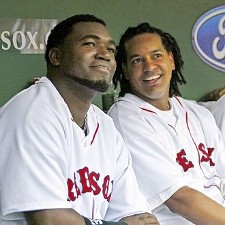
What does 2003 have to do with 2004 and 2007? Weren’t Ramirez and Ortiz tested in 2004 and 2007, and weren’t those tests negative? Why should their 2003 tests be attached to 2004 and 2007 and have any bearing on the outcome of those seasons?
Do people assume that because Ramirez and Ortiz tested positive in 2003 they used steroids in 2004? Assume all they want, but the Red Sox dynamic duo didn’t test positive in 2004. You can’t find them guilty by association with their 2003 tests.
I have a more relevant question that no one is asking but someone should. Is The New York Times breaking the law in reporting the positive 2003 tests of Ramirez, Ortiz and Sammy Sosa? Why doesn’t anyone care if the Times is breaking the law?
Donald Fehr cares. The head of the players union and a long-time lawyer, Fehr issued a statement last week in response to the Times report on Ramirez and Ortiz in which he said quite clearly that the Times is breaking the law. Fehr declined to comment on the report itself because the judge’s order bars him from saying anything about the case.
“But,” he said in a statement, “there should be no mistake. The leaking of information under a court seal is a crime. The active pursuit of information that may not lawfully be disclosed because it is under court seal is a crime.”
And Fehr said it was sad that “the Times is pursuing and publishing what it openly declares to be information which may not be legally disclosed.”
The Times disagrees with Fehr’s view, saying it is not breaking any laws or doing anything improper. George Freeman, the Times’ assistant general counsel, said, “This is a reporter’s duty. You try to get people to give you information all the time. If you pay somebody to do something illegal or facilitate their finding something illegal, that’s one thing. The law is pretty clear on that. The reporter has to be actively involved in a crime, If you just ask questions, that’s not illegal. That’s how we get information.”
The names the Times has published are under court seal. That seal bars lawyers and anyone else connected to the legal fight between the players union and the Federal government from discussing or divulging any of the information, namely the names on the list of positive test results.
Yet the Times reporter, Michael Schmidt, has by his own admission called everyone he could think of connected to the case to try to get names. Schmidt has declined to discuss the criminal aspect of his pursuit of names, but the Times executive editor, Bill Keller, has said it is ludicrous to call it criminal. The Times, he has said, is simply practicing journalism.
In 39 years at the Times, I collected and published a significant amount of information that people didn’t want to have disclosed. But I don’t recall any instance where my acquisition of the information crossed a line. There was also a valid reason for getting the information. I’m not sure getting the 2003 names is valid.
 Why are the newspaper and the reporter so eager to get the names? The answer is easy to arrive at.
Schmidt and the Times are pursuing a prurient pastime. The name of its game is beating the Times’ competitors to the names, not uncovering some nefarious practice that cries out for sunlight. The names are six years old. Most of the 100 or so players on the list probably aren’t even active anymore. Of the players who have been identified as having tested positive in 2003, only Ramirez has been a repeat offender.
But the Times continues to chase names with a butterfly net. That seems to be Schmidt’s primary role in his young journalistic life. It has gained attention to him to the extent that he has been invited to appear on interview shows, a coup for a young reporter eager to make a name for himself.
His answers to questions in such interviews have been revealing. In an interview on Fox Sports Radio, Schmidt was asked how he decided which names to pursue.
“What we did was we tried to talk to as many people that have seen the list as possible and to see what they knew about it,” Schmidt said. “If I showed you a list of a hundred players and it had star and middling players and guys you’ve never heard of you would probably remember the stars. So people that have seen the list tend to remember the most high profile people on the list.”
What Schmidt didn’t say was that the names were under court seal and could not be disclosed.
Has there been an effort to publish all of the names?
“Well, if I could put every name out there I would but it’s very, very difficult to get it, and the Federal Government isn’t going to release them and the Players Association isn’t going to release them. The Commissioner’s Office doesn’t want them out there so it’s pretty tough.”
What Schmidt didn’t say was that none of the names were supposed to be published because they were under court seal.
But Schmidt’s most interesting answer was to the question why it was important to name the players publicly.
“I think there’s a lot of curiosity,” he said.” What happened was after A Rod was caught people who knew everything that I knew kept on asking me ‘what’s going to happen with this list? When does it come out?’ I started to realize that there was an interest out there, that people really wanted to know what was on this list. There was a certain amount of intrigue about it. And that’s when I decided to go after the world.”
Intrigue, curiosity. Of course, there is intrigue attached to the list. Of course, people, including reporters, are curious about the names. But that doesn’t give anyone the right to show disdain for and flout the law just to satisfy someone’s curiosity. And it wasn’t the reason Schmidt went after the names. Knowing that he wasn’t the only reporter who would ignore the court seal, he was determined to get there first with the best and biggest names.
The Times frowns on its reporters breaking the law. If a reporter is late for a news conference, speeds to get there and is stopped and receives a summons, the Times will not pay the fine. The Times does not allow its reporters to pass themselves off as someone they are not to gain access or information.
Why then does the Times allow, no, encourage a reporter to induce lawyers to violate a court order? Lawyers, we have often heard on television shows, are officers of the court. Would the Times encourage police officers to break the law? 
For the Times to commit a criminal act, Freeman, the lawyer, said, “we’d have to facilitate the criminality.” He cited an example of a reporter driving someone to the courthouse and distracting the clerk while the person got the information.
“As long as we’re not complicit in the action, the law is that we’re not guilty,” Freeman (at right) said. Without that freedom to pursue information, he added, “we wouldn’t have got the Pentagon papers or tons of other information. We get tons of information from people in government.”
But there is a difference between getting information from a government agency and getting it from information that a judge has placed under seal. There are no laws preventing the dissemination of information from a government agency, just protocol and government’s desire for secrecy.
But if a newspaper can’t get the information it seeks without someone breaking a law or violating a court order, the newspaper might want to consider stopping short of inducing someone to break the law.
That’s what is sad about the Times’ publication of those names. In its zeal to get names the Times is inducing lawyers to violate a court order that bars anyone connected to the case from talking about it or divulging any information about it. Schmidt clearly has solicited information from some of these lawyers.
For one thing Schmidt readily admits that he talked to “as many people as possible” who have seen the list. For another, a lawyer told me months ago that Schmidt was calling lawyers seeking names, thereby trying to induce them to violate the court order.
But the Times rejects the charge that it is doing anything wrong. Its executive editor says it is practicing journalism. The Times, however, should not be proud of this particular journalism.