The most momentous trading deadline day of the past five years would have to be July 31, 2004. On that day, the Boston Red Sox acquired Orlando Cabrera, Doug Mientkiewicz and Dave Roberts. Shortstop Cabrera and first baseman Mientkiewicz would stabilize a shaky infield defense incapable of helping win a pennant, and Roberts would steal the base that would lead to an incredible, improbable playoff victory over the Yankees. The Red Sox first World Series championship in 86 years followed.
Probably more is made of the July 31 deadline than should be. For one thing, teams can make deals after July 31, and getting waivers to make them possible, has become easier now that teams don’t put in claims for everyone to block them from going elsewhere. The Yankees once did that with Jose Canseco, and to their shock and dismay they wound up with him.
For another reason, far more names are tossed around leading up to the deadline than are ever traded. They make for spirited speculation, but they primarily serve to mislead fans and unfairly raise expectations.
This season’s most oft mentioned name was Roy Halladay, Toronto’s ultra-talented pitcher. The Blue Jays’ general manager, J.P. Ricciardi, triggered all of the talk weeks ago when he announced that Halladay was available. What he didn’t say was that he would require so much in return for Halladay that no team would be willing to make a trade for him.
Not surprisingly, the deadline has passed and Halladay remains with the Blue Jays. But plenty of other players changed hands before the deadline Friday, including some other front-line pitchers. Jake Peavy went to the White Sox, Cliff Lee to the Phillies and Jarrod Washburn to the Tigers. The Dodgers acquired the Orioles’ closer, George Sherrill, to bolster their bullpen.
Among position players, catcher-first baseman Victor Martinez and first baseman Casey Kotchman went to the Red Sox, second baseman Freddy Sanchez to the Giants, shortstop Jack Wilson to the Mariners, third baseman Scott Rolen to the Reds, first baseman Nick Johnson to the Marlins and Cabrera, the shortstop from the 2004 deadline, to the Twins.
Then there was Adam LaRoche. On July 22 the Red Sox acquired him from the Pirates, and nine days later they traded him to the Braves for Kotchman.
The Cardinals didn’t participate in any deadline-day activity. They had already made their deals, acquiring left fielder Matt Holliday, infielder-outfielder Mark DeRosa and infielder Julio Lugo.
The trades for Peavy, Washburn and Cabrera reflect the tight race in the American League Central. The White Sox and the Tigers opted to strengthen their rotations, the Twins their infield five years after Cabrera aided the Red Sox assault on their history.
Peavy, who earlier in the season, rejected a trade to Chicago, joins the White Sox on the disabled list, where he has been with an ankle injury since June 9. He may not be back pitching until early next month so it’s not clear how much help the right-hander can be to the White Sox.
Although Peavy had been the subject of trade talks and rumors much of the past year, his trade now was somewhat unexpected. His name had not come up in the discussion of trades. It was Halladay who dominated talks about trades, but he wasn’t traded and Peavy was.
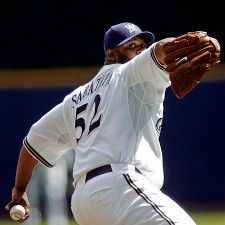 The big name a year ago was CC Sabathia, who was phenomenal after Milwaukee obtained him from Cleveland July 7. He had an 11-2 record with a 1.65 earned run average in 17 starts for the Brewers, who edged the Mets by a game for the wild card but lost to the Phillies in the division series of the playoffs.
Rich Harden (5-1, 1.77 e.r.a. in 12 starts) helped the Cubs get to the playoffs, but like Sabathia he lost his playoff start. Joe Blanton, on the other hand, had a more successful experience. After the Phillies traded for him, he had a 4-0 record and a 4.20 e.r.a. in 13 starts for them, then won the clinching game of the division series and Game 4 of the World Series.
Mark Teixeira was traded a year apart on or about deadline day, but last year his team, the Angels, lost in the first round of the playoffs despite his .467 batting average, and the year before the Braves didn’t reach the playoffs despite his .317 average.
Last year, of course, the post-trading star was Manny Ramirez, who propelled the Dodgers into the playoffs by hitting .396, slugging 17 home runs and driving in 53 runs in 53 games. He hit .500 in the first-round victory over the Cubs and .533 in the league series against the Phillies, leading all players on both teams with seven r.b.i., but the Dodgers lost to the Phillies.
Jason Bay, whom the Red Sox acquired when they sent Ramirez to the Dodgers, was productive for Boston, hitting .412 in the division series, but he slipped to .292 in a losing effort against the Rays.
The 2007 trading deadline activity did not produce a Ramirez or a Bay or a Sabathia or a Harden. The Red Sox acquired reliever Eric Gagne thinking he would solidify their bullpen, but he was beyond his previous level of success, struggling with a 6.75 e.r.a. in 20 appearances.
The 2006 deadline became known for another type of development, not the kind teams look for when they make trades around that time. On July 30, 2006 the Yankees made a six-player trade with the Phillies, obtaining two major leaguers for four minor leaguers.
One of the major leaguers was Cory Lidle. After the season, when the Yankees failed to make the playoffs, Lidle was killed when his small plane crashed into a building in Manhattan.
S.O.P. FOR SAME OLD PIRATES
Twice in recent years the Florida Marlins have dismantled themselves. But they did it each time after winning the World Series. The Pittsburgh Pirates dismantle themselves seemingly on a daily basis, and it’s been 17 years since they even won as many games as they lost, let alone play in or win a World Series.
Every few years a new regime comes in to operate the Pirates, proclaiming how it will do a different and better job, and every time it does the same old dreadful job.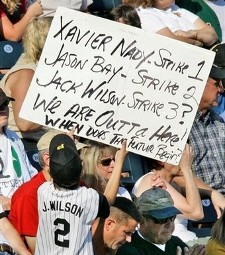
In case the current regime thinks no one is watching its nefarious machinations, my 14-year-old grandson is.
“As of last count,” he wrote in an e-mail last week, “the Pirates have now traded away two starting outfielders this year, along with three starting infielders. That is 62.5% of their original starting line-up…plus that doesn’t count Eric Hinske, a utility guy. Add these to the Bay and Nady deals of last year, and I have to wonder if maybe the Detroit Lions have some serious competition for worst franchise in sports.”
And the next day the Pirates traded two more players, no starters but relief pitchers.
For Pirates fans, it’s bad enough that the Pirates can’t mount a winning season, but the club’s hierarchy won’t even give the fans a consistent set of players to relate to and root for. I asked Commissioner Bud Selig what he would say to those fans.
Some people might expect the commissioner to admonish the Pirates for shedding their best players, saying they owe it to the fans to put a representative team on the field. But that was not Selig’s approach.
“I can understand the restlessness of the Pirates fans,” he said but then went into an explanatory mode.
“They haven’t won with these guys and you have to give Neil Huntington and Frank Coonelly time,” Selig said, referring to the Pirates’ general manager and president. And then he brought up one of his favorite historical figures, Branch Rickey, who toward the end of his brilliant front-office career was the Pirates’ general manager in the 1950s.
“Rickey’s last sojourn in Pittsburgh wasn’t good, but later it culminated in a world championship,” Selig said. “You need time to put that together.”
Of the current Pirates, the commissioner said:
“From everyone you talk to the Pirates are getting very good prospects. I know how difficult this is. I think at this point they felt they reached a point with this club with 17 losing seasons and it wasn’t going to get any better. They clearly have improved their farm system. This clearly is going to take time. In the end I don’t think they have any other viable options.”
Despite the commissioner’s cheerleading for the Pirates, one reality remains clear. Even if some of the young prospects develop into major leaguers, they won’t wear Pittsburgh uniforms for long. The Pirates will trade them as sure as they have traded Bay, McLouth, Morgan, Sanchez and Wilson. It has become an integral part of the Pirates’ pattern.
CASTILLO REPAYS MINAYA
 Among the many aspects of his job Mets’ fans have criticized Omar Minaya, the team’s general manager, for this year, the four-year contract he gave second baseman Luis Castillo two years ago brought some of the harshest comments. Castillo hit .245 last year and had a generally awful season.
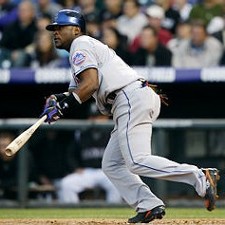
A popular refrain last winter was if Minaya hadn’t given Castillo that contract, he could have gone out and obtained a good second baseman for this season.
But two-thirds through this year let’s look at the season the 33-year-old Castillo is having. Entering the weekend, he had started 84 games, sixth most among National League second basemen; was hitting .302, third best and within points of the two players ahead of him (Felipe Lopez and Chase Utley) and had a .401 on-base percentage, second only to Utley’s .424 and 46 points better than his on-base last season.
Castillo has had two terrific calendar months this season, hitting .370 in April and .384 in July.
IN THE HALL OF FAME OF RUDENESS
In his Hall of Fame induction speech, Jim Rice glossed over his treatment of the baseball media when he played, saying reporters asked him about his teammates and he wouldn’t talk about his teammates. Not so. That explanation might be Rice’s revisionist history, but those of us who were there know better.
Rice simply refused to talk about any subject and worse, was the rudest player I ever encountered.
I recall one episode with Rice at Fenway Park where I had arranged to speak to him hours before a game. I arrived at the appointed time, and Rice was in the Red Sox clubhouse. But he was not there to talk to me and answer questions.
First, he repeatedly left the area of his locker, finding an interminable list of things to take care of before settling down for serious talk. Once he sort of stayed at or near his locker, though, he stood with his back to me the entire time, making it difficult for me to ask him questions or hear his answers. There was not one question about a teammate.
The fascinating aspect of his election is that it was the writers he snubbed and treated rudely who elected him.
REPORTER IN NEED OF AN EDUCATION
The New York Daily News reporter whose reports led to the Mets’ dismissal of Tony Bernazard as their vice president for player development said last week he didn’t have a conflict of interest in writing these reports. In the interest of a journalism education the reporter, Adam Rubin, should have received years ago, I offer him the thoughts of Andy Schotz, chairman of the ethics committee of the Society of Professional Journalists.
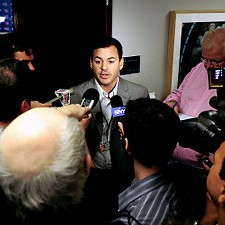 At the core of Rubin’s conflict, Schotz noted, was his conversations with Mets officials about getting a job in their player development department. Speaking generally of the matter, Schotz summed up the prevailing view of the incident: “Adam Rubin is a good guy; he has good integrity. Omar Minaya was outrageous to attack him.”
“That’s too simplistic,” Schotz said.
Rubin’s conversations with club officials, he said, were not harmless, as Rubin has depicted it.
“Getting close to people you cover,” Schotz said, “it becomes a different level of communication with them. I think reporters and newsrooms have to remind themselves constantly of why they are there. You muddy the waters when you expand the relationship. He lost sight of the fact that it does create the perception of conflict.”
A lawyer friend offered an interesting observation. “In the law,” he wrote in an e-mail, “it is said the appearance of impropriety is as bad as actual impropriety.”
“I think that’s true with journalistic ethics, too,” Schotz said. “It doesn’t matter what you write if people don’t believe it.”
Schotz emphasized that beat writers have to act very carefully to avoid suspicion of a conflict He didn’t cite Shakespeare, but it was that writer who in his play “Julius Caesar” said that Caesar’s wife must be above suspicion. Adam Rubin didn’t rise to the level of Caesar’s wife.
“I’m not even sure you should be delving into it if you’re a beat writer,” Schotz said of personal inquiries to club officials. “He said there’s nothing wrong with asking about the process. You’re not talking about a high school kid who asks a banker how do I become a teller. You have a relationship with the team and you can’t have this side conversation with that wink wink.
“He asked for advice. You are now opening yourself up to an actual conflict, which he is denying, but the perception of conflict, which you don’t control, is there. You can’t tell anyone how to interpret that. They have their own interpretation. You can’t tell the public how to interpret it.
“This isn’t necessarily about did Rubin write e-mail to teams but the idea of coziness and chumminess by beat reporters with people they cover.”
