There are reasons to like the wild card. Bud Selig likes the wild card because it creates more late-season interest in the cities whose teams have a chance to make the playoffs as a second-place team. Fans in those cities would otherwise have nothing to root for in the final weeks and months, and more interest in more cities means more revenue for teams and for Major League Baseball.
The Angels like the wild card because in 2002 they won the World Series after qualifying for the post-season as a wild card. The 2003 Marlins and the 2004 Red Sox followed the same path to their World Series championships. They like the wild card, too.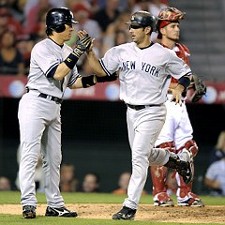
There are reasons, however, not to like the wild card. The biggest reason, I think, is it kills races for division titles. Often, if two teams are competing for first place the loser is assured of the wild card so it doesn’t really matter, except for homefield advantage, which team finishes first and which second.
In fact, there was a situation where the Dodgers and the Padres reached the final game of the 1996 season tied for the lead in the National League West and were playing each other. Both teams were assured of playoff spots so the Dodgers lifted their best pitcher, Ramon Martinez, after one inning to save him for the first post-season game against Atlanta.
The Padres won the game and the division title. As it turned out, the Dodgers’ strategy didn’t help them in the post-season. The Braves swept them in the opening series. But then, the Cardinals swept the Padres. Nevertheless the existence of the wild card influenced the outcome of that division race.
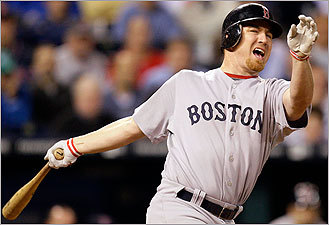
This season the Yankees have already clinched a post-season spot and the Red Sox are zeroing in on their own spot via the wild card. But if not for the existence of the wild card the Yankees and the Red Sox might be engaged in a scintillating race right now.
With the Red Sox losing the first two games of their series in Kansas City this week, the likelihood of a race diminished, but the fallacy of the predestined outcome applies here. What is the fallacy of the predestined outcome? It is a variation of the fallacy of the predestined hit.
So named or at least popularized by Ken Nigro, a former Baltimore baseball writer, who now works with the Red Sox, the fallacy of the predestined hit refers to the situation where something is assumed after something else has occurred.
It usually relates to a hit a batter gets after a runner is out trying to steal a base. An announcer will say, “Oh, if Jones had not tried to steal second, the Red Sox would have runners at second and third and no one out.” He has assumed that had the runner remained at first, the batter would have hit the same double.
But he has not taken into account that with a runner still at first, the pitcher might have pitched the batter differently and the batter might not have hit the double. In this case, the double is the predestined hit, and it is a fallacy to assume that the batter would have hit it.
Applying the fallacy to a race between the Red Sox and the Yankees, if circumstances for the Red Sox were different, were they not virtually assured a playoff spot, their approach to the series with the last-place Royals might have been different. Players are human beings, and they are affected by the reality of their circumstances.
I am always puzzled by players talking about the motivation they got from something said by a player on the other team. This sort of remark is heard even in a post-season situation. I have never understood how a player can be motivated by someone’s words more than they already are by the chance of winning a game or a series and going to the World Series.
I remember when I was in high school the coach of the football team would gather his players for a pre-game motivation session and tell his players, “I just heard someone on the other team say you guys are yellow.” His ploy never worked, but maybe that was because they were always a bad team to begin with, yellow or not.
 But I suppose if even professional players think they are motivated by derogatory remarks from an opposing player, you can’t dismiss the possibility. So perhaps if the Red Sox had to beat the Royals to remain in the race for a playoff spot, say, the championship of the American League East, they might have played them harder and more successfully.
In 1978, to go back to another Yankees-Red Sox race, there was no wild card, and the loser would go home. The Yankees overcame the Red Sox 14-game lead and bumped them from first place, only to have the Red Sox stage a last-gasp rally and tie the Yankees for the division lead on the final day of the season. The Bucky Dent playoff game ensued.
But we can’t go back and recreate the race that wasn’t. With a week and a half left in the season, the Yankees and the Red Sox are not fighting for a lone playoff spot. The loser has a fallback position.
We are left, then, with the question of whether or not the Red Sox can overtake the Yankees and win the division title. I suppose a corollary question is do the Red Sox care if they finish first or second as long as they win the wild card.
There’s always homefield advantage to consider. Commissioner Selig, Fox television and others think homefield advantage is so important that baseball bases it for the World Series on the outcome of the annual mid-season exhibition game, the All-Star game.
Other than homefield advantage, which really does seem to be an advantage in a playoff series, a playoff spot is a playoff spot. Playing as the wild card did not affect the Red Sox in 2004. The wild card can not have homefield advantage in the division and league series, but that doesn’t always mean anything.
The Red Sox won their division series as the wild card last year, then lost Game 7 of the league series to the Rays. A year earlier the Rockies won both the division and league series as the wild card.
So maybe there is still an A.L. East race and maybe there isn’t. But if the Red Sox needed to finish in first place to make the playoffs this year, think of the intensity and the excitement and the drama that would fill this weekend’s three-game series between the Red Sox and the Yankees at Yankee Stadium. It would be as good as a playoff series.
