If Alex Rodriguez, Ryan Braun and other players are guilty of drug violations that warrant lengthy, if not lifetime, suspensions, how should Commissioner Bud Selig be judged? A case could be made for a lifetime ban for the commissioner.
Selig has long claimed he didn’t know players were using steroids and said no one came to him complaining about steroids use. He also blames the players’ union for delaying implementation of a drug-testing program. In a brief telephone interview Friday he angrily rejected any suggestion that he had been guilty of tardily dealing with the issue.
“I put a minor league program in place in 2001,” he said. “It’s nonsense to say we were slow. Was I late to the party? I don’t think so. That’s insulting.”
I have often pointed out that Major League Baseball could not unilaterally initiate testing for performance-enhancing substances. Any such program had to be negotiated with the Players Association in collective bargaining. In that sense, I have defended Selig against critics who blamed him for not doing more and not doing it sooner.
“I’m not blaming the union,” Selig said. “They had their own program.”
A testing program was adopted when the union agreed to it. “As soon as we could we did,” Selig said. “We did something. It’s a matter of collective bargaining.”
And if anyone thinks baseball was late in reacting to players’ use of steroids, the commissioner said, “ask Don Fehr and Gene Orza.”
Fehr was the union leader and Orza his chief lieutenant during the early steroids negotiations. Following the players’ wishes, they resisted a drug-testing agreement. The union’s stance has changed over the years because the players’ position has changed.
The non-users have grown weary of protecting the users and no longer want to be tainted with their illegal acts. Selig has benefited from the change in the union’s stance because it has led to a stronger testing regimen and has enabled the commissioner to crow that baseball’s testing is the strongest in sports.
As time marches on, though, people tend to forget the development of drug testing. Despite what he may say now, Selig was eager to institute testing and subsequently strengthen it because he didn’t want to be whacked around by Congress again. A Congressional committee had treated him roughly at a hearing, and once was enough.
In assessing Selig’s pursuit of steroids, it is necessary to consider his reaction to the discovery by Associated Press reporter Steve Wilstein that Mark McGwire was using androstenedione during his scintillating home run contest with Sammy Sosa in 1998.
Andro, a steroids precursor, was legal at the time, buts its use by McGwire raised questions. It has since been banned. In 1998 Selig ignored Andro.
“I’m not going to do anything that would hurt Mark,” he said of the slugger, of whom he was fond. Years later McGwire acknowledged that he had used steroids.
 On a recent David Letterman television show, Letterman asked Selig about steroids and the 1998 volcanic eruption of home runs.
“I remember when the first story of andro surfaced in July of 1998,” Selig said. “I had no idea. Nobody had complained to me. Nobody had talked to me about it.”
But he didn’t care enough to question McGwire’s use of the substance. He didn’t want to do anything that would hurt McGwire.
In the Letterman appearance, Selig deftly steered the conversation away from steroids, but he took it onto yet another Selig landmine.
“I had lived through the cocaine era of the ‘80s in baseball,” the commissioner said, “which was very, very serious and which 29 players in the Pittsburgh drug trials were convicted. Four went to jail. It was a very, very serious thing.”
We interrupt this recollection of the Pittsburgh cocaine trials to say that Bud the self-proclaimed student of history failed that course.
No players were tried in the Pittsburgh drug trials. No players were convicted. Only drug dealers were tried and convicted. Players testified but nowhere near 29. Four members of the Kansas City Royals served prison terms but in a Kansas City cocaine case unrelated to the Pittsburgh drug trials.
Selig continued his recitation of his version of baseball’s drug-testing history, and he earned another ‘F.’
“We couldn’t get a drug-testing program,” he told Letterman, referring to the cocaine era he spoke about.
However, under Commissioner Peter Ueberroth, the two sides had a joint drug agreement, which included testing, for about a year until Selig and his fellow owners unilaterally terminated it, which was their right under the agreement, on the last day of the 1985 World Series. This is what I wrote in July 1987 in The New York Times:
“The extinct joint drug agreement was in place for about a year, basically covering the 1985 season. It wasn’t to the owners’ liking, because it didn’t provide mandatory testing and it put the burden on the clubs to take the first step in trying to determine if a player was using drugs. Thus, during the 1985 World Series, the clubs notified the players that, under the terms of the agreement, they were terminating it.”
Under that system, a club was able to initiate testing by reporting its suspicions of a player’s use to a panel of doctors, who would determine if testing were warranted. The clubs didn’t like the idea of turning in their own players, and on the Letterman show Selig conveniently forgot about that testing program. What he meant was “We couldn’t get a drug-testing program that did what we wanted.”
Now, with the union on board, Selig basically has free reign to do what he wants, and what he apparently wants, based on his scorched earth policy in the Biogenesis matter, is to make life difficult for players who have crossed him and threatened to tarnish his legacy. Nearing the end of his lengthy tenure, Selig seems to be all about his legacy. His crusade against Rodriguez is part of that mindset.
As a student of history, Selig finds his personal history important, and he won’t be satisfied unless he locks up the steroids chapter the way he wants it to be written. That helps explain his aggressive treatment of Rodriguez.
If illegal substances have contributed to his production, the New York Yankees’ star has eluded detection by the urine bottle, and Selig believes he has lied to investigators and impeded the Biogenesis investigation. Selig will do everything he can to nail A-Rod.
But here’s an issue for Selig to consider. It comes from a reader:
He has boasted of how MLB now has the strongest anti-drug program in sports. Yet the huge scope of the Biogenesis investigation emphasizes how flawed the MLB drug testing is. Of the 20 or so names allegedly connected to Biogenesis, only a few have tested positive for PEDs (Ryan Braun, Melky Cabrera, a few others). MLB is seeking to discipline the Biogenesis group (rumored to be Alex Rodriguez, Nelson Cruz, and others) not thanks to MLB’s testing, but thanks to the work of a Miami newspaper reporter who dug up the alleged evidence.
That so many players may have obtained PEDs without testing positive is an embarrassment to Bud Selig and MLB. Even worse, MLB has not made public any of the evidence. They are seeking to mete out discipline without having to present their evidence. They are trying the named players through the media by “leaking” information anonymously through their TV network spokesmen on ESPN and FOX, two companies that make a great deal of money on baseball and who are complicit in spouting MLB’s party line.
More evidence may be needed to establish a case against Selig, but in his mind he convicted Barry Bonds on circumstantial evidence and we learned in our youth what’s good for the goose is good for the gander.
WHAT WOULD JACKIE SAY?
 The Jackie Robinson movie, “42,” has received generally favorable reviews, but there’s one filmgoer who has a serious problem with it and feels the makers of the film owe her and her family an apology.
She is Sherrill Duesterhaus, and she is the daughter of Fritz Ostermueller, who in the interest of full disclosure I will acknowledge was my favorite Pittsburgh Pirates’ pitcher in my youth.
For some inexplicable reason, the makers of the film chose Ostermueller as the racial villain in a movie that apparently needed a villain because it is the story of Robinson’s breaking the color barrier, a seminal event in baseball history.
“I totally respect Jackie Robinson and his story is one that should be told,” Duesterhaus wrote in an e-mail followup to our telephone conversation Friday. “He is an inspiration and a legend. The courage it took to break the color barrier in baseball is beyond most of us. But his story is marred with untruth about a successful but long forgotten Pirate pitcher, Fritz Ostermueller. It is a shame to honor one man at the expense of another’s honor.”
The film depicts Ostermueller as a racist, which his daughter and teammates say he was not. In the film, Ostermueller hits Robinson in the head with a pitch, igniting a benches-clearing brawl, then yells at him, “You don’t belong here.”
None of that happened, Duesterhaus said, and some of the pitcher’s teammates confirmed in notes to Sally O’Leary, the editor of the Pirates’ alumni publication, “The Black and Gold.”
According to a newspaper article about the 1947 game in question, a pitch hit Robinson on the left wrist, and no fight ensued.
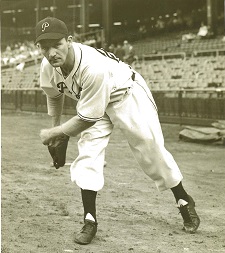 As if it’s not bad enough to create an incendiary fictional scene in a movie that’s supposed to be factual, it depicts Ostermueller as a right-handed pitcher. He was left-handed, and I can confirm that because that’s why he was this left-hander’s favorite pitcher.
My effort to reach the writer and director of the film, Academy Award-winner Brian Helgeland, was unsuccessful – he has an unpublished telephone number in Malibu, Calif. – so I turned to research and found an astounding admission from him.
What he disclosed in a newspaper interview shouldn’t have surprised me – it is, after all, Hollywood – but he told the story of another scene in which he said he took a comment from Gene Hermanski and put it in Pee Wee Reese’s mouth
The Dodgers were in Cincinnati, and Reds fans were being exceptionally abusive to Robinson. In a memorable real scene, Reese, a white man, walked over to Robinson and put his arm around him, a gesture that quieted the crowd.
“Maybe tomorrow we’ll all wear Number 42 so they can’t tell us apart,” Reese says in the movie.
Except Helgeland is quoted in the interview as saying it wasn’t Reese who made that remark. “Actually, it was Gene Hermanski who said it,” Helgeland said, referring to a Dodgers outfielder. “But I didn’t develop Gene as a character. I thought it was such a great line that I gave it to Pee Wee.”
Helgeland, then, must have thought “you don’t belong here” was such a great line that he invented it and gave it to Ostermueller. Maybe the pitcher’s family should be flattered instead of upset.
On the other hand, there was this comment from Thomas Tull, whose company, Legendary Entertainment, produced the film as well as the “Dark Knight” trilogy:
“It’s one thing to screw up Batman. It’s quite another when you’re dealing with an icon of American history.”
In dealing with that icon, though, it’s all right to screw up someone else who apparently is not important enough to care about.
The problem is very few people who have seen or will see the Robinson film know who Ostermueller was, and their lasting impression of him will be that he was a racist. That, however, is not who he was, and he deserves better, even in the make-believe land of Hollywood.