In the 25 years he has been banished from baseball, Pete Rose has probably uttered the phrase “second chance” as many times as he had hits (4,256) in his record career.
“If they gave him another chance, I would bet he would do the right thing,” Tommy Gioiosa said. “With Pete, I think he gambled out of boredom. He wanted to have fun. It was a big price to pay.”
Paul Janszen offered another view of Rose, who was thrown out of baseball for life 25 years ago today. Janszen and Gioiosa were two of the names most prominently linked to the 1989 John Dowd investigation that resulted in Rose’s banishment by Commissioner A. Bartlett Giamatti.
Mimicking Rose’s oft-stated position, Janszen said, “’Hey, man, I deserve a second chance.’ He’s gone to a couple churches in Philadelphia and Louisville and he makes a few bucks saying everybody deserves a second chance. His second chance came when baseball said sign the agreement and apply for reinstatement.
“That second chance came every year. It’s like letting the fox back in the hen house. If you want to, say ‘I’ve been a dumb s.o.b. This is what I’ve done. I failed so many people.’ I can’t understand the mindset of a guy who has everything.
“My opinion is people have to earn second chances. You can’t earn them by waiting out time. If you talk from your heart and say ‘I’ve been an idiot; I won’t go near a race track,’ I think that would resonate with the commissioner, whoever he is. But he still loves it. I feel sorry for him.
“He’s still got time. He’s still breathing. I feel sorry for Pete.”
I appreciated Janszen’s candor, as I did Gioiosa’s. I appreciated their willingness to talk about Rose, with whom they have had little or no contact in years. But I have no sympathy for the 73-year-old Rose. His arrogance, his cockiness and his belief that he was too good to be punished – after all, he was Pete Rose – prompted him to lie for 15 years, from the day he was sentenced in 1989 to the day his book was published in 2004.
Despite my disdain for Rose, I thought he had a chance to be reinstated if he had an unusual attack of intelligence and went straight, acknowledging that he had bet on baseball games, including games he managed as manager of the Cincinnati Reds. In fact, I speculated in retrospect that had he done that immediately, he could have returned after only a year in baseball purgatory.
I posed my theory last Friday to Fay Vincent, who became commissioner three weeks after Rose’s banishment when Giamatti died of a heart attack. Vincent didn’t dismiss the possibility of a Rose reinstatement, even if Giamatti had lived, but he said it would have required more than a year.
“Three, four years,” Vincent suggested. “It had to be long enough to be meaningful.”
 Would Vincent, the deputy commissioner, and Giamatti have let Rose back? “I think we would have,” Vincent said in a telephone interview but added the caveat of reality. “Could Pete Rose have spent three, four years understanding what he had done? Can an 800-pound elephant fly? No, an elephant can’t fly. Rose doesn’t think he did anything wrong now.”
In other words, it would have been impossible for Rose to admit he bet on baseball games, violating baseball’s cardinal rule, which is posted in large letters on large posters in every clubhouse. Anyone whose eyes were good enough to get 4,256 hits is able to read the rule and the death penalty for violating it.
With the coming change in commissioners, from Bud Selig to Rob Manfred in January, speculation has already started that Rose could escape his purgatory. Selig, some have speculated, would not reinstate Rose because he thought too highly of Giamatti to go against his decision to ban Rose for life.
Manfred, however, owes more to Selig than Selig owed to Giamatti. As owner of the Milwaukee Brewers, Selig helped Giamatti become commissioner. As commissioner, Selig put Manfred in position to succeed him and supported him for the job in the face of fierce opposition from a group of misguided owners led by Jerry Reinsdorf of the Chicago White Sox.
As Selig eases toward retirement, he has withheld a verdict on Rose’s most recent application for reinstatement. It’s the only decision that Selig has taken longer to make than Lew Wolff’s request to move his Athletics from Oakland to San Jose.
Selig spoke most recently of Rose’s status last Friday in Cincinnati, the latest stop on his farewell-tour of major league cities.
Acknowledging that Rose was a great hitter, the commissioner said, “But, you know, there are a lot of things in life that happen that the commissioner, or any of us, wish hadn’t happened. I was particularly close to Bart Giamatti, one of the best friends I ever had in the world.”
He added, “How it ends, eventually, I do not know. I’ve taken it seriously, talked to a lot of people. It is one of those situations that is difficult and you wished it didn’t exist. I have to think about this. I have five months to think about it.
“All factors enter my mind on this. I’ve spent many hours talking to people, a lot of players, some of whom I’m very close to. I’ve spent an enormous amount of time on this. And in the end I’m going to say what I say to people on any subject. I have to do what I’ve always been trained to do. Do what I think – what I think – is in the best interest of this sport. That transcends everything else.”
I would not profess to be an expert on interpreting Selig’s words, but if I were Rose and heard or read those comments, I don’t think I would be making plans to apply for a job in baseball any time soon.
If for no other reason, Selig or Manfred should not reinstate Rose because he is still lying. In finally admitting that he bet on baseball, Rose said he never placed bets from his ball park office, as if that would make his gambling any more acceptable.
Dowd, however, dug up more than enough proof that calls were placed from Rose’s office at Riverfront Stadium to bookies, whether he made them himself or had one of his betting buddies dial the bookies’ numbers.
Rose also said he never bet against the Reds, another canard. My favorite exhibit dug up by Dowd was Michael Bertolini’s betting book, in which he recorded bets he made for Rose during the 1987 season.
According to the Dowd report, Rose bet on 390 games in a 3-month period in ’87, 52 of them Reds games. At some point Rose stopped betting on games started by Bill Gullickson. He didn’t bet against the Reds in those Gullickson games, but the absence of bets was a clear signal to the bookies. The manager might as well have bet against the Reds because he was saying to the bookies, “I don’t expect us to win these games.”
At Rose’s urging the Reds traded Gullickson to the New York Yankees for Dennis Rasmussen Aug. 26.
Incidentally, Dowd found that in that three-month period in 1987, Rose wagered $2,500 or more on 69 games and lost 64. Had that .072 average applied to his on-field hitting, we wouldn’t be talking about Pete Rose 25 years after he was tossed.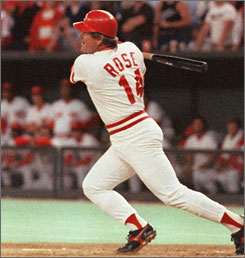
I came upon the Rose scandal early in 1989. I was in Florida for spring training not far from Plant City, where the Reds trained, and when I heard that Rose had been summoned to New York to meet with Commissioner Peter Ueberroth and the incoming commissioner, Giamatti, I knew I had to get to the Reds’ camp the next day.
Commissioners do not routinely yank managers out of spring training for meetings so this had to be something good. Or bad for Rose.
“Sports Illustrated called and said ‘we’re working on a big piece about Rose betting on baseball,’” Vincent related. “He came up for the meeting and had his lawyers with him. He had a green sort of light weight suit, was 20 or 30 pounds overweight and had a spikey hairdo. He looked like a stuffed sausage. He looked like a penny ante Mafioso.”
For the first several minutes, Vincent recalled, Giamatti was “chatting him up.” Then Vincent interrupted. “Mr. Rose, may I ask you a question?”
“He spun around and said yes. I said I’m going to ask you about betting on baseball. I’m warning you there’s going to be an investigation. Did you bet on baseball? He said, ‘No, I’m not stupid.’” The lawyers jumped in and said, ‘You’re listening to this guy Janszen? He’s not a credible witness.’”
Vincent added, “I did warn him that it was very important that he tell us the truth and he immediately lied.”
I had heard before I went to Plant City that the subject of the meeting was Rose’s gambling, but he denied that. ”That’s not the reason,” he said, kneeling on the grass in foul territory on one of the team’s spring practice fields.
I asked him if the meeting could have bad implications for him. ”You can read anything you want into it, but I don’t see anything bad,” he said.
I don’t doubt that Rose believed what he said. Bad things don’t happen to Pete Rose, he more likely thought.
But as Rose was returning to Plant City, Giamatti was asking Vincent, his designated deputy commissioner, if he knew anyone they could hire to conduct an investigation into Rose’s alleged betting. Vincent knew Dowd from the Justice Department in Washington, and he became the investigator.
Once he finished his investigation and his findings became known, Dowd became the target of Rose supporters and other supposedly intelligent observers. I never understood why because I found Dowd’s work solid and unimpeachable.
Yet entire books were written questioning Dowd’s investigations, only to be embarrassed when Rose finally admitted his guilt. Here is one example.
Bill James, the noted statistician, said Dowd had not even a shred of evidence against Rose and pointed to Janszen’s involvement with Rose, writing, “Janszen was also a compulsive gambler, and since Rose’s bookies might have been reluctant to accept large bets from Paul Janszen himself, Rose’s story – that Janszen used his name to cover Janszen’s bets – is reasonable.”
Other critics tried to excuse Rose by citing gamblers like Janzen and Gioiosa, but the criticism seemed more like ineffective efforts to excuse Rose for engaging in illegal activities. The critics, in the end, looked foolish and ignorant while Dowd’s work has withstood the test of time and Major League Baseball’s weird attempt to undermine Dowd’s work.
At great expense, the commissioner’s office redid Dowd’s investigation only to find it was solid and impenetrable to question.
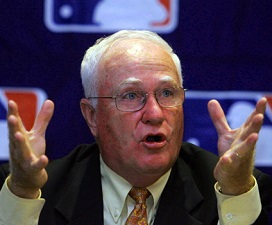 Bob DuPuy, who preceded Manfred as Selig’s chief operating officer, hired his Milwaukee law firm, Foley & Lardner, to redo the investigation.
“I’m not sure you would say redoing as much as reviewing,” DuPuy said in a brief telephone interview last Thursday. “It was a review of where we were at the time rather than let’s redo the Dowd report.”
DuPuy said he would call back in the next couple of days for further discussion but did not call.
Another former baseball official confirmed that an independent investigation was done by Foley & Lardner.
“It was reinvestigated,” he said, “because they were angry with John Dowd, who was speaking out about the investigation. That angered a lot of people. DuPuy tried to take away Dowd’s license. They were trying to undermine Dowd.”
Dowd said the reinvestigation began after “Selig objected to my going on ESPN and talking about it,” referring to the report. “He accused me of violating client-attorney privilege.”
Selig and DuPuy filed a charge against Dowd with the D.C. bar association, accusing him of violating attorney-client privilege by speaking publicly and in interviews about the Rose investigation and report. The report, however, had been made public as the result of a Rose lawsuit in Cincinnati, and the bar dismissed the charge.
A person familiar with the second investigation said it was never completed because the lawyer, Martin Weinstein, found it had been conducted so well, fairly and accurately that nothing more needed to be done.
“They said the investigation was totally fair and impartial and it was one of the best investigations they ever reviewed,” this person said. “They came back with very, very high marks.”
Janszen said he was contacted in the second investigation, but Gioiosa said he wasn’t. When they were younger, they both served time in prison, Janszen for tax evasion, Gioiosa for cocaine distribution.
“I didn’t cooperate in any investigation,” Gioiosa, 56 years old, said. “I didn’t cooperate with the FBI.”
Gioiosa lived with Rose before Rose’s baseball problems began. “My dad was an alcoholic,” he related, “and Pete took me into his home. He opened a lot of doors for me. I wasn’t going to cut a deal to do something to somebody who was good to me.”
Janszen, 57, who repairs and sells fitness equipment, said he thought Rose still had something to contribute to society. “I think he would be such a great role model,” Janszen said. Without the gambling, of course.
“I feel sorry for Pete,” he added. “I haven’t talked to him since this went down.”
Gioiosa is an independent distributor for a nutritional company. It was when he was in Las Vegas for a company event last October that he saw Rose for the first time in more than 20 years.
“I heard that he was there,” Gioiosa said. “We shook hands. I forgave him and we had breakfast. I felt bad for him. He was sitting there signing autographs.”
“He was one of the greatest players I ever saw,” said Gioiosa, a former college baseball player. “I think he made mistakes. With Pete I think he gambled out of boredom. He wanted to have fun. If they gave him another chance, I would bet he would do the right thing.
“When I look back, being around Pete, he was like Elvis Presley. He got caught up with that celebrity worship thing.”