Over the six years this web site has existed, its 650 columns have triggered e-mail responses that have ranged from complete and total thoughtful agreement to vile, nasty, repugnant, fan-fueled comments.
It’s always gratifying to have readers agree with the thoughts and ideas presented in a column, but it could become boring to have all readers agree all of the time. In other words, I don’t mind a contrary opinion expressed by a reader.
But what I really appreciate is readers whose responses suggest ideas for additional columns. I received one of those this week, though I don’t know that the writer/reader meant to suggest this column.
This was a response to the column about the election of Rob Manfred as the next commissioner and the determined but failed effort of Jerry Reinsdorf, chairman of the Chicago White Sox, to block Manfred.
This was the e-mail:
How could you be opposed to a salary cap? The Yankees and now the Dodgers are constantly trying to buy championships, and this is not good for the sport or the fans. The players could still be paid the same as a whole, just like in the NFL (they get a percentage of what the league makes).
In fact, I’d love to see players just get their percentage of league revenues with a minimum salary and see free agency eliminated completely. I realize that the owners’ greed caused free agency in the first place, but now that most of the players are millionaires, this issue no longer exists. The players have unions to adequately represent them, and being guaranteed a percentage of what the owners make should be good enough. Free agency is bad for the sports and bad for the fans. We need a fans union to get rid of this scourge!
I will address these questions and comments one at a time:
How could you be opposed to a salary cap?
First, let me deal with the terminology. Everyone calls it a salary cap, as in the NFL, the NBA and the NHL having salary caps. But none of those leagues have caps on their players’ salaries. And Jerry Reinsdorf and his henchmen don’t seek a cap on individual salaries. The other leagues have and Reinsdorf wants a cap on team payrolls.
But whether you’re thinking of putting a cap on individual salaries or team payrolls, how can I be opposed to a cap? That’s easy. How many baseball fans, including the e-mail writer, would like their employer to put a ceiling on what they can earn?
Employers often do that anyway, but I wouldn’t want my salary dependent on what my fellow workers earn, in other words, what part of the company payroll is designated for me, no matter how good a job I do.
The Yankees and now the Dodgers are constantly trying to buy championships, and this is not good for the sport or the fans.
Despite their inflationary payrolls, the Yankees and the Dodgers aren’t playing each other in the World Series every year. Neither are they playing anyone else. The Yankees, in fact, haven’t played in the World Series since 2009, which is also the last time they won the World Series. The Dodgers last won it in 1988 and haven’t been back since.
The Dodgers reached the playoffs last year but lost in the league championship series. The Yankees didn’t play in the post-season last year.
The Yankees and the Dodgers might be trying to buy championships, but their money hasn’t been well spent. Poorer teams, meanwhile – Oakland, Tampa Bay, Kansas City, Pittsburgh – are beginning to win or challenge for league championships.
The best thing low-revenue teams have going for them is they often are more capable of drafting and developing better players than high-revenue clubs.
The players could still be paid the same as a whole, just like in the NFL (they get a percentage of what the league makes).
Under that system, what happens when a club reaches its limit and still has three or four players to sign? Say oops and go back to players they have already signed and say we need to redo your contract and reduce your salary so we can sign some of your teammates?
When clubs sought a cap on M.L.B. payrolls in 1994, players were reportedly receiving 60 percent of industry revenue. Depending on whose calculations you choose to believe, the players’ share has plummeted below 50 percent, to a level between 42 percent and 49 percent.
The clubs, then, have done very well without a cap. If in 1994 the players had agreed to a cap, the clubs would be spending more on player salaries than they are.
And don’t forget this part of the cap argument. Even if the players agreed to accept a cap, they would do it only if it was accompanied by a payroll floor. That means the bottom tier of clubs on the payroll scale would have to increase their payrolls by a lot.
Fourteen teams began this season with payrolls under $100 million, nine under $90 million, four under $80 million. With a cap in place, some or all of those teams would have had to increase their payrolls by significant amounts. Do you think they would vote for a payroll cap? You might have a fiercer fight among the clubs than between the owners and the players.
In fact, I’d love to see players just get their percentage of league revenues with a minimum salary and see free agency eliminated completely.
Now there’s an idea: Erase the last 38 years of baseball history and start back in 1976. Strip the players of the rights Marvin Miller, Richard Moss and their successors fought for in court, in grievances and eight work stoppages.
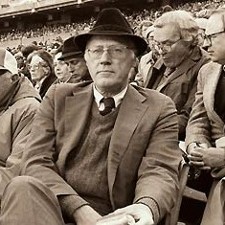 Revert to the days of Bowie Kuhn, the blatantly bad commissioner, who decried the advent of free agency, warning it would spell doom for baseball. Where is Kuhn now that industry revenue is reaching $9 billion and one team, the Dodgers, sold for $2 billion? Those developments and others would have killed Kuhn if poor health hadn’t.
But here we have a surrogate in my e-mail pal, advocating for Kuhn’s position, not to mention Reinsdorf’s:
I realize that the owners’ greed caused free agency in the first place, but now that most of the players are millionaires, this issue no longer exists. The players have unions to adequately represent them, and being guaranteed a percentage of what the owners make should be good enough. Free agency is bad for the sports and bad for the fans. We need a fans union to get rid of this scourge!
I have long said that the fans are their own union and are free to exercise their rights and their clout any time they want. All they have to do is stop going to games and stop watching them on television. Sponsors will disappear, television networks will disappear and millionaire players will disappear.
Then the Bowie Kuhn legion of believers would be happy.