If Bud Selig is sincere about his plan to retire as commissioner when his current term expires next January, where is the search committee interviewing candidates and seeking his successor? In similar circumstances previously, search committees were in place and working at this equivalent time.
Isn’t the absence of a search committee a dead giveaway that Selig intends to stay on for another term, whether it’s a year or two years or even longer? Not necessarily. There is another scenario, and this is the one, I am told, that will play.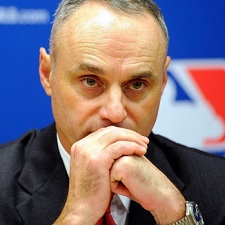
No search committee is needed, in this scenario, because there won’t be a search. Selig, who as outgoing commissioner holds a position with the owners different from his predecessors, is determining the future of his office and, according to people in and close to Major League Baseball, already has drawn up a succession plan.
Selig refused to discuss the matter other than reiterating that he is retiring. “I really am; I’m going to be 80 years old July 30,” he said on the telephone last Thursday.
According to two baseball officials, though, many owners don’t want Selig to go away. If they can’t persuade him to continue as commissioner, they want him to remain close enough to guide the new commissioner.
“With the unparalleled success he’s had with the owners,” an official said, “why wouldn’t they want him to be around and available? If the new commissioner can take advantage of the skills of the previous commissioner, why wouldn’t the owners want to do that? Why wouldn’t his successor want to do that?”
That successor, said the people in baseball and closely linked to baseball, will be Rob Manfred, MLB’s chief operating officer.
Under the plan outlined by those people, Manfred will be the commissioner with Selig not far away, serving, one person said, as eminence grise.
That is not a baseball term that can be found in “The Dickson Baseball Dictionary.” But the American Heritage Dictionary defines eminence grise (greez) as “a powerful adviser or decision-maker who operates secretly or unofficially.” The dictionary says the French version is “the power behind the throne.” French or English, that will be Selig.
In yet another layer of authority, the owners are expected to create a committee of three or four owners to serve as an advisory board for the new commissioner. That committee will make the structure of authority more strongly owner oriented.
“They won’t seek an outsider,” said one of those who told of the plan. “They don’t want an open search. The owners don’t want that. They have liked one of them as commissioner.” He noted that Jerry Reinsdorf, the influential chairman of the Chicago White Sox, “has said all along ‘we want someone inside running the game, not an outsider.’”
Manfred, 55, declined to comment on any aspect of the succession issue, but he obviously has no problem with the setup. He has worked well with Selig and has worked more closely with him in the past couple of years.
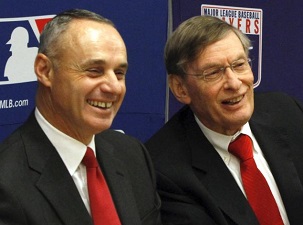 With Selig as eminence grise (e.g. on your lineup card), the owners would be guaranteed no surprises, just as they have not had any during Selig’s 21-year tenure as acting commissioner and commissioner.
The harshest action he has taken against owners was forcing Marge Schott to relinquish her position as managing partner of the Cincinnati Reds as a result of her offensive views and language and forcing Frank McCourt to sell the Los Angeles Dodgers because of his questionable operation of the team.
At the other extreme, Selig has been soft on owners, allowed teams to violate his own rules, for example, on minority hiring, without taking disciplinary action.
For the owners, Selig has been a comfortable commissioner, and they have no interest in hiring an outsider who would come in and ride roughshod over them. Nor do they want a commissioner who would act contrary to their wishes.
With Selig and Reinsdorf leading the troops, the owners forced Fay Vincent out of the commissioner’s office in 1992 because he dared to attempt to develop a working relationship with the union. Selig et al were gearing up for economic warfare with the union and didn’t want Vincent to get in the way.
Now, however, Selig boasts of the extended period of labor peace – 22 years through the term of the current labor agreement.
That period of peace could have been 27 years, but the owners stubbornly made one more attempt at getting a cap on payrolls, making the 1994 World Series a casualty of that foolish attempt.
Manfred, who is a graduate of Cornell University and Harvard Law School, worked for a Washington, D.C., law firm, and was brought into the 1994-95 strike as outside counsel. He went to work for Major League Baseball as its chief labor executive in September 1998 and became chief operating officer last Sept. 30.
Bob DuPuy had been C.O.O. but resigned Sept. 28, 2010. DuPuy denied it, but the belief in baseball circles at the time was he left because Selig told him he would not recommend him as his successor. Selig did not replace DuPuy but gave Manfred increasing responsibilities.
Selig could have considered three or four other internal high-ranking executives, most notably Bob Bowman, C.E.O. of MLB Advanced Media, and Tim Brosnan, executive vice president of business, for the position of second in command. But it became clear as time went on that the commissioner favored Manfred.
“Rob has tremendous institutional knowledge,” Selig said when he named Manfred C.O.O., “and first-hand experience with many of our most complex matters, including labor, revenue sharing, competitive balance and the most comprehensive drug program in American professional sports. I am pleased that I will work with him even more closely in the near future.”
And they will continue working closely in the farther future, Manfred receiving a salary in the $5 million-$10 million range and Selig the same, down from his current salary of $25 million but not a bad pay day for a retired executive.
By not having a search committee, MLB will avoid the subterfuge that played on and on for years before Selig dropped the word “acting” from his title in July 1998 and accepted the job.
Selig had always denied being acting or interim commissioner. He was, he always said, simply the chairman of the executive council, which in the absence of a commissioner was in charge of MLB. He also repeatedly said he did not want to be commissioner.
Those who believed him paid dearly for taking him at his word. One was Len Coleman, the National League president (when there were league presidents), who privately let people know he was interested in the job. When Selig learned of Coleman’s interest, that effectively ended whatever future role Coleman might have had in baseball.
George Bush fared better. Managing partner of the Texas Rangers, Bush told Selig he would be commissioner if the owners wanted him. Though Selig has denied knowing of Bush’s interest, too many people have told the story to doubt it.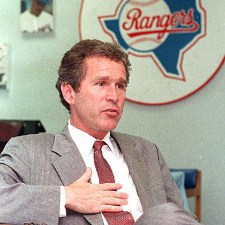
According to one official, Bush kept asking and Selig kept him dangling. Finally, Bush informed Selig that the Texas Republican Party wanted him to run for governor and needed an answer. But again no answer from Selig, whose OK would have snatched out of his grasp the job he wanted. So Bush ran for governor, and the rest is history.
If Selig’s list of accomplishment as commissioner includes the wild card, instant replay and revenue sharing, add making of a president.
The point is Selig wanted to be commissioner, and nobody better dare to get in his way. Why he took six years to accept the position nobody knows.
But when the first search ended in 1994 – a second subsequently was initiated – one of the supposed leading candidates, Arnold Weber, president of Northwestern University, supposedly told Bill Bartholomay, chairman of the search committee, to go jump in the lake.
That would have been Lake Michigan.
As for the legitimacy of the search, a senior club executive said at the time Selig finally accepted the job, ”I think the whole thing was orchestrated. He was telling a small group of people from day one he wanted it but told everyone else he didn’t. Then came the draft and he said he would accept it.” Speaking of the second search, he called it a sham.
The earlier search also ended in no appointment when a group of owners submitted a letter to the executive council saying they were not prepared to elect a new commissioner and preferred that Selig remain in charge until the labor dispute was resolved.
Coming full circle from Vincent’s forced resignation after owners accused him of being too friendly with union officials, Manfred is more responsible than anybody for forging labor peace, which has had a great deal to do with the explosive increase in industry revenue to $8.5 billion.
Instead of being forced to step aside, he is moving up.
THE KNEES OF HOME RUN KNOWLEDGE
Although I had seen Ralph Kiner from a distance – the right field stands at Forbes Field in Pittsburgh – the first thing I saw of him close up was his knees. They made a lasting impression.
I was 10 or 11 years old and had gone to a Pirates game with my older sister, Sandra. As kids used to do after day games, we went to Webster Hall, the hotel a few minutes from the ball park, where some of the players stayed. The idea, of course, was to get autographs.
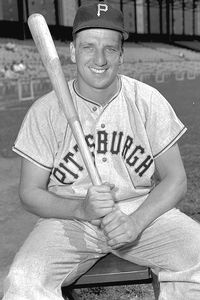 I don’t remember what players we saw, but I vividly remember turning around at some point to face the entrance and saw a pair of knees coming at me. I was a tiny kid so it was likely that I was eye level with those knees. I looked up and saw that they belonged to Kiner.
He was, of course, the Pirates player fans went to Forbes Field to see. The teams he played on were so bad that many fans would stay at games until he batted for the last time, then make a great exodus. Others would wait until the bleacher gates were opened around the seventh inning and hope they would see one at-bat.
In seven full seasons with the Pirates, Kiner led the National League in home runs every season, but he played on only one team that had a winning record and one team that had one of the worst records in history (42-112 in 1952).
Nevertheless, for some reason pitchers pitched to him, and he hit 301 home runs in 1,095 games for the Pirates, 1 every 3.64 games. Babe Ruth hit 660 in 2,084 games for the Yankees, 1 every 3.16 games. The Yankees’ lineups, of course, were loaded with better hitters, giving pitchers more to worry about. Ruth had Lou Gehrig and Bob Meusel; Kiner had Tony Bartirome and Bobby Del Greco.
It was a sad day and a day of shock in Pittsburgh when Branch Rickey traded Kiner to the Cubs in 1953, but the Pirates had finished the 1952 season with a 42-112 record. Something had to be done, and Kiner was the team’s No. 1 asset.
My recollection of Kiner as a left fielder was that at best he was mediocre. That is why when I started voting for the Hall of Fame and Kiner was on the ballot, I didn’t vote for him. But as he approached the end of his eligibility, I realized I was being unfair to him because I had seen him play defense more than other players and was judging him more harshly than others.
I voted for him, as did 57 others who hadn’t voted for him the previous year, and he squeaked in with one more vote than he needed.
When Kiner began his post-playing career as a broadcaster of Mets games, he distinguished himself for what seemed like his total recall of stories and events that made him delightful to listen to.
He also became known for malaprops, a habit he didn’t hide from. Aside from his malaprops, though, he could speak the English language, something too many former players can’t do in their announcing careers.
TO LIE OR TELL THE TRUTH, THAT WAS THE QUESTION
If I had to pick a single moment in the Alex Rodriguez saga when the Yankees’ star slugger knew he was a loser, it would be the moment he disrupted the hearing into his appeal of his 211-game suspension by slamming the table and storming angrily out of the arbitration hearing.
Rodriguez, however, took nearly three more months and only he knows how many more millions of dollars in legal fees before he threw in the towel and cried, “No mas, no mas.”
That’s what he did last week when his lawyers withdrew his lawsuits seeking to overturn the arbitrator’s decision on his appeal and against Major League Baseball, Commissioner Bud Selig and the Major League Baseball Players Association for wrongful prosecution and wrongful representation.
Either Rodriguez came to his senses on his own, some new adviser got him to see the light or his lawyers uncharacteristically decided not to take him for millions more than they had already billed him.
Rodriguez had virtually no chance of having a federal judge throw out the ruling of the arbitrator, Frederic Horowitz, and there was probably too much evidence against him for him to prevail in his other lawsuit.
Rodriguez irreparably damaged himself and his case when he exited the grievance hearing without testifying. If he didn’t testify and produce evidence to show that Tony Bosch’s documents were creative fiction, Horowitz would have no ground on which to consider overturning the suspension.
Rodriguez, however, apparently had no alternative. He had to stage the storm-out scene apparently to get out of testifying without flatly refusing to testify. By storming out, Rodriguez was saying, “I can’t testify because if I testify and tell the truth, I’ll hang myself, and if I testify and lie, I’ll be subjecting myself to perjury charges.”
Better to lose the season and prepare for next season, he and his lawyers and assorted other advisers decided, than lose it and spend it in jail.
It just took them longer than it should have to accept that reality.